


Finished! Looks like this project is out of data at the moment!
This project is currently paused; please check Talk for updates on when we might be restarting with fresh data. We will post as soon as we have news. In the meantime, thank you for all your classifications!
Note: our results pages are available at https://supernovahunters.github.io/
FAQ
What am I being asked to do?
We are asking you to help us find supernovae in the data from the Pan-STARRS1 telescope. You will be shown a series of 3 images. Based on the content of the 3 images we need you to decide whether you think the rightmost image contains a real supernova or if it is a bogus detection.
How do I distinguish between real and bogus detections?
A real supernova will look just like a star in the rightmost image. It will also be visible in the leftmost image, but should not be visible in the centre image. If for any reason you think the detection in the righthand image doesn't resemble a star then the detection is probably bogus.
Where can I see more examples?
To see more examples and for some explanation of why certain artefacts appear, check out the field guide to the right of your screen. There are also some examples available by clicking the "Need some help with this task?" button in the classification interface.
Why can't a computer do this?
This is one of the problems we are trying to solve. Our current software already removes many of the bogus detections, but many still get through our filters. One of our goals for this project is to eventually train robots to take some of the burden of humans. But first we need your help to build a large data set of reliably labelled images that the robots can learn from.
What are supernovae?
Supernovae are explosions of stars. There are many theories to explain what causes the different supernovae we see and why some are rarer than others. By discovering supernovae and studying them we hope to distinguish which of these theories best explain nature. If you want to learn more go to our Research page.
Where do the images come from?
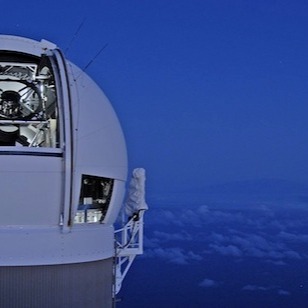
The images in this project come from the Pan-STARRS1 telescope. Pan-STARRS1 stands on top of a mountain called Haleakala on the island of Maui in Hawaii. The telescope began scanning the night sky looking for anything that changes in 2010. It comprises a 1.8m mirror and the largest CCD camera ever built, with 1.4 billion pixels. To learn more about the Pan-STARRS1 telescope and its mission visit the Pan-STARRS webpage.
Why do we need to find supernovae?
It turns out that we can do all kinds of interesting astrophysics and cosmology with supernovae. For one, we have found that there are many different types of supernovae. Trying to explain these differences in terms of the mechanism that drives the explosion is the main focus of supernova research. We can also glean some information about the galaxy the supernova exploded in. It seems that certain types of supernovae only occur in galaxies with certain properties. One type of supernova known as a Type Ia can even be used to measure the expansion of the Universe.
What happens if I find a supernova?
The Pan-STARRS team will analyse supernova candidates produced by your classifications. We will pass interesting candidates to the wider astronomical community by releasing Astronomer's Telegrams (ATels) and submitting candidates to the Transient Name Server (TNS). We also plan to pass candidates directly to the The Public ESO Spectroscopic Survey of Transient Objects (PESSTO) who can obtain follow up observations. Ultimately we aim to publish papers presenting our research and data on some of the supernovae we find.
Do I get credit for my discoveries?
Yes! If you are one of the first to contribute to the discovery of a supernova we will include you on the Transient Name Server TNS announcements we make which are publicly available. Everyone who helps discover a supernova will be added to a list of discoverers on our public webpages.
Do I have to log in to get credit for my discoveries.
Yes, you must be logged into your Zooniverse account so we can identify who classified each object in order to receive credit.
I am listed as a discoverer on the Results page, but not on the TNS.
This is an error and the object you have been listed as a discoverer of should not be listed on the Results page. This is caused by an issue with the code that determines discoveries and is due to incorrect handling of a case where an object is uploaded to Supernova Hunters but is discovered by researchers before it is retired from Supernova Hunters. This is a mistake with Supernova Hunters and not the TNS. In these cases, you are not a discoverer. We are working to fix this issue.
How do I know if I'm doing this right?
Humans are really good at recognising patterns. We expect most detections to be bogus. If you are worried then have a look in the field guide to the right of your screen for some guidance. If you are still unsure make your best guess then click "Done & Talk" and let us know how you classified the image and we can try and give you guidance for similar cases in the future.
What if I made a mistake?
We ask multiple people for classifications of each image. So if you really think you made a mistake don't worry too much, it will probably be compensated for by others' classifications.
Why are there asteroids in the project?
We remove most asteroids from our data. Anything that moves between 2 images taken roughly 20 minutes apart are automatically rejected. But there are some asteroids that appear to move slowly on the sky. To catch these we cross match the positions of our detections with the expected orbits of known asteroids calculated by the Minor Planets Centre. Sometimes these orbits are not very accurate and known asteroids slip through this check. We also add about 10% of the known asteroids to the project. These look exactly like supernovae in the difference image and act as control subjects. They allow us to check that we can recover them and measure the performance of our computer algorithms and an idea of how well Supernova Hunters is working.