


Finished! Looks like this project is out of data at the moment!
This project is currently paused; please check Talk for updates on when we might be restarting with fresh data. We will post as soon as we have news. In the meantime, thank you for all your classifications!
Note: our results pages are available at https://supernovahunters.github.io/
You can do real research by clicking to get started here!
Zooniverse Talk
Chat with the research team and other volunteers!
Supernova Hunters Statistics
View more statsAll Time Stats
Active Stats
Active stats provide information about currently active workflows and subjects.
Message from the researcher
Connect with the research team on Talk to learn more about this project!
About Supernova Hunters
How do stars evolve? How fast is the universe expanding? How far away are the galaxies we observe? These are some of the questions we hope to help answer by studying supernovae.
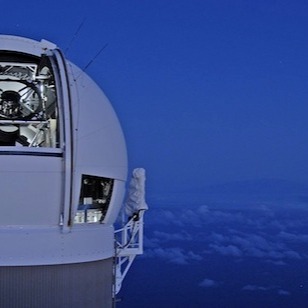
But first we have to find them! On the island of Maui in Hawai'i the Pan-STARRS1 telescope is scanning large areas of the sky each night trying to do just that. Using a process called difference imaging we look for anything that has changed by comparing each night's data with high quality reference images of the same area taken a few years ago.
Supernovae are explosions lasting a few weeks to several months which we hope to discover as new sources of light that have appeared since the reference image was taken. But our current software makes many bogus detections of supernovae.
These are image artefacts due to the electronics in the camera or image processing gone wrong. Currently computers aren't very good at telling the difference between the real and bogus detections.
You can help improve our understanding of supernovae and improve our detection algorithms by classifying detections as real or bogus.
Operation of the Pan-STARRS1 telescope is currently supported by the National Aeronautics and Space Administration under Grant No. NNX12AR65G and Grant No. NNX14AM74G issued through the NEO Observation Program. The supernova search project originated at QUB within
the European Research Council under the European Union's Seventh Framework Programme (FP7/2007-2013)/ERC Grant agreement no [291222] (PI: S. J. Smartt).
The background image is the Lagoon Nebula. Credits: Eugene Magnier (UH IfA), Peter Draper & Nigel Metcalfe (Durham University), copyright PS1 Consortium