




Finished! Looks like this project is out of data at the moment!
Research
Our Mission
Through this project, we aim to identify brown dwarfs in binary systems within the Sun's local cosmic neighborhood. By studying brown dwarfs, we can learn more about giant exoplanet atmospheres, the star formation process, what compounds are prevalent throughout our Milky Way galaxy, and how the composition of proto-stellar material shapes the development of stars.
Brown dwarfs are enigmatic celestial objects intermediate in size (mass) between the smallest red dwarf stars and the largest planets. Because each brown dwarf cools over the span of billions of years, it can be very difficult to determine either the age or mass of a given brown dwarf -- a young, warm brown dwarf can have the same mass as an old, cold brown dwarf. This phenomenon is known as the age-mass degeneracy, where a particular temperature or luminosity could indicate either a younger, smaller brown dwarf or an older, larger object. To learn all that brown dwarfs can potentially teach us, we must somehow "solve" this age-mass degeneracy!

Credit: NASA/HST
Luckily, this age-mass degeneracy can be mitigated by a brown dwarf’s companion star if one is present -- that is, if the brown dwarf lives in a binary system. The companion star can be analyzed for properties like age, metallicity, and space velocity, allowing us to assign these measurements to the brown dwarf orbiting it and thus determine the brown dwarf's true age and mass, "solving" the age-mass degeneracy problem. That being said, brown dwarfs in binary systems are very rare treasures! Brown dwarfs in binary systems are sometimes called "benchmarks" because of the unusually detailed information they provide about the brown dwarf's properties.
In Backyard Worlds: Binaries, we need your help to visually inspect observations from NASA’s Wide-field Infrared Survey Explorer (WISE) for new benchmark brown dwarfs. We will thoroughly probe for previously overlooked brown dwarfs in binary systems, marking a major step toward otherwise infeasible research on brown dwarfs within our galaxy.
About the WISE All-Sky Infrared Survey
We will be scanning the solar neighborhood -- our Sun's local patch of the Milky Way -- using infrared images from NASA's Wide-field Infrared Survey Explorer (WISE) space telescope. While ordinary stars like the Sun shine brightly at visible wavelengths, brown dwarfs glow mainly in the infrared, making them visible targets to the WISE telescope.
In Backyard World: Binaries, you'll be examining snippets of the night sky (as observed by WISE), looking for cases of two objects moving together across the screen. If one of the moving objects appears to be a reddish/brown color, this one is a very cold brown dwarf and you have identified a brown dwarf binary!
What Are Brown Dwarf Binaries?
Astronomers have long studied binary stars, which have also been recognized and utilized by humankind more broadly for centuries (even historically using the Mizar and Alcor double star as an eye exam!). A "binary system" describes a pair of two objects that are gravitationally bound and will continue orbiting their shared center of mass. Our project is particularly focused on brown dwarf binary systems -- binary systems where at least one co-orbiting body is a brown dwarf.
Detections of brown dwarf binary systems will appear in WISE image blinks (referred to as "flipbooks") as two light sources traveling together across the screen. We refer to this behavior as "common proper motion", and call the binary system a "co-moving pair". We also sometimes refer to the members of such a binary pair as "co-movers". Note that the images in our data set will appear to have an "inverted" color scheme compared to the example below, with the co-moving sources appearing as black or orange/brown and the empty sky appearing white-ish in color.

Credit: Mark's Astrophotography
Here you can clearly see two objects traveling together across the image.
How Do Brown Dwarf Binaries Help Us?
Brown dwarfs are formed in a similar manner as stars (such as our Sun!) but lack enough mass to trigger sustainable hydrogen fusion. Stars, on the other hand, "shine" or emit visible light because of nuclear fusion occurring in their cores, making them relatively easy to identify in space. Planets and exoplanets do not have enough mass to sustain fusion of any kind and emit very little visible light, making them significantly more difficult to detect. Brown dwarfs live along this boundary between exoplanet and star, having enough remnant heat from their birth to emit light in the infrared. We can detect these wavelengths using specialized telescopes such as the Wide-field Infrared Survey Explorer (WISE)! In short, brown dwarfs act as natural links between stars and planets, providing us a rare opportunity to learn more about low-mass stellar formation and giant exoplanet atmospheres.
However, to best understand brown dwarfs and their place in between stars and planets, we must first "solve" the age-mass degeneracy for at least some brown dwarfs. Brown dwarfs are notoriously difficult to age, as they cool gradually throughout their lives and have complex signatures of molecules like water and methane in their atmospheres. In order for us to determine brown dwarf masses and uncover how metallicity, interstellar cloud structure, and gravity impact observables, we must have accurate age estimates for individual brown dwarfs.
We do this by identifying any potential co-moving companion star and assigning the companion star's measured quantities to its partner brown dwarf. These brown dwarfs with companions are called "benchmark brown dwarfs," and can be found orbiting with white dwarfs, main sequence stars, or other brown dwarfs.
Additionally, the atmospheres of brown dwarfs are very similar to those of giant exoplanets, but can be observed in detail without the glare of a much brighter host star interfering. These brown dwarf atmospheres show strong signatures of water and methane, which are important molecules for the development of the organic compounds we see on Earth. Some brown dwarfs may even be rogue planets that were ejected from their original star system! Thus, better understanding brown dwarfs, for instance by identifying new benchmark systems, can provide valuable insights into the formation of other star and planetary systems.

Credit: NASA/JL-Caltech
Why Do We Need the Human Eye?
Compared to typical "main sequence" stars and distant galaxies, brown dwarfs are very rare. WISE has detected billions of galaxies and normal stars, but probably only a few thousand brown dwarfs. Brown dwarf binaries will be even rarer! Our telescope images have artifacts like diffraction spikes, optical "ghosts", and more, that occur far more often than brown dwarf binaries, making it difficult to create an automated detection system to pick out candidate brown dwarf binaries. Additionally, brown dwarfs and binary pairs can appear partially hidden by other stars, galaxies, and other detector noise. Fortunately, the human eye is highly adept at picking out shared/common proper motion of two moving bodies from flipbooks!
We've identified tens of thousands of prime locations within the WISE dataset that are ripe for discovering brown dwarf binary companions because they are in the surroundings of other known nearby stars. The most efficient and effective way to find potential brown dwarf companions to these nearby stars is to leverage the power of citizen science to analyze huge sets of telescope data in a short period of time.
What is Proper Motion?
Brown dwarfs are cold and dim, so they can only be detected when nearby to us. All inhabitants of the Milky Way Galaxy are moving relative to the Sun. However, we perceive the objects close to us as moving much faster than ones farther away. For an example of this effect you can try right now, take your finger and put it about 10 inches from your eyes. Close one eye, and move your finger about 6 inches from left to right. Now, take your finger and extend it as far away from your eye as you can. Move it the same 6 inches from left to right again.
You should be able to see that your finger appears to move a larger angular distance when it is closer to you than when it is farther away. Essentially the same thing is happening with brown dwarfs, but on the scale of light years rather than inches!
Barnard's Star is a red dwarf star relatively close to the Earth at a distance of approximately 6 light years. As such, it has a fairly high apparent motion. Here's what Barnard's Star looks like in telescope data:
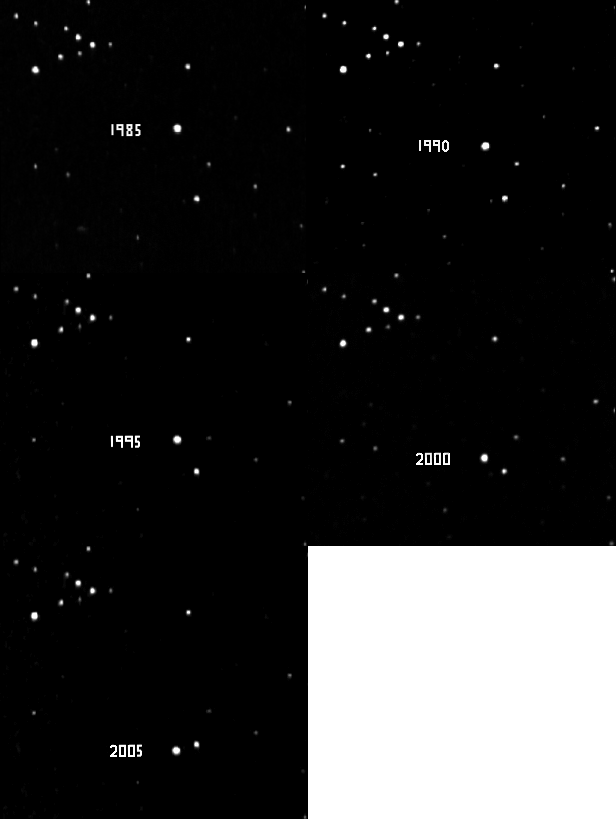
Note that the above animation is on a loop; Barnard's star doesn't actually "jump backward" at any point, it just keeps moving along essentially a straight line trajectory.
For a star moving at a speed v perpendicular to our line of sight with a distance d from Earth, the angular velocity is proportional to to v and inversely proportional to d:

Here, v would be in units of distance over time (like m/s or km/s), d is the distance between us and the star (in units like light years) and μ is the rate of apparent motion across the sky, which astronomers refer to as proper motion. Proper motion has units of angular distance per unit time. It turns out that the convenient unit of proper motion for nearby stars is arcseconds per year, where one arcsecond is 1/3600th of a degree. Barnard's Star has the highest proper motion of any currently known star or brown dwarf, at roughly 10.4 arcseconds per year.
It is very common for nearby brown dwarfs to have proper motions much smaller than that of Barnard's Star, but still detectable by eye. In Backyard Worlds: Binaries, you will encounter a variety of objects with different proper motions. Our project interface will provide you with the necessary tools to analyze potential binary candidates (see field guide and tutorial), across a range of different speeds.
Temperature and Color
If you've looked at the night sky, you've probably noticed that stars come in different colors. The color of a star is indicative of its temperature. A blue/white looking star is relatively hot, while a cool star (say, a red dwarf like Barnard's Star) will look more red/orange in color. The light emitted by an object due to its temperature is known as blackbody radiation.
This phenomenon isn't just limited to stars though. Your typical incandescent lightbulb works the exact same way -- electricity causes the filament inside the bulb to heat up to around 2300 degrees Kelvin and it emits blackbody radiation in the visible spectrum (for reference, the Sun has a surface temperature of 5800 degrees Kelvin). Objects don't have to be thousands of degrees to emit light though -- the human body is warm enough to emit light too! However, the light you (and other cooler objects like brown dwarfs) emit is in the infrared wavelength range and is outside humans' visual spectrum.
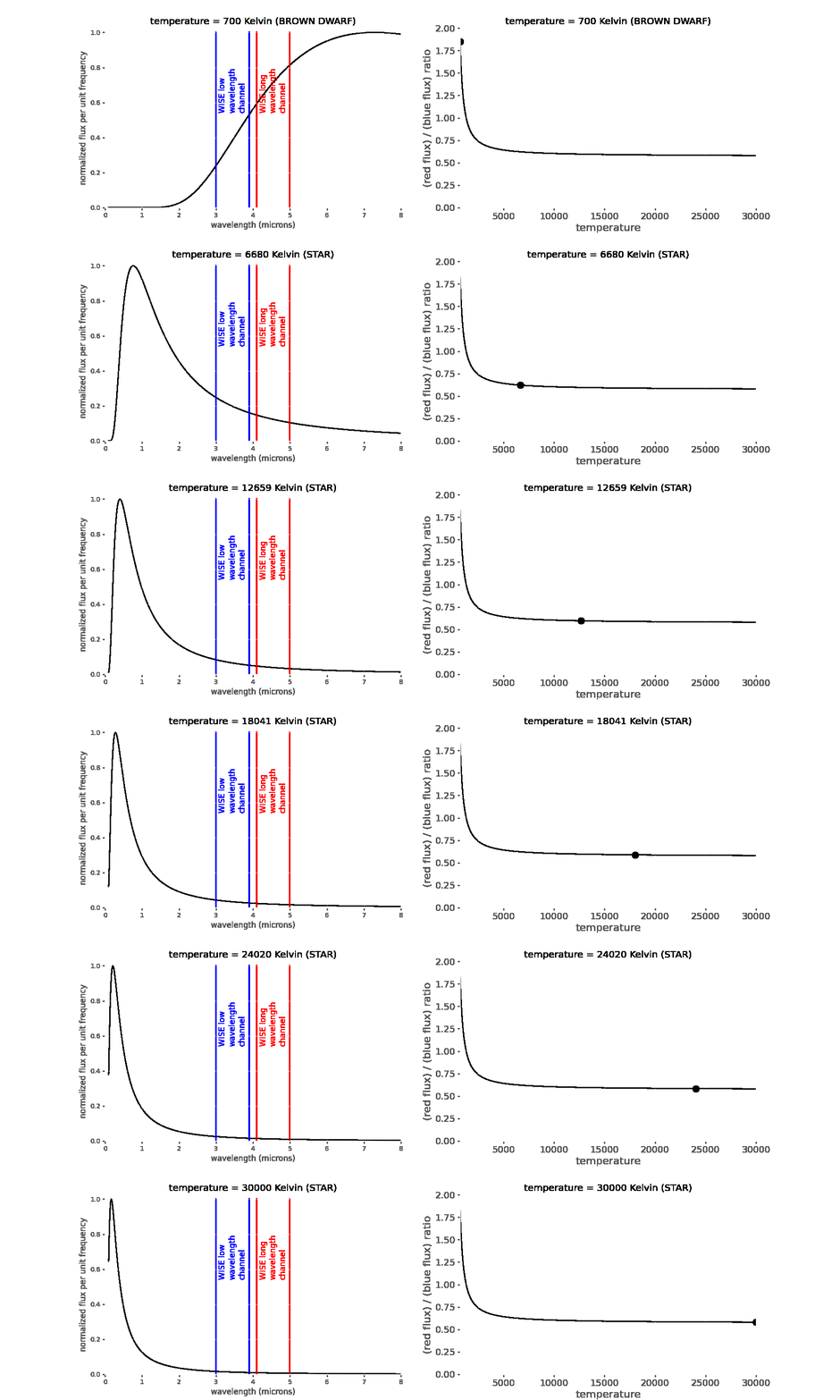
Thankfully, modern wide-area surveys like WISE (and its extension, NEOWISE) are sensitive enough to detect brown dwarfs in the ~3-5 micron wavelength range where they emit light most strongly. So, the data you will be analyzing in Backyard Worlds: Binaries aren't visible light pictures like you might take using a normal camera, they are actually capturing light that would be invisible to human observers. The data is then transformed to visible light through 'false-color' rendering, at which point we can visually inspect the images with our eyes.
Final Notes
For more information on how to navigate this project and the science of brown dwarf binaries, be sure to check out our FAQ section!
Backyard Worlds: Binaries is a sibling project of Backyard Worlds: Planet 9 and Backyard Worlds: Cool Neighbors. Backyard Worlds: Planet 9 searches for hypothesized planets in the distant reaches of our own solar system, as well as brown dwarfs. Backyard Worlds: Cool Neighbors focuses on searching for brown dwarfs. These projects have serendipitously discovered many brown dwarfs in binary systems, which is why we now have Backyard Worlds: Binaries, dedicated entirely to making more of these discoveries.
The material contained in this project is based upon work supported by a National Aeronautics and Space Administration (NASA) grant or cooperative agreement. Any opinions, findings, conclusions or recommendations expressed in this material are those of the authors and do not necessarily reflect the views of NASA.
For more NASA citizen science projects, go to science.nasa.gov/citizenscience
