




Finished! Looks like this project is out of data at the moment!
FAQ
Frequently Asked Questions
This page will be regularly updated with commonly-asked questions about the science and project.
What Do Brown Dwarfs Look Like?
If we were able to see brown dwarfs in greater detail, it's theorized that they might look like Jupiter with banded cloud structures and may even have a purple or red glow.
However, because brown dwarfs are so small and emit so little light, these objects are very hard for us to detect. In the telescope images we need your help scouring, brown dwarfs may appear as small dots moving across a field of otherwise static stars. They may be slightly orange, although that alone is not a determining factor. Check out the field guide for some examples on what a brown dwarf looks like!
What Are Dipoles?
When making classifications, we ask that you look for something called "dipoles" in the sky difference image. The difference image is located on the right hand side, shown below.

To confirm whether two objects are indeed co-moving (traveling across the sky together), we check if any dipoles are present in the difference image that match the location of two co-moving objects in the WISE sky view. Dipoles appear as blobs/circles which are half black/brown (depending on the object) and half white. Brown dwarfs will sometimes have dipoles that appear a faint dark orange/brown. The sides appear to "switch" or flip positions as the object travels across the sky. A clearer example, of two M dwarf main sequence stars, is shown below.

You can see two very strong dipoles in the sky difference view, moving in the same direction. It is very important to confirm that the dipoles move in the same direction before deciding if the two objects are co-moving together as a binary pair, as a shared dipole direction means that the two objects are actually traveling together!
Difference images are created specifically to detect motion across the sky. The sky difference view is created by aligning multiple observations of the same patch of the sky and subtracting the two images, leaving a black patch where the object has moved and a bright white patch where the object originally was. Together, these two patches form the dipole, whose length and direction directly indicate the object's movement. We use dipoles in this project to distinguish moving objects against stationary background stars/galaxies!
Distinguishing Between Artifacts and Celestial Objects
Dealing with real data provides a set of classification challenges that you, as a brown dwarf binary hunter, must consider. As such, it is important to be able to tell the difference between artifacts present in the data and the actual brown dwarfs we wish to discover.
Ghosts
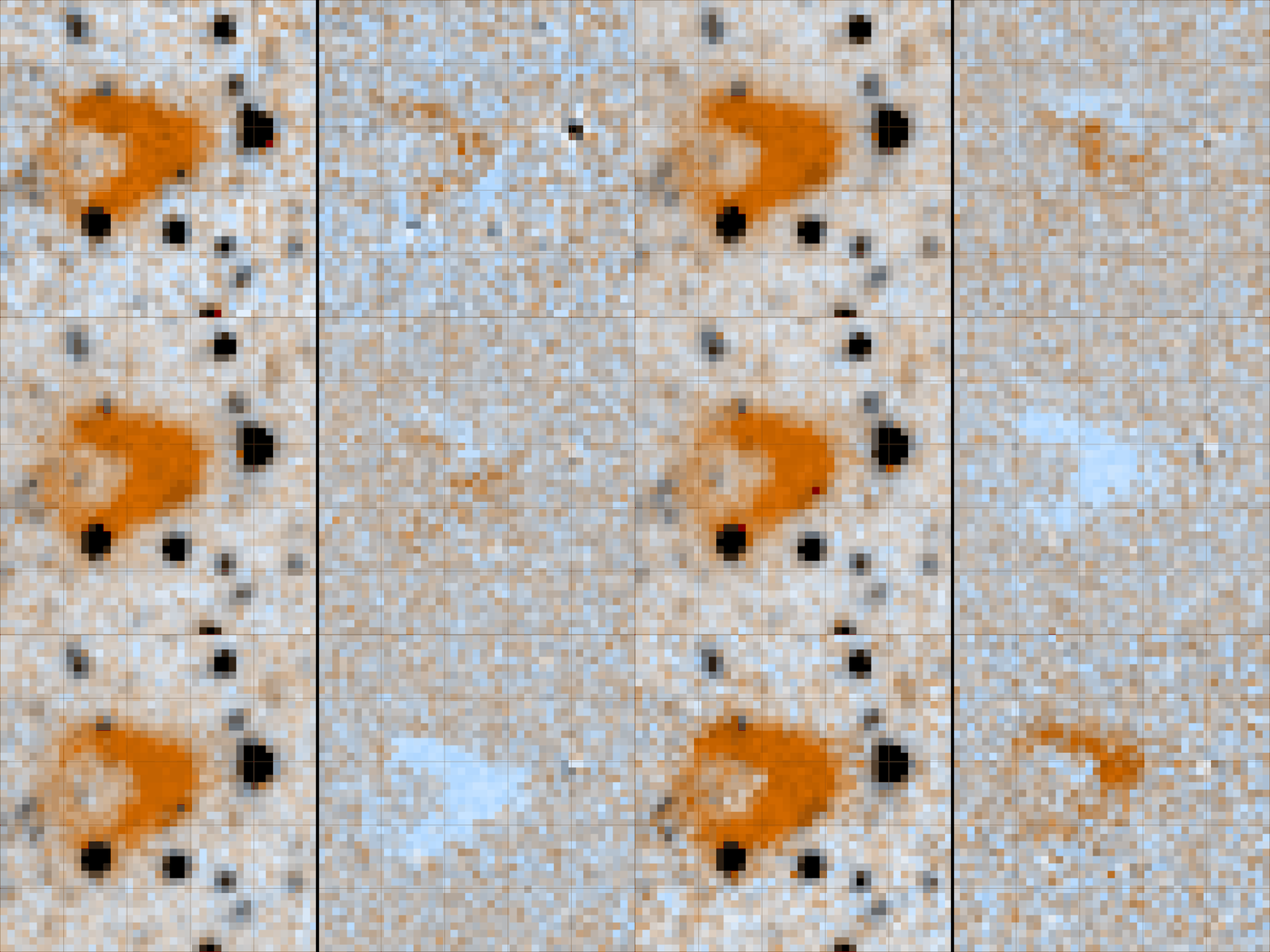
Detector noise and defects can masquerade as orange and/or moving sources, and therefore show up as "bogus" brown dwarf candidates. Here's one example, a so-called "ghost" in the WISE data:
Explore an example of a "ghost"
It looks very orange, but it has an odd donut-shaped appearance which is different from the shape of stars in the imagery, hence we know it can't be a real brown dwarf. If you follow this link, you can see an example of how a particular ghost is sourced by a neighboring bright star.
Diffraction Spikes
As light enters the WISE telescope, the support beams which hold the secondary mirror cause light to be diffracted. As a result, diffraction spike artifacts can be seen around bright stars in some of the images you will be searching through. In this example, a diffraction spike from a nearby bright star spans across pretty much the entire field of view:

Explore an example of a diffraction spike
Crowded Fields
While not an artifact, "crowded fields" -- areas of the sky such as the plane of the Milky Way galaxy with lots of stars -- can be more difficult to comprehend, both for computer programs and for humans. A crowded field example, with a variable star in the center, is shown below. Variable stars can be prevalent in crowded fields and "flash" on and off in the difference image, but do not have half-and-half dipoles that switch sides. This flashing behavior is not due to movement, but because of changes in its luminosity.
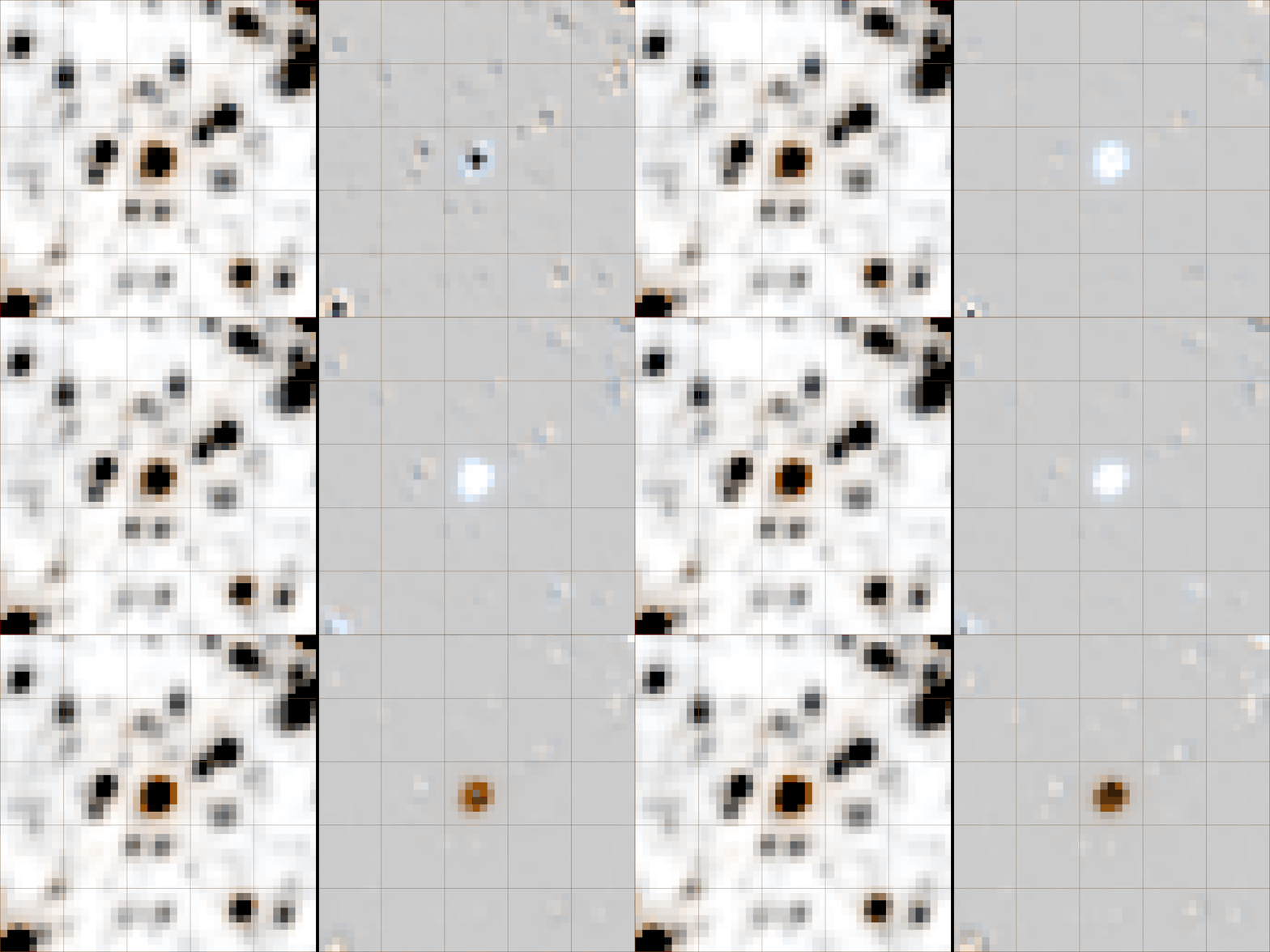
While these are the most common types of artifacts, there are several others you may encounter while classifying. Check the field guide for more information!
Is there an in-depth guide about distinguishing between celestial moving objects versus artifacts and known versus unknown brown dwarfs?
Yes! Expert citizen scientist Leopold Gramaize has provided this incredibly helpful guide with very detailed advice/instructions.
What if I see 3 or more possible co-movers in one subject's field of view?
It is possible (but very rare) to find a "triple star" system where three objects are gravitationally bound and appear to be co-moving with one another all in a single subject's field of view. In many cases, what may seem like three (or more) co-movers is likely a slight misalignment in the images used to make the difference image panel view. Such image misalignments might also cause you to perceive more than one pair of potential co-movers within a single subject.
In these cases, make sure to carefully check both provided image panels (the WISE sky view and difference image view) to confirm whether these objects are actually moving together with the same speed and direction. If you think you have confirmed that there is a rare system with 3 or more co-movers in one subject, or a case of two co-moving pairs in one subject, use this Google Form to provide information about your discovery!
Why do we care about brown dwarfs?
Brown dwarfs have physical characteristics which overlap with both stars and planets. By counting their numbers and determining their ages and masses, we can learn about how stars, planets, and galaxies form. Cool brown dwarfs are especially handy because we use them as analogs to exoplanets. They are roughly the same size as Jupiter (in terms of radius), and sometimes have low temperatures approaching that of Jupiter, yet they are far easier to study than exoplanets because they do not closely orbit bright stars that would overwhelm them with glare. Consequently, we can get very detailed information about their atmospheres, which tells us about their composition, rotation, clouds, storms, and even magnetic properties. Brown dwarfs are even thought to have planets that orbit them. Working with you on this citizen science project, we hope to uncover benchmark brown dwarfs that will help us make sense of the diversity seen among the brown dwarf population. To learn more, read Jackie Faherty's blog post.
I think I found a brown dwarf binary. What should I do?
In addition to completing your classification within the "CLASSIFY" tab of this Zooniverse interface, please fill out and submit this Google Form with information about your discovery! This form will flag and prioritize your candidate for review by the science team.
How does Backyard Worlds: Binaries relate to other Backyard Worlds projects?
Backyard Worlds: Binaries is a sibling project of Backyard Worlds: Planet 9 and Backyard Worlds: Cool Neighbors. Backyard Worlds: Planet 9 searches for hypothesized planets in the distant reaches of our own solar system, as well as brown dwarfs. Backyard Worlds: Cool Neighbors focuses on searching for brown dwarfs. These projects have serendipitously discovered many brown dwarfs in binary systems, which is why we now have Backyard Worlds: Binaries, dedicated entirely to making more of these discoveries.