


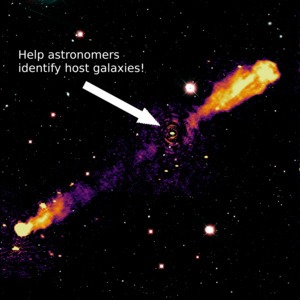
Finished! Looks like this project is out of data at the moment!
Thank you for your efforts! We've completed the classification stage for this project! To browse other active projects that still need your classifications, check out zooniverse.org/projects.
Research
What are we looking for?
Supermassive Black Holes
Almost all of the sources found in the LOFAR radio survey of the northern sky are what astronomers call Active Galactic Nuclei (or AGNs for short). Active Galactic Nuclei are powered by supermassive black holes in the centers of galaxies. Nearby material passes very close to these supermassive black holes and is flung out in the form of two immense jets. These jets are visible at radio wavelengths and observing this radio emission can tell astronomers a lot about the formation and evolution of supermassive black holes.
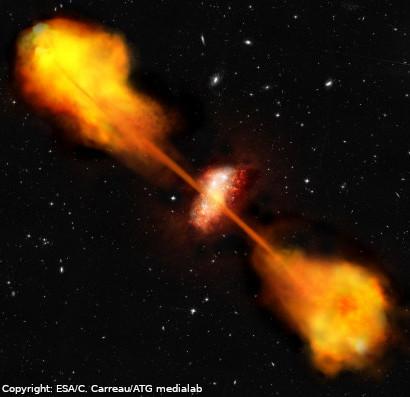

The first image shows an artist's impression of two radio jets ejected from a supermassive black hole in the center of the large foreground galaxy. It also shows all kinds of background galaxies that we would see with a good optical telescope. The second image shows a real example of two jets around a supermassive black hole found by observing with the LOFAR radio telescope!
Star forming galaxies
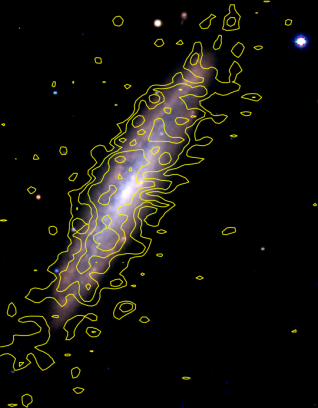
In some cases, LOFAR also picks up nearby galaxies where much star formation is going on. In this case, we do not see radio jets but the shape of the radio emission follows the shape of the nearby galaxy closely. To visualise this, we show the radio emission as yellow lines (called contours) in the foreground and the image from an optical telescope in the background.
Why do we need your help?
Reassembling radio sources
The LOFAR survey has made images of hundreds of thousands of these jets and galaxies, which have been identified by an automatic "source finder" computer program. Unfortunately, this program is not perfect and sometimes it splits a single radio source into multiple separate components. Radio astronomers need your help associating the components that the source finder program mistakenly separated. This will let us reconstruct the full radio sources from their separated components.
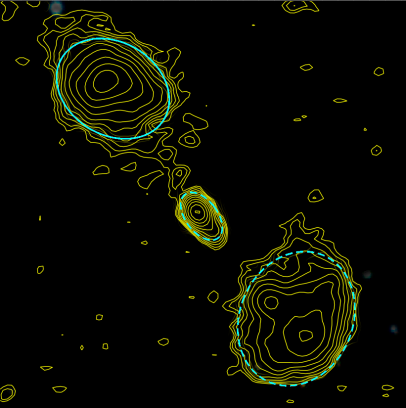
This image also shows a pair of radio jets found with the LOFAR telescope. This time, the radio emission is visualised as yellow lines (called contours) and the blue ellipses surround what the source finder thinks are separate sources. In this case, the presence of three ellipses shows that the source has been incorrectly divided into three separate components. You can fix that mistake by associating the components!
Finding the Active Galactic Nuclei
Astronomers are also interested in identifying the galaxy that powers the radio emission. These galaxies can be seen at visible wavelengths, and provide additional data to help astronomers determine, for example, the distance to the observed radio source.
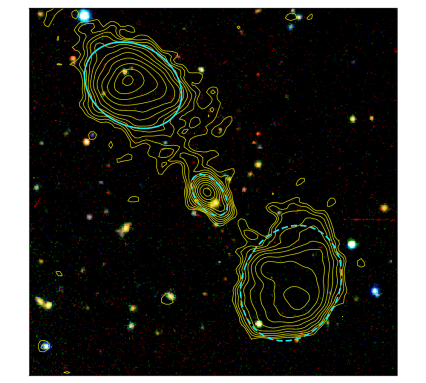
The image above now shows sources found with an optical telescope behind the contours and ellipses. The host galaxy is visible in the background as the bright source in between the two lobes.
Getting started
To help you get started we've built a dedicated training workflow and a step-by-step tutorial video that will guide you through the classification process.
If you're new to LOFAR Galaxy Zoo we recommend that you open the tutorial video in a separate browser tab and then and then click on Tutorial on the homepage to go straight to the training workflow now.
If you prefer, we also have a text-based tutorial that should pop up the first time you start classifying, and it can be revisited as often as needed by clicking on the handy "Tutorial" button that is displayed in the classification interface. The main workflow also has 10 'gold standard' images where experts have found the right answer. These images help you get started by providing feedback and help us calibrate the responses. However, you will only see these images if you are logged in!
We've also provided a Field Guide that contains useful examples of the different types of radio sources you will encounter, as well as useful tips and some pitfalls to avoid.
If you ever feel uncertain, remember that every image will be seen by several people, and when the results are inconsistent they will be analysed in more detail by the experts. You don't have to get it right every time!
You can start classifying by clicking on the classify button at the top of this page. Have fun and thanks for you help!