


Finished! Looks like this project is out of data at the moment!
Thank you for your efforts! We've completed the classification stage for this project! To browse other active projects that still need your classifications, check out zooniverse.org/projects.
FAQ
How are the blue ellipses made?
The blue ellipses are generated by an algorithm which tries to estimate whether seemingly separate sub-components (e.g., two radio lobes) of a source belong together. Unfortunately, this algorithm is not completely accurate, which is why we need human eyes to take another look at the more difficult images.
What is meant by "Radio emission"?
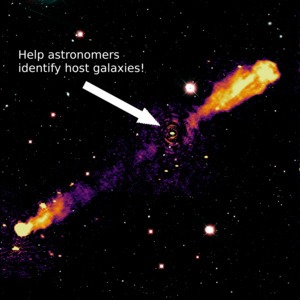
When we look up into the night sky, our eyes can detect the visible light "emitted" at "optical" wavelengths by stars in our own galaxy. We could describe this light as "optical emission". However, visible light represents a tiny fraction of the radiation that is emitted by stars, galaxies and other celestial objects. Many objects also "shine" at very long wavelengths, radio wavelengths, and we call this "radio emission". Our eyes cannot detect radio waves, so we need to build large radio telescopes like LOFAR to see the radio signals that distant galaxies produce.
Why do you study these objects?
While many scientific questions can be answered with the data that the LOFAR telescope provides, there are four main science drivers:
- Creating a picture of how massive galaxies, clusters of galaxies and black holes form in the first billion years of the Universe.
- Studying magnetic fields in the Universe, both in our own Milky Way and on the largest scales, in clusters of galaxies.
- Creating a picture of the earliest star formation processes in the Universe.
- Exploring at frequencies never before observed from the Universe. This will undoubtedly lead to new and unexpected discoveries.
Do I have to click on the solid blue ellipse as well?
Clicks on the solid ellipse are ignored, but to prevent us from mistaking a click on the solid ellipse as a click belonging to a dashed ellipse, you should not click on the solid blue ellipse.
What should I do when ellipses overlap?
When the blue ellipses overlap, try to place your marker such that it is inside only one ellipse. If this is impossible, for example because one ellipse is completely contained in another bigger ellipse, place it as close as possible to the centre of the ellipse that you want to select. Don’t worry about selecting the solid blue ellipse as this will be ignored.
Why am I getting feedback in the main workflow?
We have put 10 'gold standard' images into the main workflow where experts have found the right answer. These images help you get started by providing feedback and help us calibrate the responses. However, you will only see these images if you are logged in! If you are receiving feedback in the main workflow, this means you have come across one of the gold standard images. It does not necessarily mean you are in the tutorial workflow, so you can just keep clicking!
Why is the amount of subjects so low (only a few thousand)?
Over the region we're eventually planning to complete, we're expecting a total of around 150,000 sources suitable for classification (out of around 5 million in total), and those 150,000 will need 5 views each. However, although we have most of the data to make the radio images, we are not uploading all 150,000 at once. The reason is that we're trying to finish one part of the sky before moving on to another. Since the objects shown to volunteers are randomly chosen from the pool, we can only do this by restricting the numbers of objects that are live at any one time. As the project progresses more subjects will be uploaded.