


Research
Project concept
I Have Gone and I Am Going will be an online exhibition drawn from the correspondence of Bernhard Blume and Carola Rosenberg-Blume. As a young adult in Weimar Germany, Bernhard was an up-and-coming playwright, hailed alongside Bertholt Brecht as one of “the five B’s.” Carola was an actor, vanguard feminist, and educational reformer. Their lives were overturned when the Nazis came to power and Carola was dismissed from her teaching position because of her political activity and her Jewish ancestry. Their letters offer informal glimpses of the daily lives of two young artists thriving in Weimar Germany and surviving the accession of a fascist movement to totalitarian power. Each letter will be paired with a newspaper account of an event occurring on the day the letter was written – illuminating the social and political setting Bernard and Carola moved in, one of economic hardship, political polarization, democratic collapse, and fascist takeover.
The materials
In the fall of 1935, seeking employment that would allow them to emigrate, Carola sailed on her own, knowing little English, to New York City. Her letters home to Bernhard, written in pencil on notebook paper and ocean-liner stationery, are quick-witted, passionate, endlessly curious. Her mission succeeded, and a year later the couple emigrated with two young children to the United States. Most of Carola’s immediate family remained in Europe and were murdered by the Nazi regime.
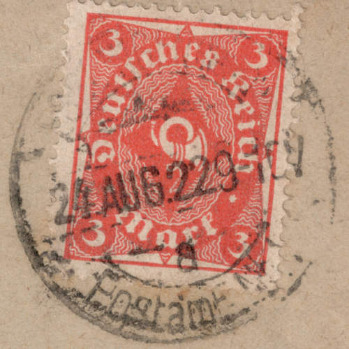
Also valuable as a window on life in interwar Europe are Bernhard’s letters to his brother Walter, who died of leukemia in 1925 in a Stuttgart hospital. Their markings hint at the realities of hyperinflation, German postal sorting methods, variant scripts, and the pressures bearing down on the fragile Weimar democracy. They also capture a pedantic aspect to Bernhard’s character that would enable his transformation, in America, to an eminent scholar of German literature.
The letters are arranged into four [CHK] Subject Sets:
- Sixteen letters written in fountain pen, with envelopes, from Bernhard to Walter between May 1922 and February 1925.
- Twenty-nine leaves from Carola to Bernhard on notebook paper and ocean-liner stationary written late in 1935.
- Five letters to Bernhard from his mother, Hedwig Blume, from 1926 to 1950.
- Four letters from Walter Blume to his family written between 1920 and 1925.
[I believe there are more?]
Other Subject Sets hold supplemental materials, among them:
- Manuscripts and typescripts of unpublished plays and stories in both German and English.
- Drafts of letters to and introductions of Thomas Mann.
- Correspondence (a postcard, a note, a telegram) from Thomas Mann to the Blumes.
- Correspondence between Bernhard and various publishers and literary agents.
- Official German documents, such as a birth certificate, a death certificate, a student card.
- Hedwig Blume’s handwritten will.
The work ahead
Transcription. Volunteers skilled in reading handwriting, some straightforward, some cryptic, are invited to transcribe the letters – as much as they feel like. Description. Others are asked to draft physical descriptions of the materials: creases and stains in the paper, changes in handwriting, stamps and cancellations. Translation. Once a letter is transcribed, volunteers fluent in German and English are asked to create working translations. Connection. Volunteers with expertise in this period of German history are invited to suggest, for further research, important events occurring on the day a letter was written.
Curation. Meanwhile, the lead researcher will be securing institutional sponsors, funding, and a host for the exhibition. As materials are finished, he will select, arrange, and narrate materials, researching as needed and enlisting the aid of subject-area experts. The exhibition will be created on Twine, an open-source application for creating interactive non-linear digital games and stories: it’s also surprisingly good for exhibitions. Publication. While the exhibition will be a curated selection, all materials created by volunteers – transcriptions, descriptions, translations, connections – will be published in digital form at [TK]. Donation. Physical materials will eventually be donated to the Deutsches Literatur Archiv in Marbach, Germany, where the rest of Bernhard’s papers are housed, and the City of Stuttgart Archives, where Carola’s live [permissions TK].
Recognition. Every volunteer will be acknowledged gratefully in the exhibition text. Those who contribute substantively to ten or more Subjects will be highlighted in a rotating “Volunteer of the Week” profile. Volunteers who can offer significant expertise may, funds permitting, be enlisted as paid collaborators.