


FAQ
Transcription
How do I create a transcription?
See the Field Guide for step-by-step instructions. [A tutorial also?]
What transcription conventions should I follow?
Please follow the conventions of semi-diplomatic transcription:
- Transcribe spelling, grammar, & punctuation as you see them.
- Preserve line breaks (press Enter at the end of a line).
- Lower superscript letters “silently” (without noting or tagging them).
- Expand & tag abbreviations (see tutorial).
- Preserve brevigraphs like the ampersand (&).
- Use tags to mark cancelled words & inserted words (see Field Guide).
- Use tags to mark unclear or illegible words (see Field Guide).
- For unclear words, make your best guess, or use periods (one for each illegible letter, your best guess – see Field Guide).
- Do not mark accidental blotches on the page or flourishes in the script.
Adapted from Prof. Liza Blake’s “Transcription Conventions for Semi-Diplomatic Transcriptions.”
Do I need to tag?
Nope. You can leave it for a reviewer to do.
Where do I go for help?
Describe your question or concern on the Transcription discussion board in Talk.
Physical description
How do I contribute to a physical description?
See the Field Guide for step-by-step instructions. [A tutorial also?]
[Use a controlled vocabulary for written objects? what does DLA use?]
[Should responses be paragraph form, bullet points, radio buttons with space for comments?]
What sorts of physical description are useful?
Anything you can state with confidence about the artifact is potentially helpful. Some of the things you might notice:
Paper
- Tears, creases, dog-ears, crinkling
- Printed linings or other patterns
- Discolourations, stains
- Missing portions, affixed scraps or slips
- Other signs of use, wear, age, degradation
For instance, this envelope has had a portion of the front panel torn away:

The missing portion might be noted, “Square portion of front panel torn away in location where a stamp is typically affixed.”
Markings
- Medium (e.g., pen ink, pencil)
- Darkness, colour, uniformity of marks
- Overall impression of script (e.g. formal, neat, hurried, messy)
- Distinctive or unusual graphs (i.e., letterforms)
For instance, in this letter, the ink of the first line of the main text is darker than that of the address and salutation:

The change might be noted, “The ink of the first line is darker than that of the salutation, suggesting the author refreshed his pen in the interval.”
Modifications
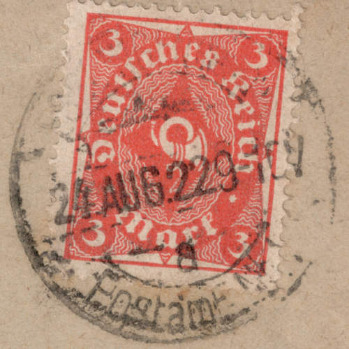
- Stamps(s)
- Postmark
- Stationer’s mark or label
Describe colour, shape, placement, other visible characteristics, as appropriate.
How do I ensure my description is accurate?
Zoom in on the image to examine parts of it in detail. Most important is to describe what you see – only make inferences you can be confident of. For instance, a two rust-coloured parallel lines in the upper left corner probably indicate the presence at one time of a metal paperclip.
How should I format my description?
Please state your observations as bullet points.
Do I need to provide a complete description?
Absolutely not. Just describe features that catch your attention & hold your interest.
Where do I go for help?
Describe your question or concern on the Description discussion board in Talk.
Translation
When transcriptions have been reviewed and approved, they will be run through DeepL for an initial rough translation, which will be posted for volunteers to mark up.
How do I mark up translations?
See the Field Guide for step-by-step instructions. [A tutorial also?]
How fluent must I be in German or English to mark up translations?
You needn’t be a native speaker, but you should be fluent enough to recognize German idioms & to translate them into idiomatic English.
How literal or free should translations be?
We’re aiming for a happy medium: a translation that reads naturally while preserving all literal & factual content. A few pointers:
- It’s fine to change word order if that results in more natural English.
- Avoid changing sentence structure (order of phrases & clauses) unless preserving it leads to significant confusion.
- Change place names to English-language spelling (where applicable).
- Leave times & dates in their original format (twenty-four hour clock; day-month-year).
- If you run into wordplay or metaphor that won’t carry over, translate literally, & write a short explanatory note.
- In general, if you have to choose between factual meaning & artistic value (e.g., style, eloquence, wit), go with factual.
Where do I go for help?
Describe your question or concern on the Translation discussion board in Talk.
Connection
What sorts of connections are relevant?
Two sorts of connections will be most helpful.
Local
Knowledge about persons, places, events described (even just touched on) in a letter. The more specific the better. A note about New Jersey, where Carola travelled in search of employment, is not as useful as a note about the building on the Princeton campus where she would have met X.
Contextual
Knowledge about important events on the day the letter was written. Particularly helpful are notes relating to the exhibition’s through line: the fragility of Germany’s post-WWI democracy, its displacement by the Nazi regime, the Nazis’ gradual conversion of Germany into a totalitarian state.
What’s the title about?
It comes from a letter Carola wrote to Bernhard on her trip to the US, where she shifts from German to English to conjugate the verb “to go.” In other words, she breaks from her native language to the language of her upcoming exile, performing the break in the very act of naming it.

The title also alludes to the strange present-pastness of all correspondence: the letters’ time has passed, their purpose either accomplished or never now to be accomplished, and yet here they are, serving other purposes, as material traces of the human situations that made them need to be.
Why does this project matter?
This exhibition hopes to rescue two culture-makers from undeserved obscurity & to permit them, though gone now, not to have left us. Most crucially, in our own period of social upheaval & economic inequality, marked by political polarization & the rise of what Steven Levitsky calls competitive authoritarianism, with worse perhaps to come, these materials may offer lessons – what to watch for & how to resist it – to those intent on fighting for civil liberties, social justice, & human rights.
Who’s the exhibition for?
Anyone who wants to learn more about the life of artists & activists in democratic & pre-war fascist Germany; about the cultural & political conditions that led to the collapse of the Weimar Republic & the rise of the Nazi Party; about textual materiality & the study of handwriting; or about the interplay of private & public life as revealed in acts of inscription.