

Finished! Looks like this project is out of data at the moment!
Research
A Great Act of Service
The 25,926 men and women represented by these cards comprise what former President William Howard Taft called "one of the greatest achievements of peace in all the history of human warfare."
From 1914 to 1918, the conflict that would come to be known as the First World War ensnared twenty-eight nations with a total population count of 1.5 billion, or 90% of the world’s known population. Fifty-nine million men fought in World War I, resulting in 7.7 million deaths and 18.6 million injuries. By the time America entered the war in 1917, it was clear that World War I would be remembered as a great humanitarian crisis. Prior to the American entry to the war, the YMCA had been providing services to the Allied forces as well as relief to prisoners of war. This was possible due to the United States’ status as a neutral nation. When President Wilson declared America’s involvement in the war on April 6, 1917, the YMCA pledged its support. Tapping the YMCA’s legacy of service during previous conflicts, the YMCA was asked to take on nearly all human service activities for the U.S. military.
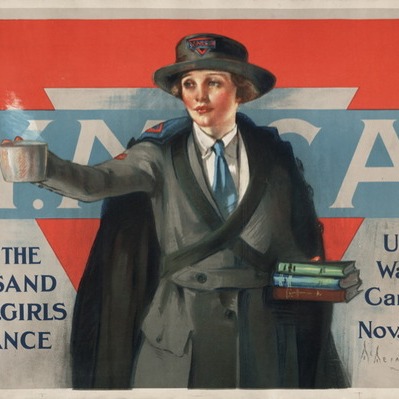
Over the next two years, the YMCA dispatched 9,475 men and 3,480 women overseas (11,306 men and 1665 women also served the homefront) to administer to the mental, spiritual, and physical needs of the Allied forces. Educators offered literacy and English instruction, and ministers provided spiritual support. General Pershing, Commander of the American Expeditionary Force, specifically asked the YMCA to organize athletic activities in order to assist in making the troops “fit to fight.” In addition to strengthening troops and providing recreation, baseball proved to be an effective means of training soldiers to throw grenades. In all, 75 million soldiers engaged in YMCA physical activities during the war.
As one of the nation’s largest and oldest social welfare institutions, the Young Men’s Christian Association (YMCA) is a dynamic organization that has worked to improve communities around the globe for 165 years. One institution that has long benefited from the support of the YMCA is the Armed Forces, work which began in 1857 when the Portsmouth, Virginia Y started to engage with the local naval yard. The largest of the YMCA’s wartime relief efforts, measured by individuals served and dollars spent, took place during WWI. The records housed at the Kautz Family YMCA Archives, University of Minnesota Libraries provide a comprehensive account of the YMCA’s war work, both domestic and international narrating public attitudes and engagement prior to, during, and after the war-- the conditions of soldiers in training camps, on the front lines, in leave areas, and in prison camps. Furthermore, they document the variety of ways the YMCA engaged with soldiers, bringing a “bit of home over there,” through educational services, managing canteens and leave areas, providing entertainment and organizing sports including the Inter-Allied Games, providing counsel through chaplains, and distributing religious tracts.
This project seeks to shed light on these individuals and make freely available the biographical and demographic information contained within these cards by:
-
engaging citizen scientists in the coding of a large, currently inaccessible, collection of 25,926 punch cards containing a wealth of valuable demographic information.
-
providing full, open source, access to the resulting data (including raw and collated) to scholars, students, and the public at large.