Dataset complete - Thanks everyone for your hard work. We are currently in our field season, getting ready to collect more images for you to classify!
FAQ
The Project
We have thousands of cameras set across the state. Most are set approximately 30 cm above the ground. Once triggered by movement the cameras take 3 images in a row. This gives us the best opportunity to see the animal. You can see all the images by either clicking on each round button at the bottom of the image or press the play button to get a flicker book.
Getting to know Western Australian fauna
Can you see an animal but have no idea what it is? Go to the buttons above the name choices and see if you can narrow the possibilities down based on the animal's body shape, colour or coat pattern. Many of our native fauna are mainly nocturnal so you may often only get night images, colour can be obscured during night shots, but coat pattern and body shape can often still be discernible. You can also scroll down this page to get some helpful hints and other images or click on the field guide on the right hand side of the main screen. We know that sometimes it is not easy to see what an animal is particularly if it moves quickly or you can only see part of an animal. But do your best and make your best judgement on what you think it might be.
Can you only see part of an animal?
Can't tell what the animal is because it moved too fast or only part of the animal is visible? Don't worry, take your best guess using clues such as its size and whether it has fur, feathers or skin. This will tell us if it is a mammal, bird or reptile and from its size you may be able to narrow it down to down to a few possibilities (see below). Many different people will view the image and if the researchers receive a wide variety of answers it will highlight the need for that image to be reviewed by one of the researchers.
Size
Many of our macropods from can look the same, particularly if you are not used to seeing them. But their size, colour and tail shape can often be a clue to what they maybe. If it is medium to large animal it maybe a wallaby (up to 9.0 kg or 17.5 lb) or kangaroo (54 kg or 120 lb). If its smaller maybe a woylie (up to 1.8 kg).
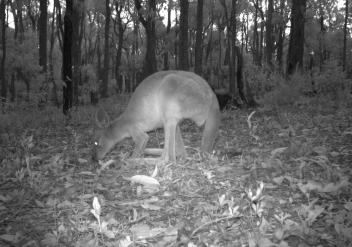 | 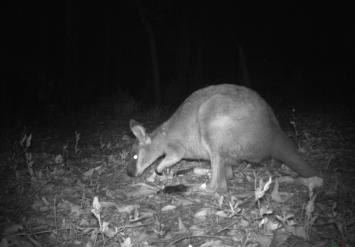 | 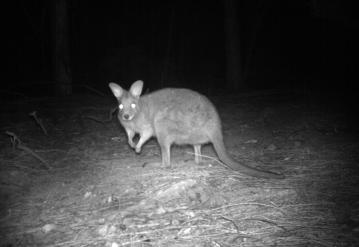 |
Grey kangaroo, large, with a long back leg and more slender body than a wallaby or a woylie. Few colour markings on face. Weighs between 28 and 54 kg (62—120 lb). | Black-gloved wallaby, medium sized, round body shape, dark markings on face, feet and hands. Shorter back leg compared to a kangaroo. Weighs between 7 and 9 kg (up to 17.5 lb). | Tammar wallaby, small to medium animal, with a relative short tail, and few markings on their face or body. Much smaller than a black gloved wallaby weighing between 2.9 and 6.1 kg and up to about 0.6 m tall. |
But if it is relatively small (think roughly cat size) and it tends to use all four feet rather than hopping, then think possum, quenda or chuditch.
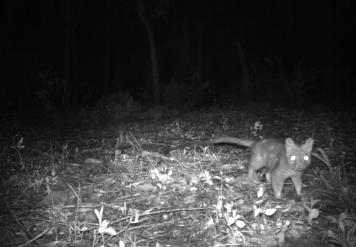 |  | 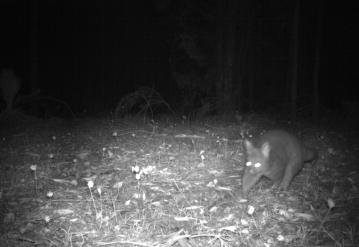 |
Chuditch, slightly smaller than a cat weighing between 1 to 2 kg (2.2 to 4.4 lb). Notice the distinct spots slender build and slender tail. | Quenda or bandicoot, smaller than a cat weighing between 0.4 to 1.8 kg (0.9 to 3.9 lb). Notice the long pointed face and lower position to the ground compared to the chuditch and possum. | Brush tailed possum, similar in size as a cat weighing between 2 to 4.5 kg (4.4 to 9.4 lb). They have a bushy dark tail, sometimes with a white tip and a fluffy coat. They have quite a stocky build. |
Tails!
Often you will only see a tail or the backside of an animal. Again this can make it really difficult to tell what an animal maybe, particularly if you are not familiar with the animal you are seeing. But put on your detective hat and narrow the possibilities down for us. Does it have fur or does it look more like skin? Skin, it is most likely a reptile.
Monitor Tail

If it has fur, it is going to be a mammal. Does it belong to a large or small animal? If it is large it is most likely one of our large macropods, perhaps a kangaroo or a wallaby. Can you tell if the tail is very long compared to the animal? and does it have a brush at the end or not? These are all clues to help you decide what animal is in the image.
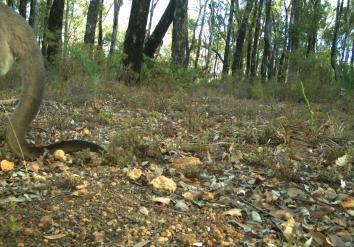 | 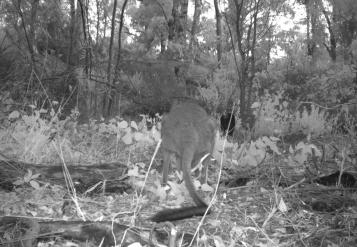 | 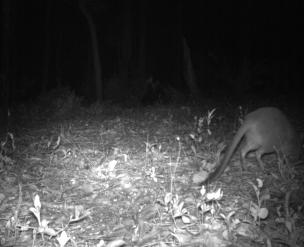 |
Tail of the grey kangaroo. Notice the dark pointed tip without a brush and only about a third of its length is on the ground. The tail is also very thick relative to its length. | Tail of a black gloved wallaby. Notice the rounded dark tip with black brush like hairs. It is very long and much of its length is stretched along the ground. | Tail of a woylie. Notice how slender it is and the black brush like hairs on the end. It is much smaller than a black gloved wallaby tail and they often hold them so only a small proportion of the tail touches the ground. |
The tail belongs to something small? Perhaps one of these?
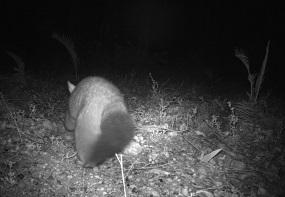 | 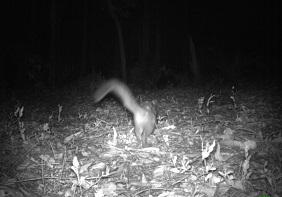 | 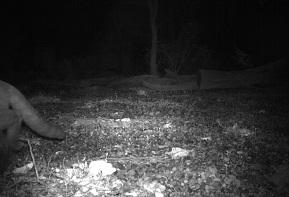 |
Brush tailed possum, as the name suggests they have a large brushy tail, fading from dark to grey as you move towards the body. They sometimes have a white tip. | Chuditch, very long tail compared to body length. Not as brushy as a possum, but they can sometimes flare the hairs on the tail when startled. If you can see spots on the body its likely to be a chuditch. | Cat, the tail is shorter than the body, it may have markings or be block coloured. Haired but not as densely as a possum and it is not as long as a chuditch tail. |
Joey in the pouch
Can see a joey in the pouch but don't know if you should count it or not. If you don't have any doubts it is there, because you can see an ear, paw or an extremely large bulge, then add it to the count. If in doubt, just count the animals you can see.
Predation
Sometimes you might see a fox, cat or a native predator with an animal in its mouth. Please classify the image based on the animal that is alive. You can make a note of the other animal in talk if you wish.

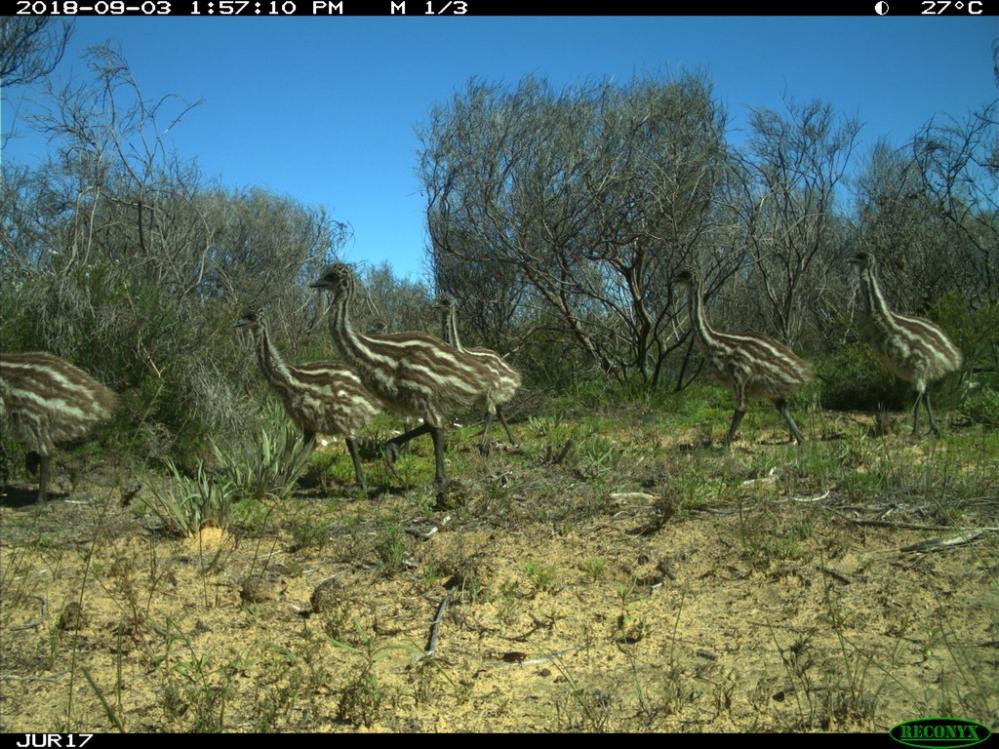
Emu Chicks
Adult emus are very distinctive, you will not find many other species in Australia that look like this. But their chicks are less well known. Young emu's can be clearly identified by their stripes. These stripes provide them with excellent camouflage so don't forget to spend some time looking for that hidden chick.