



Finished! Looks like this project is out of data at the moment!
17 Sep 2026: AMAZING!! You have all excelled and finished Refine early!! We will now be looking at the results to build the final list of lens candidates for this initial phase of the DR1 search. In the meantime, you can keep talking about your favourite systems and you can read about some rare gems you've already identified in DR1 here. We will send an update in a few weeks. THANK YOU!!
21 Apr 2026: We are back with new previously unseen data from ESA’s Euclid Space Telescope. Together, let’s find more than ten thousand lenses in this exquisite data!!
Results
31 July 2026: The second batch of Space Warps Classify is now live! Please find some stunning rare gems discovered with information on the second batch of Classify on the Space Warps blog
21 May 2026: Please join us on Space Warps Refine - an update on last year's project and and invitation to narrow down candidates in ESA Euclid DR1
08 May 2026: A million classifications for ESA Euclid DR1 - spectacular effort!
08 May 2026
As we mentioned in this blog post, last summer you helped us investigate what we might have missed in the ESA Euclid Quicklook-1 search. One of those studies has now completed that you can read about here with an update from Saamie Vincken (@saamievincken)
We used a new AI model called ‘AstroVink’ to search through over a million galaxies from the Q1 data release and rank the most promising lens candidates. What made this search different from the original Q1 search is that AstroVink was retrained using real lens candidates and tricky non-lenses from Q1 itself, making it much better at spotting lens systems that previous searches had missed, including edge-on disk lenses and other rarer configurations that were not well represented in simulated training data. This meant we could bring a fresh set of candidates to Space Warps that no volunteer had ever seen before.
Around 6,300 of these new images were shown to volunteers on Space Warps, and the systems you collectively flagged as possible lenses were shown to multiple lensing experts. This uncovered 8 Grade A and 26 Grade B new gravitational lens candidates in the Euclid Q1 footprint. These are systems that were missed in the original search, and without your classifications they would have stayed buried in the data!!
A mosaic of the newly found lenses is shown below, and the full paper describing the methods is available in this paper.
Thank you for all your classifications!

20 April 2026
An update on the recent Euclid search
https://blog.spacewarps.org/2026/04/20/more-beautiful-euclid-strong-lenses/
30 March 2026
Here's an update from Leon Roman Ecker (@eckerl) on the additional Q1 data that you inspected last summer (see also https://blog.spacewarps.org/2026/03/04/revisiting-the-esa-euclid-q1-search-what-did-we-miss/ for some background).
*Combining the efforts of citizens, machine learning methods and scientists we found 72 candidates of the first quick data release (Q1) in Euclid out of which 69 were previously unknown as strong lens candidates. These were initially missed by the scientists because of being too strict in selecting galaxies to inspect. This discarded some bright and close-by galaxies. Some of them turned out to be true gems and they would have not been found without your help of Zooniverse. One remarkable object is an edge-on disk lens which lensed two background galaxies which are believed to be merging. This is inferred when we try to model the mass of the main deflector galaxy and seeing that one background galaxy is lensed into a fold-arc Einstein ring while the other galaxy is lensed twice. This is one of many candidates of this sample found and a mosaic of the candidates can be seen in these figures below, this particular galaxy has a red outline around it.
The first mosaic contains the highest quality lens candidates (grade A candidates/definitely lenses) and the second the grade B candidates/"probable lens" candidates, although the grading is somewhat subjective.*
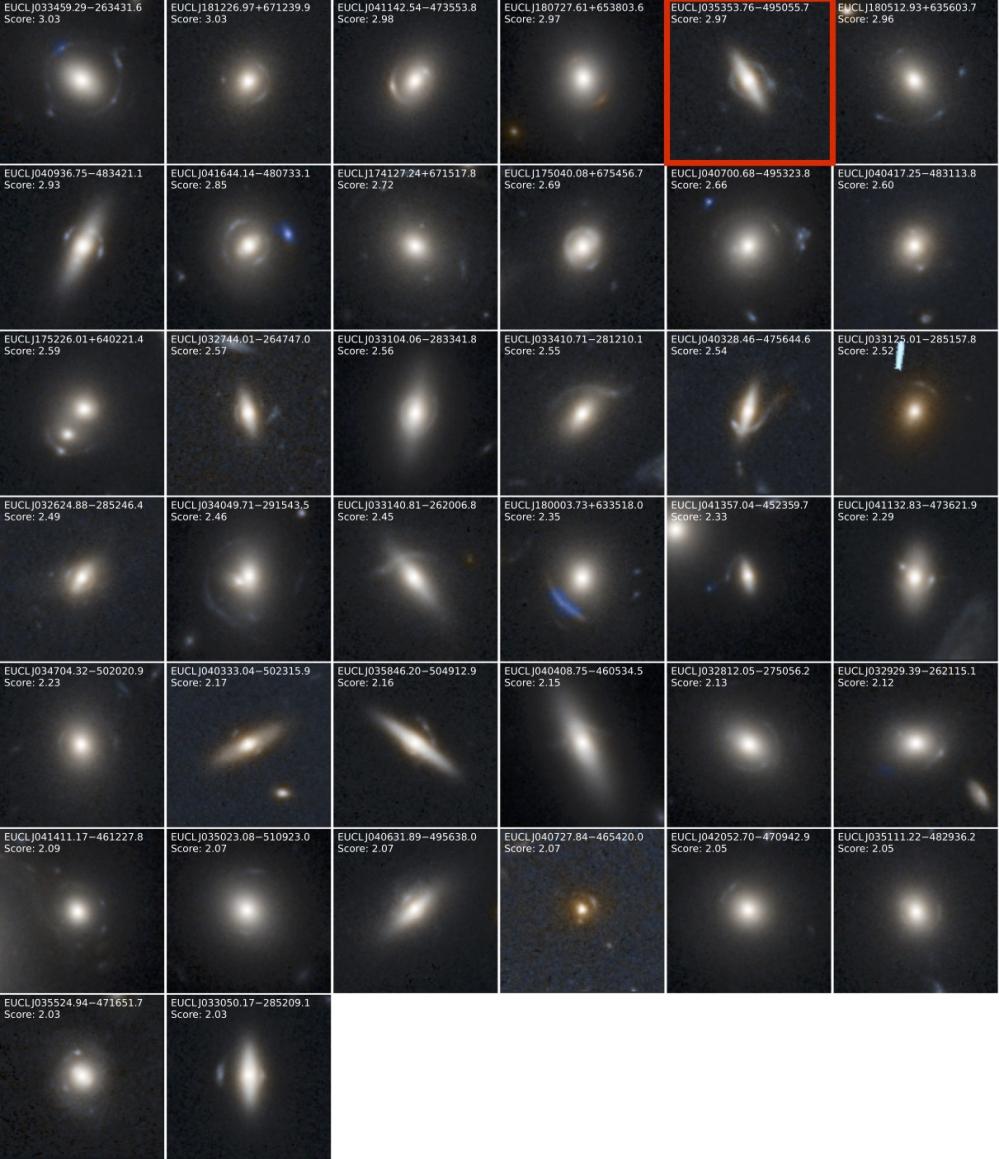

Thank you again for your amazing classifications to help finding these additional candidates from Q1. We now have permission from the Euclid Consortium to share the pre-print of the paper where you can find out more on https://arxiv.org/abs/2603.28580.
25 March 2026
An amazing effort, thank you for your classifications! Here’s an update on your recent classifications from Phil Holloway.
A huge thank you to everyone who contributed to the latest ESA Euclid lens test search – over the this test project you’ve collectively made an impressive half-a-million classifications, and identified some amazing lens candidates. The science team are now carefully going through all of the high scoring candidates you identified (this blog post summarises how the classifications are combined to arrive at the high scoring candidates). We’re not as fast as you all, and we don’t always agree, so it will take some time to get to the final results but we will keep you posted here as the sample emerges. We’re very excited to see the systems you identified, and below is a preview of some of the amazing lens candidates that we particularly liked – we hope you do too!
Amongst the beautiful lens candidates you have found, there have been some edge-on spiral lenses (centre), group-scale lenses (centre-left), and galaxy-scale lenses with clear counter images (far left/far right). Seeing counter-images give us extra confidence that a system is a genuine strong lens system, while edge-on lenses can be used to test our theories of gravity and dark matter.

As a reminder, these candidates come from a small amount of test data (about 50 deg2 of the sky), we expect there will be few hundred high quality lens candidates in this area among your high scoring systems.
Euclid will eventually survey an area of around 14,000 deg2, 280 times larger than this test area, so there are lots more lenses to come!!
Thanks again for all your contributions – Space Warps will return very soon so please watch this space!
March 2026
Revisiting the ESA Euclid Q1 search – What did we miss?
Please see our blog post update on the ESA Euclid Quick Look-1 (Q1) search. There are some interesting systems we missed first time round. We're learning with each round of classifications on what we got wrong and how we might focus your valuable classifications on the most interesting objects. We are so excited to see these new examples and hope to share the full results of the extended Q1 search, along with other updates very soon.
March 2025
Space Warps helps to find 497 spectacular lenses in Euclid Quick Look 1 (Q1) data
Thanks to your incredible efforts, we are delighted to have found 497 strong lens candidates in the Euclid Q1 data (see a selection below). Over the course of the project we had more than 800,000 classifications from over 1000 wonderful volunteers, and the results are a testament to your hard work. As part of the lens search, we developed the Strong Lens Discovery Engine, a pipeline to search for lenses in Euclid data, of which Space Warps was an integral part.
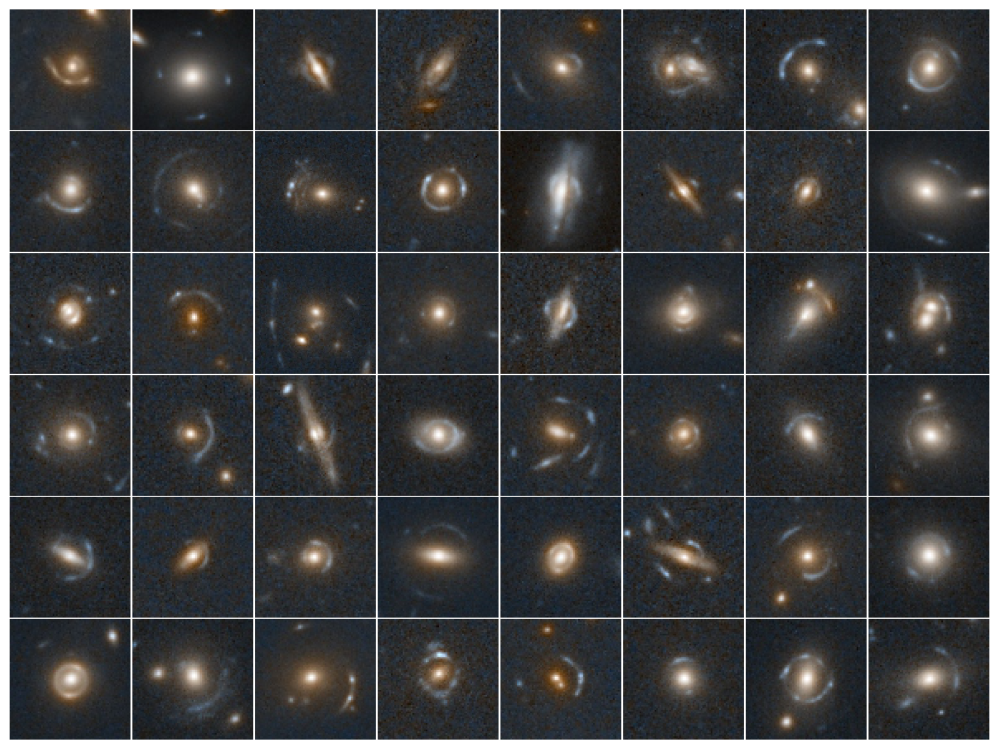
As part of the Strong Lens Discovery Engine we used multiple machine learning algorithms (including ‘Zoobot’ trained using Zooniverse classifications in Galaxy Zoo) to do an initial sift of the data which the Space Warps volunteers inspected to find the most likely lens candidates. This machine + volunteer partnership will be crucial with the much larger data releases coming soon from the Euclid survey. We also used Euclid’s incredible resolution to produce precise models of all the lens candidates and will continue to analyse these fascinating lenses for many months and years to come!
You can read the full results in the 5 science papers (19 March 2025):
A: Search overview,
B: Lens search around massive galaxies,
C: Finding lenses with machine learning,
D: Double-source-plane lenses,
E: Lens classification combining machine learning and Space Warps.
Thank you again for your incredible hard work in finding these amazing lenses – we couldn’t have done it without you! Keep an eye out for future Space Warps projects – this initial data release was only 0.4% of the sky area of the full survey, so there will be many many more exciting lenses to find soon!
Stay tuned!
Phil Holloway and the Space Warps & Euclid Strong Lensing Team