4th Sept 2026: Thank you so much for all your classifications! We have just added some new data to Space Warps Refine and we can’t wait to see what amazing systems you discover! Read about some rare gems you've already identified in DR1 here.
21 Apr 2026: We are back with new previously unseen data from ESA’s Euclid Space Telescope. Together, let’s find more than ten thousand lenses in this exquisite data!!
Education
Lensed Galaxies
Double-Source Plane Lenses
Lensed Quasars
Group-scale lenses
Lens Impostors: Disk galaxies
Lens Impostors: Galaxy mergers
Lens Impostors: Neighbors
Ambiguous cases
Stars
Artifacts
Build your own lens
Gravitational Lenses
See the definition of some lensing-related terms in the FAQ.
Lensed Galaxies
A strong lens consists of at least two galaxies: one in the foreground, doing the lensing, and one in the background, the image of which is distorted. Lens galaxies are typically very massive and can appear yellow/red in color images, with an elliptical shape. Most of the images you'll see have one such galaxy in the center. A lensed galaxy is often distorted into multiple images that roughly trace a circle around the lens, and is usually, but not necessarily, blue in color images. Strong lens systems are very rare, as they require the lens and source galaxies to be close together on the sky. Therefore most of the images you will inspect won't contain a lens, but some definitely will!
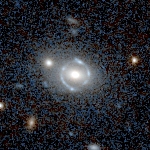
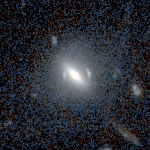
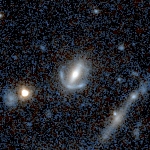
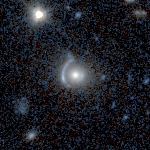
Above are clear examples of strong lenses, recognizable from the large arcs. They are often accompanied by a "counter-image", located on the other side of the lens galaxy, opposite to the main arc.
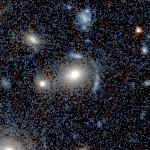
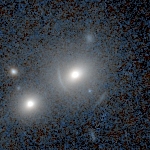
The presence of counter-images can help a lot in determining whether a galaxy is a lens or not: look out for them! Most of the lenses we're looking for, however, are not as obvious to spot as the ones above. And, in some cases, only one arc is visible, with no obvious signs of a counter-image (the counter-image may be there but could be too faint to show up in the data); examples of these are shown below:
Double-Source Plane Lenses
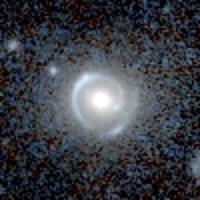
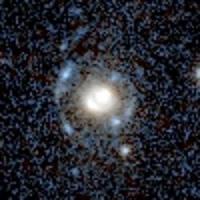
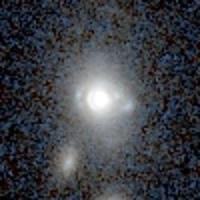
Double-source plane lenses are very rare and exceptional cases of strong lensing where two galaxies are lensed by the same foreground galaxy. They can be identified by having multiple sets of lensed arcs, seen in the examples below (the two examples on the right are from a different survey). These systems are powerful tools to study dark energy, the substance that causes the accelerated expansion of the universe. Unfortunately, these systems are extremely rare, and only a few have been discovered. Given their meaningful value in cosmology, we are always on the look out for these!
Lensed Quasars
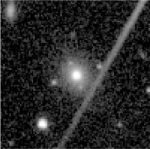
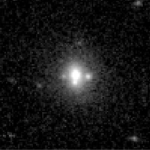
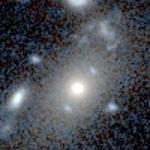
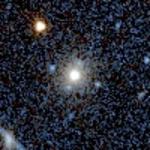
Lensing does not always produce arcs. When the background source is small in size, such as a quasar or a compact galaxy, it can be lensed into multiple circular images. Four-image systems (called quads) are quite common. Two-image systems (called doubles) are even more common, but are not as obvious to identify as a "quad". Examples of lensed quasar candidates from the Euclid telescope are shown below:
Group scale Lenses
Galaxy groups and clusters are systems containing several tens to hundreds of galaxies, gas, and dark matter held together by gravity. They are the most massive systems in the Universe. As such these are the most powerful cosmic telescopes (owing to the magnifying effect due to lensing) and can produce large, spectacular arcs and multiple images.
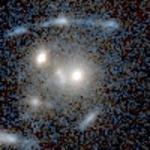
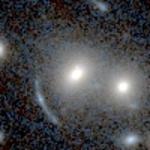
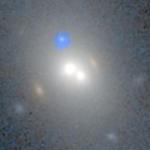
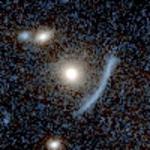
The above examples show "group scale lenses" where the foreground lens comprises a group of galaxies (usually of similar colors). The distance between the multiple image arcs produced by group scale lenses is much larger than those produced by individual galaxies. This is because it is the combined mass of the group that contributes to producing the lensing effect. The number of arcs or the arrangement of arcs around the galaxy groups can also be non-standard or complex.
Go to the Top
Lens Impostors
Lens impostors are astronomical objects that can resemble strong gravitational lensing features but are not gravitational lenses. Below are some typical examples of lens impostors that you can familiarize yourself with to aid your classification.
Disk Galaxies
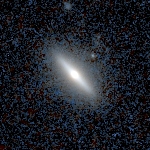
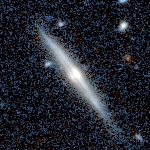
Many galaxies have "bulges" in the centers, surrounded by a disk of gas and (blue-ish) "spiral arms". We call these "disk galaxies". Unlike gravitationally lensed arcs, the arms don't trace a rough circle around the bulge and they are usually accompanied by some fuzzy distribution of light. In these examples, you can see fuzzy arms that either don't trace out a well-defined shape, or a hint of a "bar" that connects the arms to the bulge.
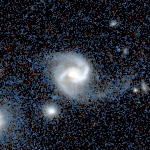
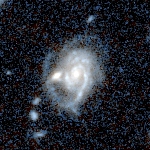
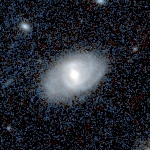
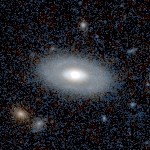
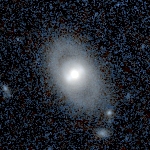
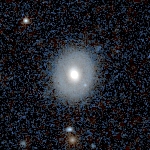
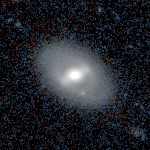
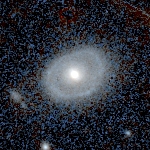
Some galaxies are surrounded by a belt of young stars. When looking at one of these "ring galaxies" face-on, it can be difficult to distinguish it from an Einstein ring of a gravitational lens. Below are examples of ring galaxies with the ring showing a typically fuzzy distribution of light. Because of their random orientation, many ring galaxies appear to be flattened/elliptical with the outer "ring" following an ellipse-like shape, such as the three examples on the left:
Galaxy Mergers
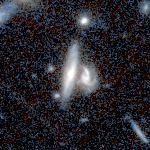
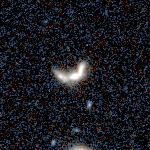
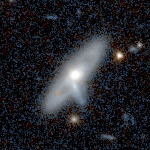
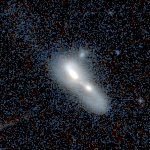
Galaxy mergers are fascinating and dynamic events in the universe where two or more galaxies come together due to the influence of their mutual gravitational attraction. Galaxy mergers typically occur in several stages, including the initial approach, a close encounter, and eventual coalescence. During these stages, the galaxies' shapes and structures can be significantly altered, with some galaxies being so altered that they appear elongated and curved. They can have a range of configurations, but lack the clear arcs and counter-images associated with lensing systems.
Neighbors
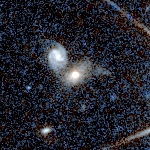
Images taken of the sky are a flattened 2D projection of a 3D universe. This means that physically unrelated and far-away galaxies appear next to each other in the 2D images - this is a chance or random alignment. Sometimes the shapes or patterns of these neighbouring galaxies are such that they can mimic lenses, but there could be clear signs that these are not gravitational lenses. For lenses, remember to look for an arc that is well-defined and curved around a plausible lensing galaxy, and also look for hints of a counter-image. If things look very extended and fuzzy, or curved the wrong way, or too straight, they are most likely not lenses.
Ambiguous cases
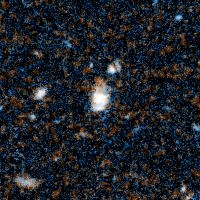
In a lot of cases, it's hard to tell whether a galaxy is a lens or not. In cases like these, we would like you to be inclusive and label them as lenses. Further screening process will decide whether or not to include such systems but at this stage of inspection, it is preferable to include them. A typical ambiguous case is shown below:
Stars
In addition to galaxies, there are also stars from our own galaxy that are visible in our images.
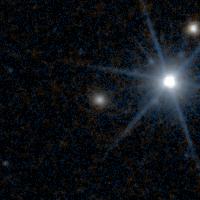
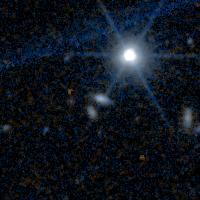
Young stars appear bluish white and older stars appear reddish yellow. Some stars are easier to spot than others. For example, brighter stars cause saturation in the camera pixels and/or show diffraction spikes (these form the white cross-like pattern in the images below). Examples of stars in Euclid images are shown below:
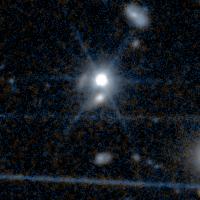
Quasars are also bright point sources, so can be hard to distinguish from stars but quasars are distant enough to be lensed by an intervening galaxy. If you see two or four 'stars' of the same colour on opposite sides of a red/orange galaxy then it might be a lensed quasar.
The mass of an individual star is too small for it to produce multiple images of a distant galaxy. These stars, however, could act as a lens for other distant stars within our own galaxy, if they appear to cross each other from our perspective. This is called Microlensing. You won't be seeing any such microlensing in the SpaceWarps images.
Artifacts
The process of recording astronomical images into the nice maps of the sky you see here can lead to some interesting artifacts in the data that aren't real. In addition, there are real objects in the sky that are moving (either fast or slow) which can leave strange features in the data.
Fast moving objects (such as the example on the left) can be caused by satellites, asteroids or airplanes. As the camera observes the sky for a fixed amount of time per exposure, fast-moving objects leave trails in the data. Other artifacts can be caused by a range of phenomena, including how the image is processed, or very bright objects saturating the image. These can obstruct light from astrophysical sources. In some cases, an artifact may be present in one of the image colour panels but not in another. In these cases, use the unaffected panels to make your classification.


Activity: Build your own lens
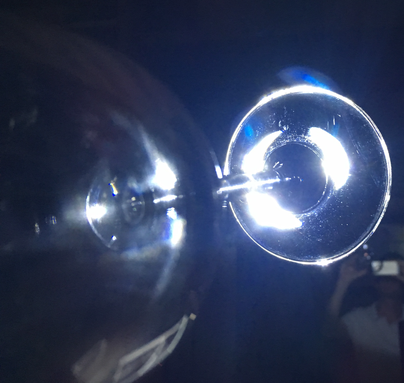
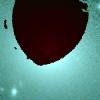
You can create images similar to gravitational lenses using a wine glass. Try looking at a light source, like a small flashlight or a candle, through the base of the glass. Play around with the glass to produce arcs and rings.