



4th Sept 2026: Thank you so much for all your classifications! We have just added some new data to Space Warps Refine and we can’t wait to see what amazing systems you discover! Read about some rare gems you've already identified in DR1 here.
21 Apr 2026: We are back with new previously unseen data from ESA’s Euclid Space Telescope. Together, let’s find more than ten thousand lenses in this exquisite data!!
Research
Gravitational lensing
Needles in a Haystack
About the Survey
ESA Story
A head start on finding lenses from artificial intelligence
Join the Space Warps team
Gravitational Lensing
Einstein's theory of gravity, General Relativity, made a remarkable prediction. Massive objects, such as stars, would bend the space around them such that passing light rays follow curved paths. Evidence for this revolutionary theory was first obtained by Arthur Eddington in 1919, when during a solar eclipse he observed that stars near the edge of the Sun appeared to be slightly out of position (read more here). The Sun was behaving like the lens in a magnifying glass and bending the light from the background stars!
In 1937, Fritz Zwicky realized that massive galaxies (which can contain anywhere from ten million to a hundred trillion stars) or clusters of galaxies could be used to magnify distant galaxies that conventional telescopes couldn't detect. As you can see, not unlike a conventional magnifying glass, these gravitational lenses not only magnify and focus the light of the distant background galaxies but they can, and mostly do, distort them as well.
When one of these gravitational lenses happens to sit right in front of a background galaxy, the magnification factor can be up to x10 or even more, giving us a zoomed-in view of the distant universe, just at that particular point. Lenses can help us investigate young galaxies more than halfway across the universe, as they formed stars and started to take on the familiar shapes we see nearby.
Observations of the distorted background galaxy can also give us useful information about the object that is behaving as a gravitational lens. The separation and distortion of the lensed images can tell astronomers how much mass there is in the object, and how it is arranged. It is one of the few ways we have of mapping out where the dark matter in the universe is, how clumpy it is and how dense it is near the centers of galaxies. Knowing this can provide crucial information about how galaxies evolve.
Go to the Top
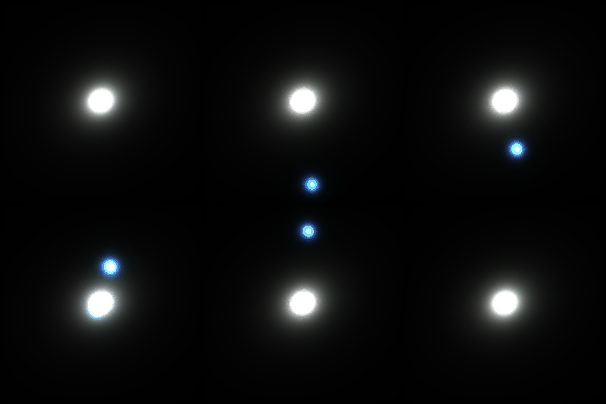
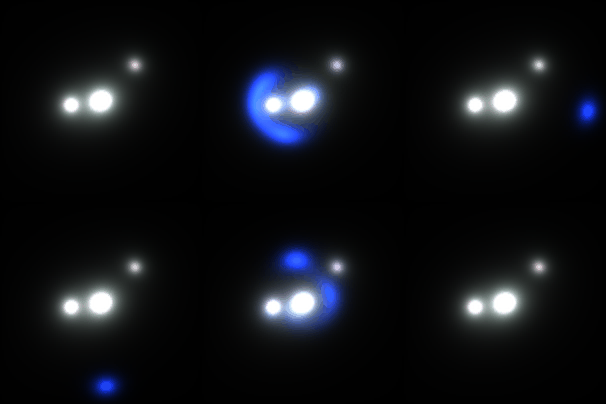
See the following lensing animations showcasing the lensed image configurations that can usually form.
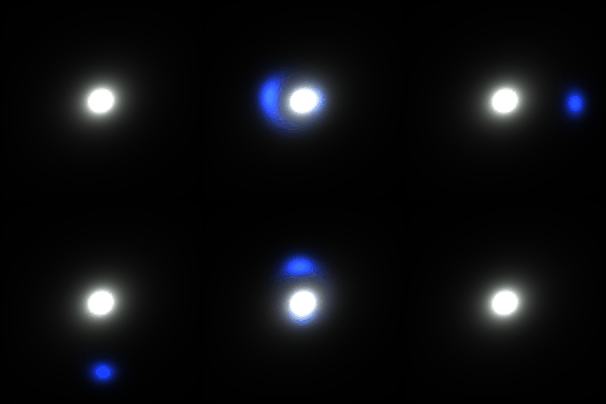
Left: A distant background galaxy moves across a massive elliptical galaxy in the foreground
Center: A distant background quasar moves across a massive elliptical galaxy in the foreground
Right: A distant background galaxy moves across across a galaxy group in the foreground. The configuration of the lensed images can be very different based on how the multiple galaxies are arranged in the galaxy group.
Video credits: Alessandro Sonnenfeld.
The speeds of the background galaxies/quasars are too slow for us to see the changing image configurations in our lifetime. In reality, we only see a single static configuration.
Needles in a Haystack
There is a lot of interesting science to be done with gravitational lenses, from precisely weighing galaxies to measuring the expansion rate of the Universe. The problem is that they are very rare. Only about one in a thousand massive galaxies is aligned with a background object well enough to cause it to appear multiply-imaged. We currently know only a few thousand objects that are behaving as gravitational lenses, largely because we have become very good at observing the night sky! Modern optical surveys cover thousands of square degrees, with images sharp and deep enough to resolve about 1 lens per square degree. There should be thousands of lenses that we can detect, but we will need to look at millions of galaxy images to find them!
The ideal solution would be to get a computer to look through all of the images, but unfortunately, this is not a straightforward solution. Teaching a computer to recognize the effects of gravitational lensing is challenging, as they can be easily confused by galaxies that look very similar to a distorted background galaxy. Here we combine the outputs of such a computer program with the input from citizen scientists to get the best of both worlds: computer speed and human intuition.
Human beings have a remarkable ability to recognize patterns and detect the unusual with only minimal training. With a basic understanding of what the distorted images of galaxies that have passed through a gravitational lens look like, participants in the Space Warps project can help discover new examples of this amazing phenomenon, and enable our survey scientists to carry out new investigations of stars and dark matter in the Universe.
The ESA Euclid Space Telescope
Euclid is a European Space Agency (ESA) space telescope that orbits the sun roughly 1.5 million km beyond the Earth. It has a 1.2m diameter mirror and a 600-megapixel camera. The huge camera allows it to take pictures 3 times the size of the full moon.
The Euclid mission is designed to explore the composition and evolution of the dark Universe. The space telescope will create a great map of the large-scale structure of the Universe across space and time by observing billions of galaxies out to 10 billion light-years, across more than a third of the sky. Euclid will explore how the Universe has expanded and how structure has formed over cosmic history, revealing more about the role of gravity and the nature of dark energy and dark matter.
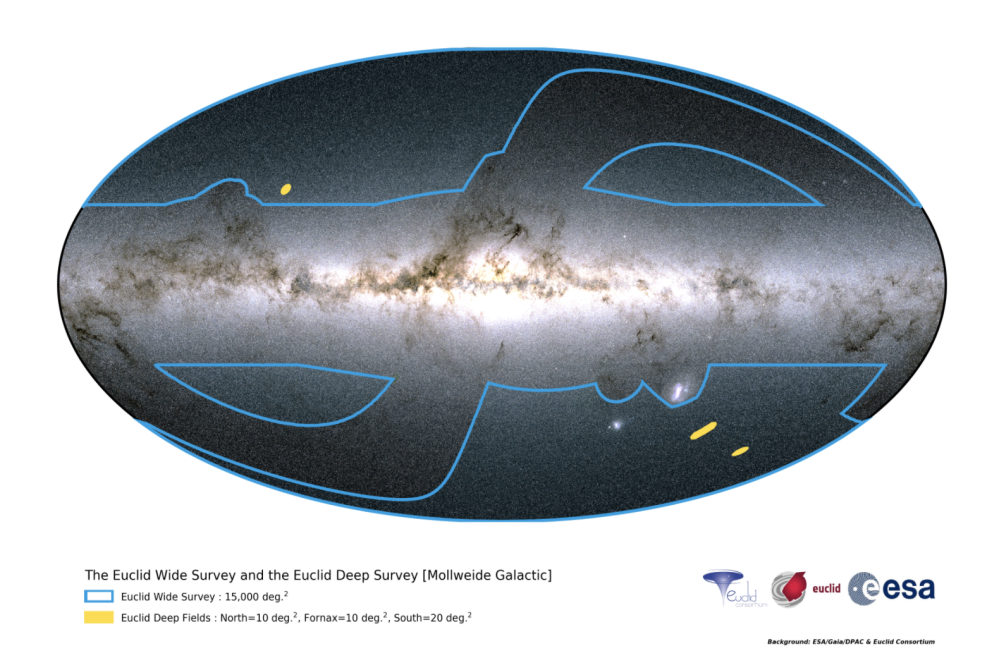
Some of you may have participated in the Euclid Galaxy Zoo project (read about that here) or our initial Space Warps Euclid projects. The initial Space Warps Euclid searches were carried out on small patches of the Euclid survey. ESA and the Euclid Consortium will release the first major release of data (Data Release 1, DR1) this autumn. The area covered by DR1 is about 30 times larger than the initial Space Warps Euclid search. While the DR1 data is not public yet, by participating in this new citizen science project you can get an early glimpse of these brand new images of galaxies captured by the telescope.
You can read more about the Euclid telescope and its exciting science here!
A head start on finding lenses from artificial intelligence
As with our previous experiments, we are combining your and researcher skills in visual inspection with artificial intelligence (AI). You will classify a combination of galaxies chosen randomly from the survey, as well as those being identified as likely candidates from a system of AI/machine learning finders. We've done this because of the impractically of screening all the data in such large datasets. While AI is giving us a head start by filtering out lots of the non-lenses, so you can focus on the more interesting objects. We know from our previous small Euclid experiments how skilled you are at spotting lenses. So by inspecting the random sample, we hope to get an indication of what else is out there that the AI codes may have missed.
Not only will you be able to discover new lenses, but when you mark something as 'not a lens', we'll feed that back into our AI system so it will get a little bit smarter at discriminating confusing objects. We have done this with the results from the first Euclid datasets you helped inspect. This has shown that the AI finders have improved in performance of choosing objects that are likely to be lenses. This way, humans and AI are a powerful combination for discovering strong lens candidtes together!
These fine-tuned AI lens finders were shown a whopping 72 million galaxies from this new batch of Euclid data. We made millions of ESA Euclid DR1 images that are centered on galaxies massive enough to potentially act as a gravitational lens using the ESA Datalabs digital platform. We would be grateful for your help in weeding out the good candidates in the top scoring images (few hundred thousand) from the machine learning classifiers. While the fine-tuned AI lens finders are better at finding very good lens candidates than before, they still rank a lot of non-lenses highly. The task will be to assess whether or not the image we show you really are lenses. This is a tricky mission: nature is very creative, and there are galaxies of all shapes and colours out there, many of which can mimic the features of a genuine gravitational lens. You can learn more about them under Education.We expect to find over ten thousand high-quality lens candidates in this batch of DR1 data, more lenses than have ever been known before!!
Because the dataset is large, we will be initially be splitting the DR1 classifications into two batches; one of roughly 200,000 and the second 100,000 images that we will release later. We will also run the search in two stages, a lens or not ‘Classify’ stage and a closer inspection in the ‘Refine’. Classify is designed for speed so we can remove non-lenses with as few classifications as possible. For the much smaller number of systems that get the highest crowd-scores in the ‘Classify’ stage, we will ask you to grade the likelihood of the lens candidate in the ‘Refine’ stage that will run later into the project. Both stages are needed to combine with researchers to generate the final set of high-probability lens candidates. The challenge is to come up with the most plausible explanation for what is going on, in collaboration with the rest of the Space Warps community. Do you think you can spot outer space being warped? You can read more about these stages in the linked blog posts. We will keep you posted on Talk about the release of batches and the classification stages.
Join the Space Warps team
Space Warps relies on the crowd classification to find (and grade) lens candidates but more importantly remove the hundred of thousands of non-lenses from the AI finder output. Every classification on lens or not is equally valuable. As such whether you see a lens candidate or not is up to the part of the Zooniverse platform that delivers any given galaxy image into your classification stream randomly. Because we need the crowd's view, everyone who carries out a classification on Space Warps ESA Euclid when logged into their Zooniverse account will be listed on the team page with their Zooniverse ID. Depending on the policy of the journal where we publish the highly ranked final candidates from the combination of AI and citizen and researcher Classify and Refine, we will add names of all those who contributed more than 100 classifications to Space Warps ESA Euclid in the appendix of the discovery paper that holds the list of candidates. Some journals will only allow full names rather than Zooniverse IDs. If you didn't already provide a publishable name when you signed into Zooniverse, please provide your name as you would like it to appear in the list via the Space Warps Contribution Certificate form. Anyone filling out the form can also ask for a classification certificate, or you can download your own from your Zooniverse home page. If you have already requested a Space Warps ESA Euclid certificate previously, you don't need to submit again for the DR1 project. Please note the certificate can only be generated when the final list of cleaned candidates is complete - this can take several months after the classification round because we carefully analyse the systems based on your crowd scores. We will keep you posted on our progress on Talk where you can also discuss any lens candidates.
We are so very excited to be embarking on this incredible project with you - happy lens finding!!!