


Finished! Looks like this project is out of data at the moment!
Thank you everyone for participating! We have finished the data, results to come. To browse other active projects that still need your classifications, check out zooniverse.org/projects
Research
Welcome
Welcome to our new Killer Whale Count project, which is a sister project to Steller Watch. Steller Watch has since been completed thanks to volunteers like you, but this tag-along project needs your help!
For more information about Stellar Watch, please check out the Steller Watch Project Page.
Project goal
The objective of this project is to assess the impact of killer whale (Orcinus orca) predation pressure at various Steller sea lion (Eumetopias jubatus) colonies throughout the western range of the Aleutian Islands by identifying and counting killer whales. The entirely western stock of Steller sea lions are listed as endangered and experienced a declines as much as 98% within the last 40 years, therefore understanding potential threats to this endangered species is very important.
Importance
The Steller sea lion population experienced drastic declines, which led to their enlistment as threatened through the Environmental Species Act in 1990. Research led to the differentiation of the population into two stocks, the western and eastern stock. The western stock was relisted as endangered due to population declines as high as 90%. The eastern stock has been recovering, but the western population is still experiencing active declines in some regions. The exact reason why these regions are declining is still unknown, however, there are many possible threats to the population, including killer whale predation.
Our research will allow us to better assess the role that killer whale predation pressure has on the endangered western stock of Steller sea lions.

For more information about the Steller sea lion status, please refer to the Education Section
About this study
Study area
The area of interest is the western Aleutian Islands of Alaska. The following image shows the general locations of the remote cameras that were used in this study, which extends from the most eastern location of Hasgox Point and the most western location of Cape Wrangell.

Remote camera details
There are two types of remote camera data used in this study and images were collected between the years 2016-2019. The first image dataset includes images that were taken to monitor the Steller sea lion population. These images mainly show the colony and land, but can contain opportunistic images of the killer whales, as some water is shown in the images. An example image from this dataset is shown below. This images happens to contain a killer whale, but please note that the images can look very different from this example based on weather conditions, location, and time of day.

The second type of remote cameras are dedicated camera boxes that were placed around the Steller sea lion colonies, but aimed towards the water to increase the chances of "capturing" a killer whale in an image. The image below is an example image from this dataset. In this particular image, there are no killer whales, but there is a seabird (which can sometimes appear to look like a killer whale). Again the images can look different based on weather conditions, time of day, and site/location. *Note: If you get an image and are unsure if it is a killer whale, bird, seal, or something else, it is always better to mark yes the images contains a killer whale, than to mark no. All of the marked images will be further analyzed, so researchers can double check!

Study subjects
There are two main study subjects for this project, the Steller sea lion and the killer whale. We are specifically looking at the interaction between an ecotype of killer whale called the Bigg's or transient killer whale, as they are known to predate on marine mammals, such as the Steller sea lion.
For the purposes of this Zooniverse project, the most important aspect to know is how to identify killer whales in the images. How do we identify killer whales in the images? There are a couple of main features that assist with killer whale identification. Killer whales have prominent black dorsal fins and distinct white eye patches around their eye. They also have a white/grey saddle under their dorsal fin. The following image shows the features of killer whales, including the eye patch, dorsal, and saddle.
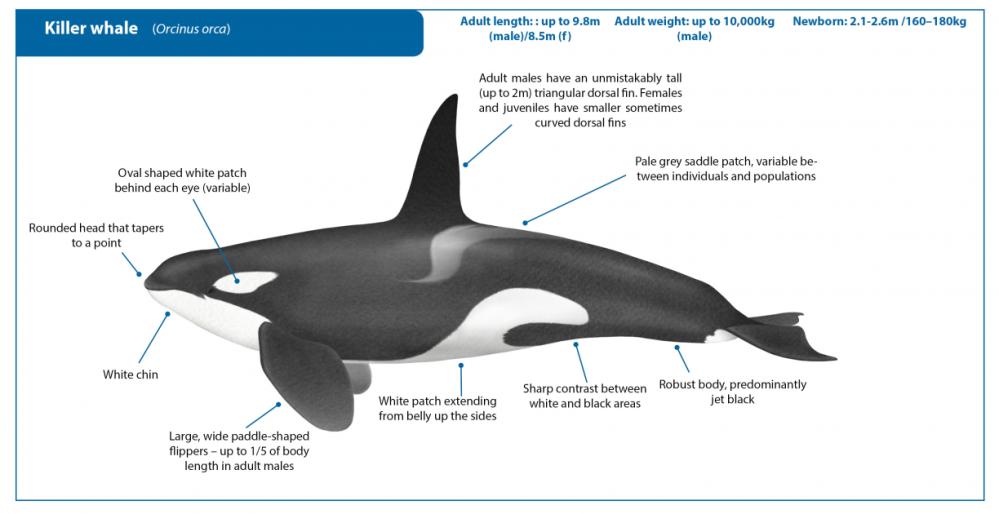
In our datasets, killer whales can appear in the water in any of the images. The most likely feature that one will see is the dorsal fin, which is more prominent in male killer whales. However, sometimes killer whales could be in the images without the dorsal showing (ex, head before the fin appears or during resting or possibly the fluke/tail). It is important to look carefully for any objects in water that seem "different".
The following images are from the dataset provided in this project where killer whales were observed. The first image shows the killer whale (red arrow) and a Steller sea lion (black arrow). In the other images, only the killer whale is highlighted with a red arrow, as our main objective is to pick out the images that contain killer whales.


For more assistance with killer whale identification, please refer to the Tutorial and Killer whale identification Field Guides.
To learn more about our study species and information about the science behind the project can be found in our Education
We need your help
As mentioned before, we have camera boxes set up at various Steller sea lion colonies and across various years, therefore we have lots and lots of photos. We actually have nearly 1 million photos total!
This is where we need your help! In order to better understand what is happening at these colonies, we need to see how often and how many killer whales are at these colonies. Due to the amount of photo data, we need your help in going through the images to pick out the images that contain killer whales. These images will then be processed and analyzed further for more accurate counts and to assess distribution across sites and years.
It is possible that we could use machine learning to do this task, but it would take the time to set up this testing, especially without the expertise. We are also very interested in working on a citizen science project to promote outreach and get others involved in helping an important endangered species.
Your Objective
Your objective is to look through images to identify and count the killer whales, plus some additional useful information. Use the following field guides and tutorials to assist in completing this task.
All graphs, figures, and images are from NOAA, the Steller Watch Project, or examples from our data unless stated otherwise