


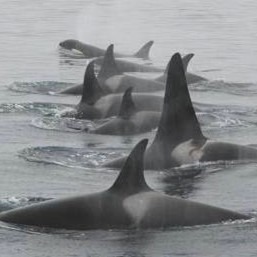
Finished! Looks like this project is out of data at the moment!
Thank you everyone for participating! We have finished the data, results to come. To browse other active projects that still need your classifications, check out zooniverse.org/projects
Education
The species and science
Killer whales
Killer whales, (Orcinus orca), are the largest member of the Delphinidae or dolphin family. They are
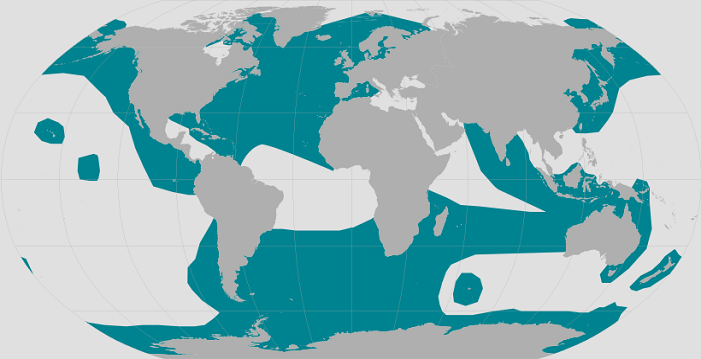
a cosmopolitan species, meaning that they live in all the worlds oceans. The overall distribution of killer whales around the world is shown in the graph below.
Although killer whales are distributed globally, there are distinct populations of killer whales. The distinct populations of killer whales have been placed into sub-groups called ecotypes. These ecotypes are based on variations in characteristics, such as morphological and behavioral differences.
Killer whale ecotypes
In the Northwest Pacific region, the region of this study, there are three ecotypes of killer whales. The three ecotypes are resident, offshore, and transient/Bigg's killer whales.
The following chart shows the morphological differences between the ecotypes. A few key differences are related to the shape of the dorsal fin and pigmentation of the saddle patch. These morphological differences allow for scientists to identity killer whales by ecotype through a process called photo-identification.

Along with physical differences in their appearance, the ecotypes also have different diets or prey preferences. Resident killer whales prefer fish, while transient killer whales have a diet that consists of marine mammals, such as Steller sea lion. There is less information known about the diet of offshore killer whales, but it is suspected they consume primarily cartilaginous fish.
The focal ecotype of this study is the transient killer whales, which are considered an apex or top predator in the North Pacific food web. Transient killer whale predation could be a threat to endangered Steller sea lions, due to top-down ecosystem impacts. Top-down impacts essentially mean that something at the top of the food web, such as killer whale predation, is impacting lower trophic levels in the food web, which is this case would be the Steller sea lions.
Killer whales and the ecosystem
The following is a representation of the North Pacific food web, focused around transient killer whales and Steller sea lions. It is important to note that top-down impacts have been known to occur in the North Pacific ecosystem with transient predation on sea otters.

The types of threats that killer whales could have to Steller sea lions, include both direct and indirect effects. The main threat that this project is assessing is the direct threat of transient predation pressure, as showed in the food web diagram. Another potential impact could be the indirect threat of competition for resources with resident killer whales. The overall concern is what impact killer whales are having to the population of Steller sea lions, so let's take some time to talk about our other focal species.
Steller sea lion
Steller sea lions are a type Pinniped and the biggest species in the Otariidae, or eared seal family. As mentioned in the previous section, they are considered a mesopredator.

The overall distribution of the Steller sea lion population extends from the Northern USA to Japan, as shown in the following figure. The Steller sea lion population was split into an eastern and western distinct population based on differences between the populations, including genetic variation. The boundary between these stocks is shown in the distribution chart by a reference line called a stock boundary and the location of Cape Suckling. As a generalization, Steller sea lions that breed to the west of Cape Suckling are considered part of the western stock and those that breed to the east are considered part of the eastern stock.

Steller sea lion status
Steller sea lions were listed as threatened through the Environmental Species Act (ESA) in 1990 due to drastic population declines. In 1997, the Steller sea lion population was officially split into a western distinct population and an eastern distinct population. Upon this separation, the western distinct population was relisted as endangered due to population declines as high as 80-90%. In 2013, the eastern distinct population was taken off the threatened list after experiencing 30 years of recovery. The western stock continued to experience declines until 2002 and many regions (particularly in the western range of the western stock) are still experiencing declines. Due to the complex situation occurring to the western stock and continued regional declines, the population is still listed as endangered.
The graph below shows the overall population trends of the western stock, highlighting the particular vulnerability of the western portion of the western stock.

The reasons why the western population is still experiencing declines in many regions are not entirely known. There are many potentional threats to the population including disease, contamination, competition for resources, climate change impacts, and predation from killer whales. The objective of this project is to assess the role of killer whale predation as a potential threat.