



Finished! Looks like this project is out of data at the moment!
The Andromeda Project is complete and retired! Please visit our next-generation cluster finding project: the Local Group Cluster Search!
Results
Results from the Andromeda Project
The Andromeda Project ran for two windows of time: 5-21 December 2012 and 22-30 October 2013. Over these 25 days, about 30,000 volunteers (see list of contributors at bottom of Team page) contributed 1.82 million image classifications that lead to the identification of 2753 star clusters. The resulting catalog represents an unprecedented census of star clusters, providing a sample that is currently unmatched in terms of mass completeness and age precision.
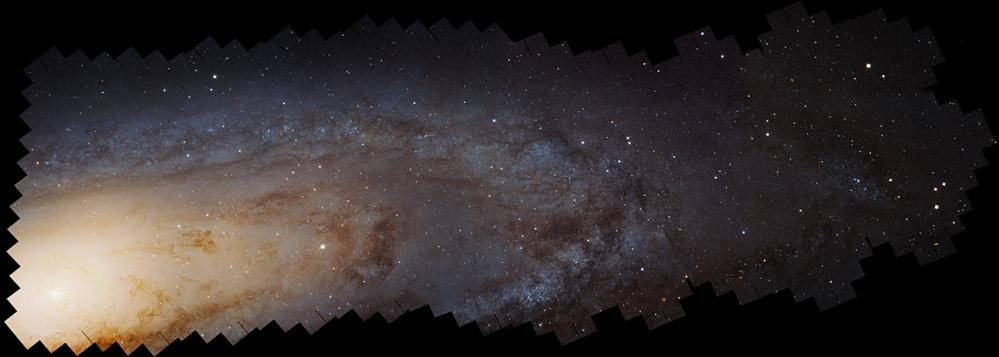
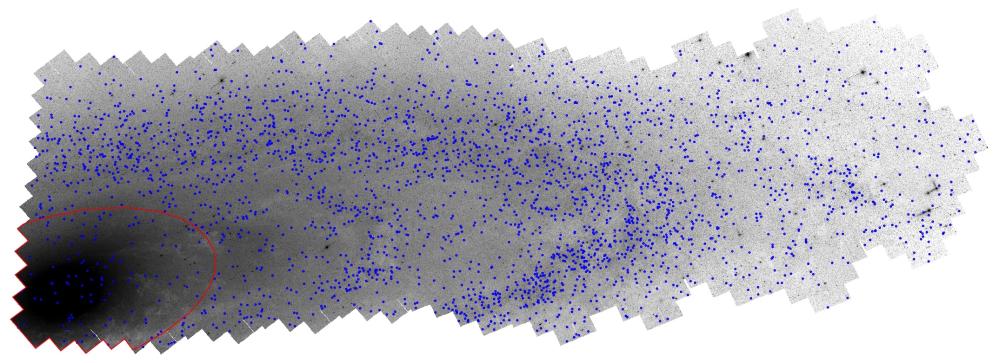
Image Credit: NASA, ESA, J. Dalcanton, B.F. Williams, and L.C. Johnson (University of Washington), the PHAT team, and R. Gendler; Johnson et al. 2015
The star cluster catalog was published in the Astrophysical Journal (Johnson et al. 2015), and this cluster sample enabled important research on a range of topics:
- Star Cluster Formation Efficiency (Johnson et al. 2016): <10% of stars in the Andromeda Galaxy form in long-lived star clusters.
- The Star Cluster Mass Function and Limits on the Formation of Massive Star Clusters (Johnson et al. 2017): The mass distribution of star clusters in the Andromeda Galaxy follows a power-law distribution, where there are many more low-mass clusters compared to high-mass clusters. In addition, the maximum cluster mass among a population of newly-formed star clusters depends on the level of star formation activity in the galaxy, such that the most massive clusters only form in galaxies with high star formation rate surface densities.
- The High-mass Stellar Initial Mass Function (Weisz et al. 2015): The mass distribution of massive stars formed in Andromeda's star clusters is measured systematically and is shown to follow a power-law distribution, consistent with the mass distribution measured for stars in our own Milky Way galaxy.