


Finished! Looks like this project is out of data at the moment!
Research
Reintroducing Wilderness
32% of Germany’s land area is covered with forest, of which over 98% are managed commercial forests. Only about 2% of Germany’s forests are older than 180 years. Human presence in most of Germany’s landscapes has resulted in a loss of wildlife in many places. The most prominent examples are large carnivores such as wolves and bears which were actively hunted to extinction in 19th century; however, there are a number of smaller wildlife species that are sensitive to human disturbance, such as various bat or bird species.
Since the early 1990s, WWF has acquired several conservation areas in the federal state of Brandenburg, with the aim of turning them into natural wilderness areas where plant and animal communities can thrive without human disturbance. The landscapes include forests, swamps and lakes, and contain 200-year-old beech forests.
Rare and/or endangered species that live in these areas include the bat species common noctule (Nyctalus noctula), brown long-eared bat (Plecotus auritus) and the common pipistrelle (Pipistrellus pipistrellus), the red kite (Milvus milvus), the red-backed shrike (Lanius collurio), Savi's warbler (Locustella luscinioides), the common crane (Grus grus), the great bittern (Botaurus stellaris) and the green sandpiper (Tringa ochropus).
The Eurasian otter (Lutra lutra), crested newt (Triturus cristatus), barbastelle (Barbastella barbastellus), greater mouse-eared bat (Myotis myotis), European fire-bellied toad (Bombina bombina) and European pond turtle (Emys orbicularis) are also present.

Project locations North of Berlin
Initial WWF intervention is required in order to fully restore the habitats to a natural state. Some of these areas were in military use by the Russians until the early 1990s and were subsequently used commercially and for leisure. Large areas are still covered with non-native pine and spruce forests, which will gradually be removed and replaced with native tree and shrub vegetation. Rejuvenation of non-native species will also be monitored and, where necessary, prevented by targeted removal. Many roads and forest trails will be closed in order to reduce disturbance. Ultimately, human intervention will be reduced to zero.
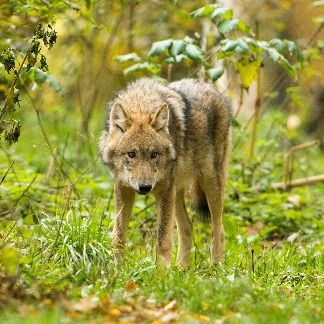
For monitoring conservation progress, camera traps have been installed in Barsdorf and Zerweliner Heide. Species commonly captured by camera traps are usually large animals such as various species of deer, boars or badgers, or smaller common animals such as squirrels or woodpeckers. Occasionally a rare wolf will cross the territory. The camera traps give us valuable information about our conservation progress, about necessary measures to take or the need for adapting our management actions.
Knowing about the presence and population status of wolves is particularly important, as the return of wolves to Germany is a sensitive issue and this predator is not universally welcome. Therefore, it is vital to know where wolves are present, in order to work closely together with local authorities, communities and livestock farmers to foster peaceful coexistence between humans and wolves.