



Finished! Looks like this project is out of data at the moment!
Research
Welcome to the European Camera Trap Project!
We have placed cameras in natural areas across Europe: Norway, Spain, Poland, and Germany. In the future, we hope to add more places. Your work will give us regular updates on wild animals, mainly mammals. With your help, we can follow changes in wildlife and give this information to managers and landowners.
Your classifications will also help us train an AI to recognize animals automatically. Thanks to you, we plan to build a strong wildlife monitoring system. This system will track animal numbers, species diversity, and biodiversity in real time. It will support conservation in these special landscapes.
Why a monitoring system?
Wildlife is facing many challenges. To protect it, we need to know what animals live in each area and how their numbers change. In recent years, new technology has changed how we study wildlife. Camera traps and citizen science make studying wildlife easier and cheaper than before. These tools give us reliable information about biodiversity. By working together, we can build better, faster, and more affordable monitoring programs.

What is camera trapping?
Camera traps are cameras placed in nature that take photos when an animal passes by. They let us study animals without disturbing them.
When we keep cameras in the same place for a long time, we can learn how animal populations change over months or years. This information is important for conservation and quick action when needed. The main challenge is the huge number of photos. That is why your help is so important!
By identifying the animals in the images, you turn them into useful scientific data. This makes it possible for us to analyse trends and understand wildlife better.
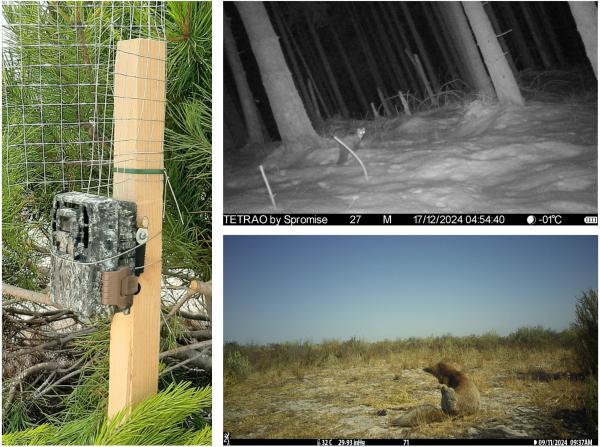
Discover our study areas
Doñana National Park

Doñana National Park is located in southwestern Spain at the mouth of the Guadalquivir River basin. The park presents a mosaic of ecosystems with a biodiversity unique in Europe. Its marshlands stand out as an important habitat for European and African migratory birds during their migration, breeding, and wintering. Internationally recognized, the park is protected under the Natura 2000 Network, Biosphere Reserve, UNESCO World Heritage Site, and Ramsar Area. Among its iconic and endangered species are the Iberian imperial eagle and the Iberian lynx. In addition, the park contains a variety of ecosystems, including beaches, mobile dunes, scrubland, and temporary lagoons.
Tatra National Park

Tatra National Park, in the southernmost part of Poland’s Małopolska province, is an alpine ecosystem in the western Carpathians. It covers about 21,000 hectares, making it one of the country’s largest parks. Renowned for its mountainous landscape, the park features towering peaks, deep valleys, and glacial lakes. Beyond its natural beauty, the park harbours a unique diversity of flora and fauna, including endemic species such as the Tatra chamois, marmot, and alpine plants, alongside non-endemic species like the brown bear, Eurasian lynx, and golden eagle. A popular destination for outdoor enthusiasts (with around 5 million visitors per year), the park offers opportunities for hiking, climbing, and wildlife observation.
Oder River Valley

The Oder Delta is a natural area of great importance, including a transboundary Natura 2000 site on the border between Poland and Germany. This area brings together terrestrial, marine, and freshwater ecosystems, surrounded by forest, rich in biodiversity and with unique ecological characteristics. This habitat is essential for a wide variety of plants and animals, including migratory birds, aquatic mammals, and fish. Thanks to the rewetting of Germany’s wet grasslands and the decline in forestry activities, the Oder Delta has been recolonized by large predators such as the wolf, Eurasian lynx, and white-tailed eagle. In addition, various conservation efforts in the delta have led to increased populations of beavers, otters, and grey seals, among other species.
Indre Østfold, Norway
Indre Østfold region is located in Østfold County, southeastern Norway, along the border with Sweden. The area covers approximately 790km2 of nature reserves and large boreal forests but also of agricultural areas, settlements, and high-traffic volume roads. Forestry and agriculture are the main sources of income in the region, and the sustainable management of wildlife populations and biodiversity in general is of very high importance for politicians, management authorities, as well as locals. The area has a high mammalian biodiversity, with large populations of moose and roe deer, as well as strongly increasing populations of red deer. In addition to a wide variety of other small and medium-sized mammals, there are also populations of wolves and lynx in the area.