


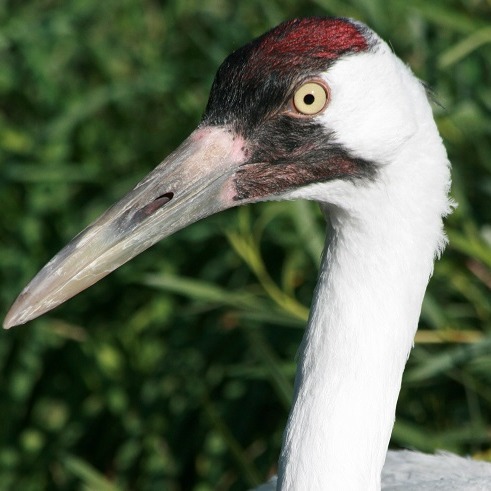
Finished! Looks like this project is out of data at the moment!
Thanks to all your hard work, we are currently out of data.
Results
Progress
Due to the project design, the statistics page is not able to update with the number of images classified and retired. We will update you here every couple of days on the project's progress. These numbers will only reflect the new/unknown images classified, and not the known nests used for your training. These values will be adjusted as we continue to add more imagery to be classified. Thank you!
Jan 6, 2022 @ 12PM (MT)
PROJECT IS NOW ON PAUSE WHILE WE PREPARE FOR THE 2022 NESTING SEASON. THANK YOU FOR ALL YOUR HARD WORK!
2021 Core Nesting Area Habitat Completed! (~72k images)
2020 Core Nesting Area Habitat Completed! (~39k images)
Please continue to check back here for updates on the campaign's progress
Update: Nov 24, 2021
Since our last update in August, the Zooniverse volunteers have finished classifying all of the 2021 imagery of the core Whooping Crane nesting area in Wood Buffalo National Park. In the August update we found that volunteers detected all of the aerial survey nests that were visible in the imagery and also detected four nests that weren’t observed in the aerial survey!
Going forward we will be uploading historical imagery to try to improve our crowdsourcing technique. Currently, 2020 images from the core nesting area are up on the Zooniverse site. We are hoping, similar to the 2021 nesting season, that you will be able to find nests in areas that were not surveyed or find nests that may have been missed during the 2020 aerial survey.
Approximately 75% of this 2020 imagery has been classified already. Once the remaining 25% is complete, we will put the project on hold while we analyse the data and prepare a manuscript for publication. We are hoping by the time the project goes live again in 2022, we will have a more efficient process!
We cannot thank you enough for your hard work over this past year, and look forward to your continued participation in 2022 (but please help us finish up the remaining images still to go!).
Update: Aug 26, 2021
Thank you for participating in our Whooping cranes! campaign. Since our last update in June, the Zooniverse team has classified another 28,536 image chips for a total of 59,038 chips representing about 90% of the habitat in which we expect to find the majority of whooping crane nests. We have completed our assessment of the aerial surveys conducted in late May (for nests and pairs) and early August (for family groups and chicks) and determined that 98 nests and 50 family groups (each with one chick) were detected during aerial surveys. Of the 94 nests observed during the aerial survey that were also visible in satellite imagery, all 94 received at least one Zooniverse vote and 93 of them received at least three votes, meaning that detection rates were very high. Zooniverse participants also detected an additional 4 nests in satellite imagery that weren’t observed during the aerial survey, bringing the total nest count to 102 nests and breaking the record of 98 nests from 2017. So, it has been a banner year for the whooping cranes and for our Zooniverse campaign!
These impressive results show that using crowdsourcing to detect whooping crane nests in satellite imagery could be a viable way to supplement our aerial surveys, possibly even replacing them in the future. We are continuing to look at the data generated by Zooniverse participants, to improve our techniques, and in the coming months will be adding historical imagery to assess these improvements. We are very grateful for your contributions so far, and thank you for your continued efforts!
Update: Preliminary Results, June 25, 2021
Thank you for participating in our whooping crane nest crowdsourcing campaign on Zooniverse! So far our team (that’s you!) has classified 30,502 image chips, representing about 22% of our total study area or 40% of the prime habitat where we expect to find the most nests. Our preliminary assessment shows that Zooniverse detected at least 58 nests that were also counted during the aerial survey that we conducted from May 21-25. In addition, Zooniverse detected (and our field team verified during a second survey) three additional nests and two probable nests that weren’t counted during the aerial survey. Please see below for image chips containing three of those nests and photos we took of them during the second survey.
These preliminary results show that crowdsourcing may be a useful technique to supplement or eventually replace the aerial survey. There are still ~110,500 image chips left to go, about a third of which still includes prime whooping crane nesting habitat, and the remainder are from places where we hope to discover new, previously-unknown nests or nesting areas. So please continue to help us classify images! Even though cranes have already left their nests so we won’t be able to verify any new nests directly, we do plan to visit new, possible nests during our aerial survey in July to look for evidence of nesting and we will also target these areas for surveys next year.
We are very grateful for your contributions so far and thank you for your continued efforts!
Three of the new nests that were detected by you!
The red arrows are pointing towards the nest, and the numbers are highlighting different features, for your reference. Since these aerial checks occurred more a few weeks after the satellite image was taken, the cranes were not necessarily sitting on the nest as consistently when the aerial photos were taken.
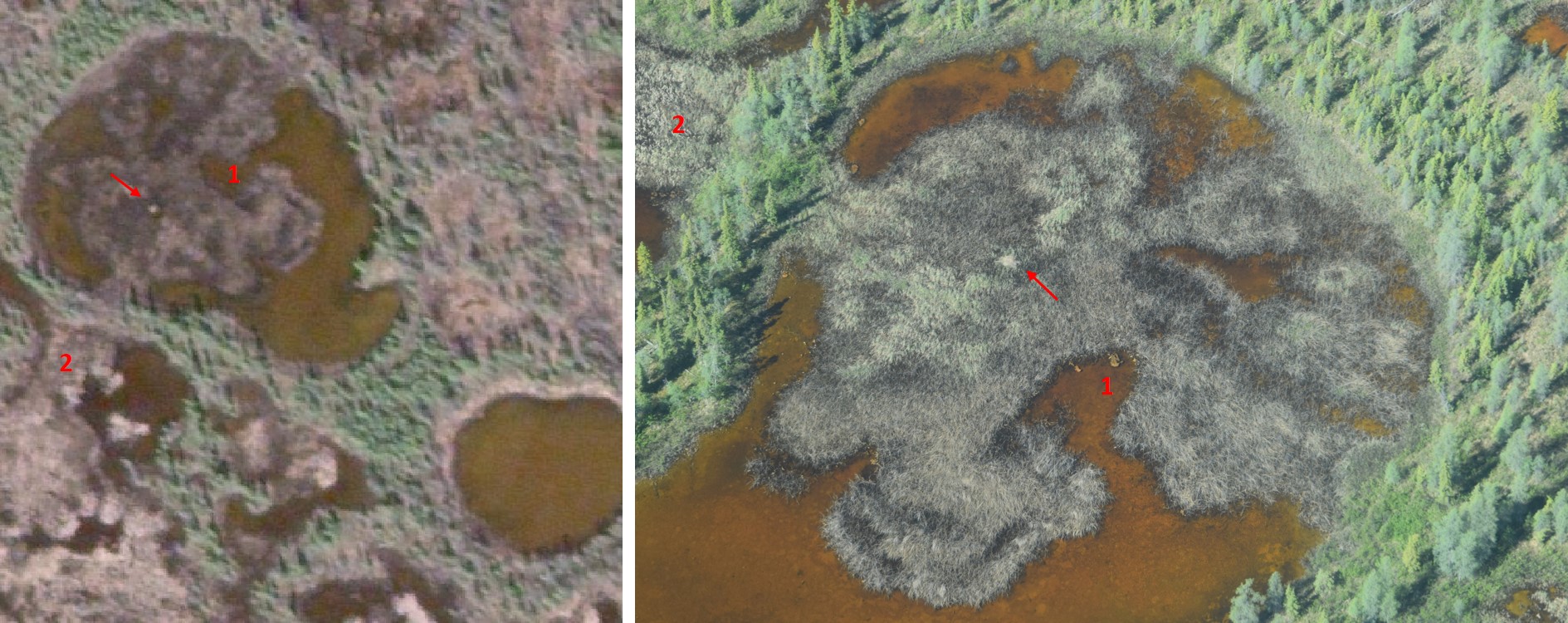
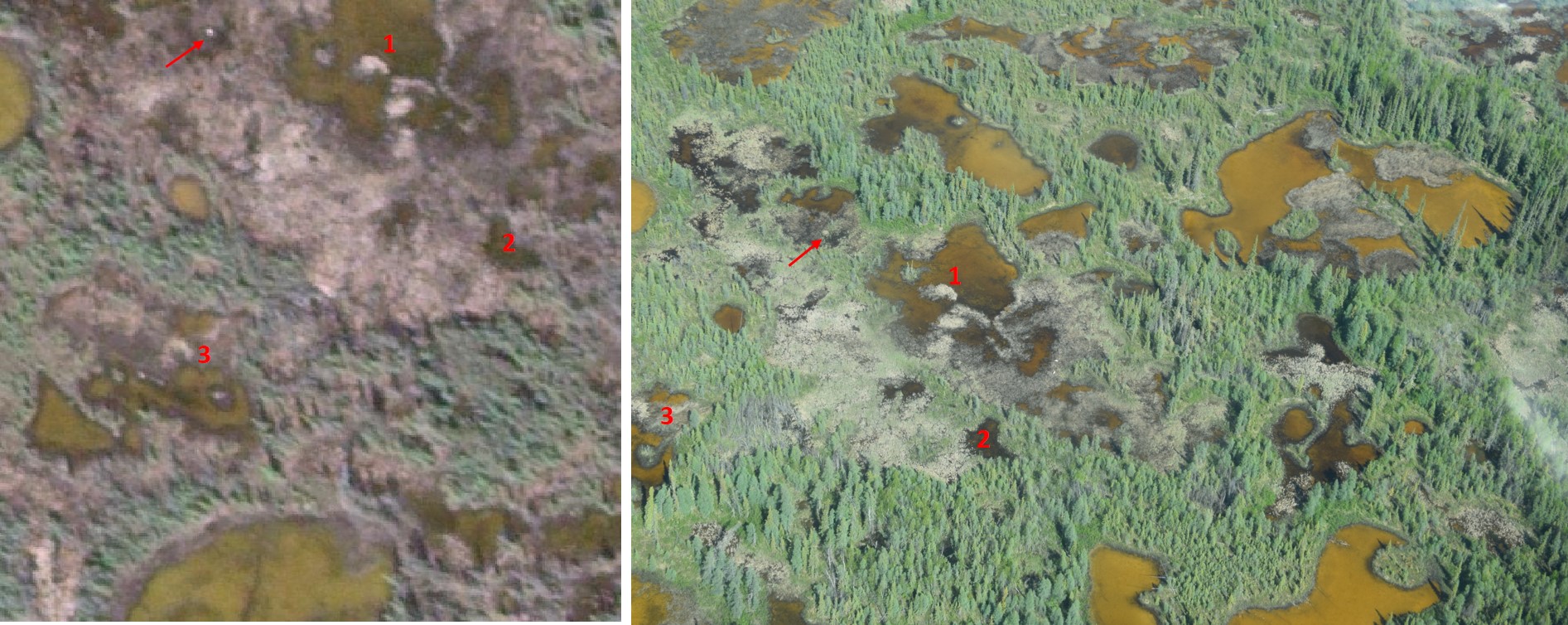
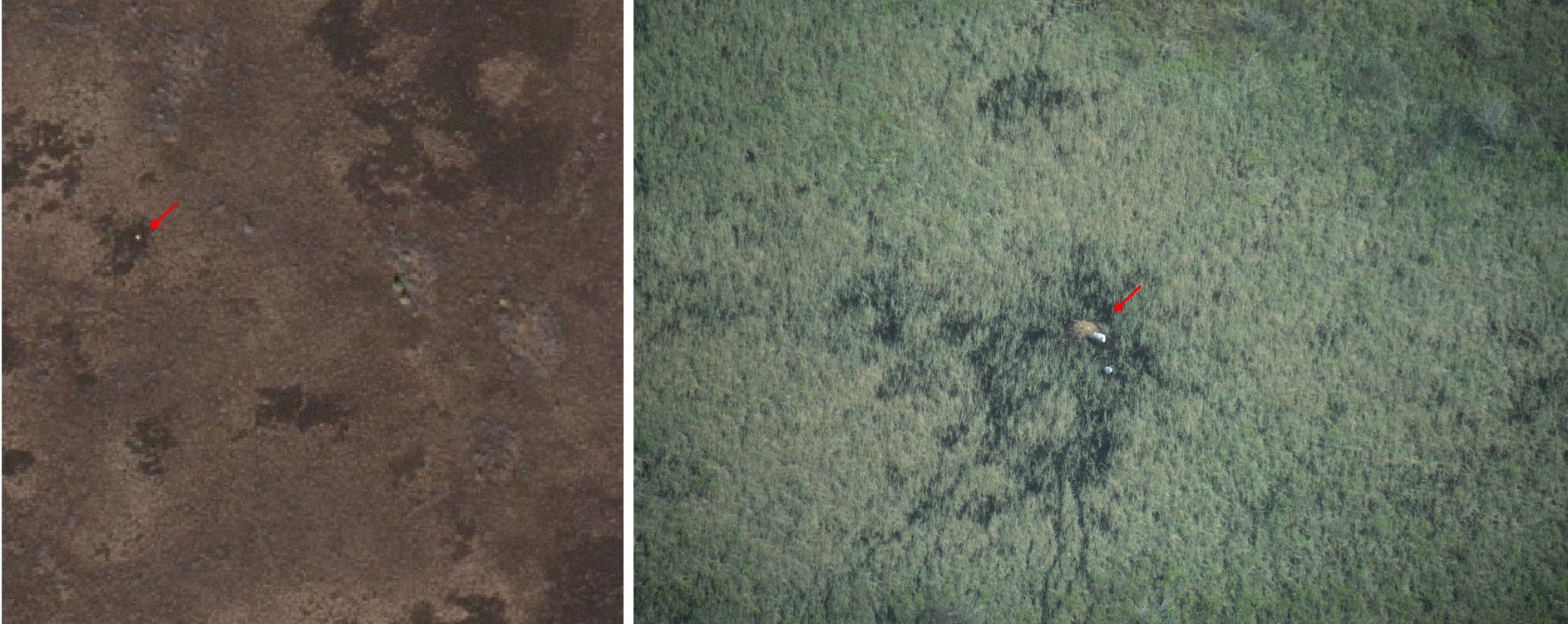

Photo credit: John McKinnon/Wood Buffalo National Park