


Finished! Looks like this project is out of data at the moment!
Thanks to all your hard work, we are currently out of data.
Research
Whooping Crane Conservation Status and Background
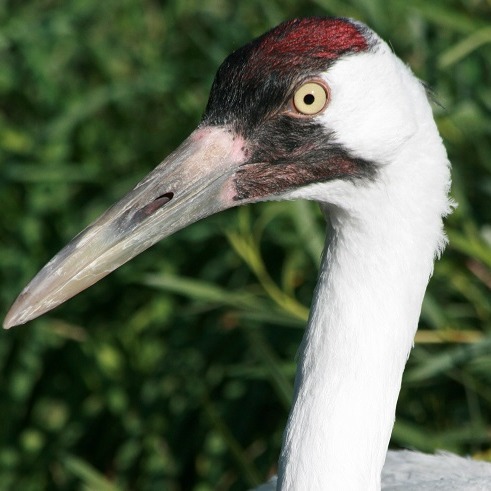
Whooping Cranes (Grus americana) are one of North America’s rarest birds, and are a federally-listed species at risk (Endangered) in Canada and the United States. Formerly widespread across the Canadian Prairies and US Great Plains , the only remaining wild, migratory population is the Aransas-Wood Buffalo population, which breeds in and around Wood Buffalo National Park and winters in and near the Aransas National Wildlife Reserve on the Texas Gulf Coast.
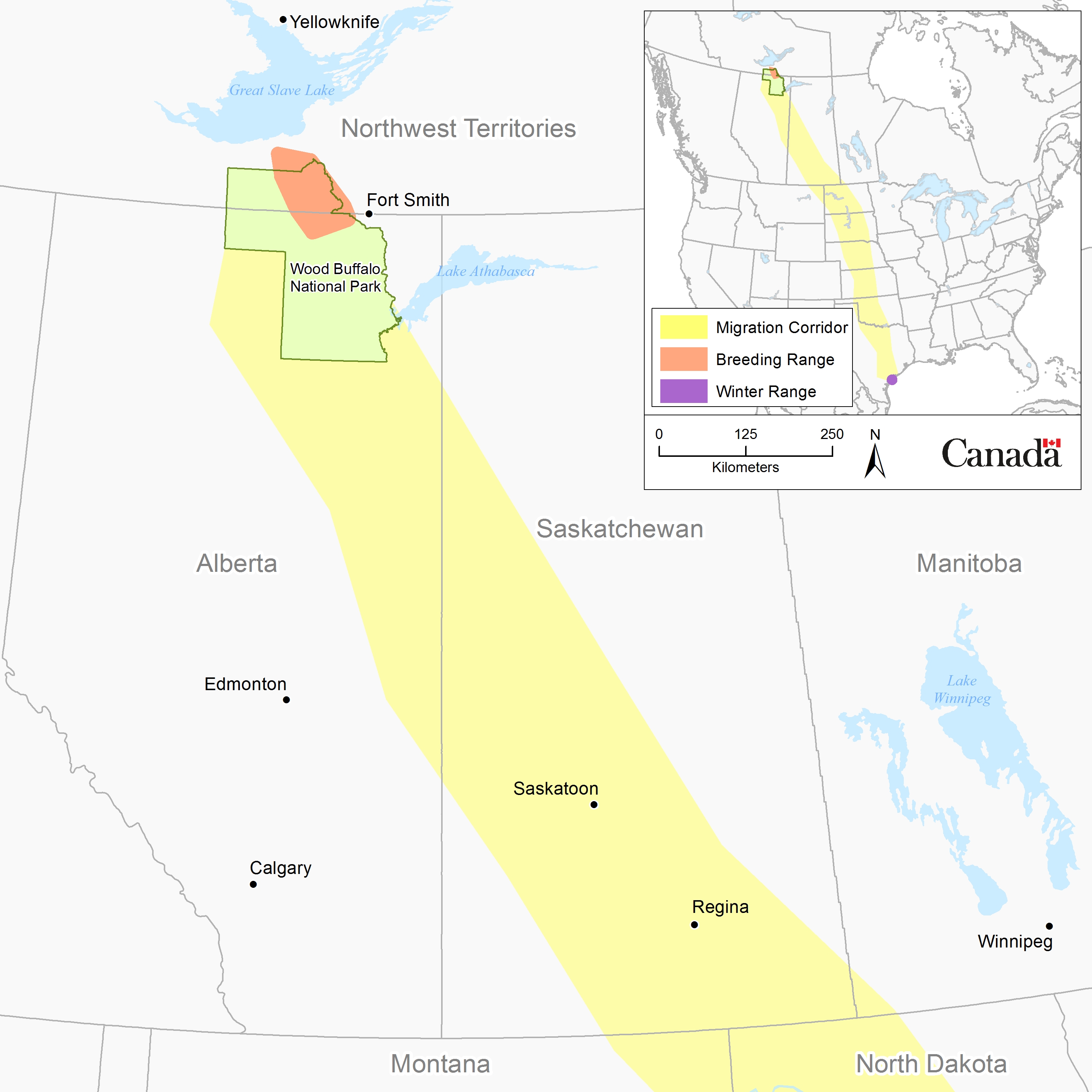
Migration corridor, breeding range and wintering range of the Aransas-Wood Buffalo population of Whooping Cranes. Images for this project were collected in the area indicated in orange
This population suffered major population declines in the early 20th century due to hunting and habitat loss, reaching a low of 14 individuals in the 1940s. Since then, protection of birds and habitat has resulted in the Aransas-Wood Buffalo population growing steadily, with just over 500 individuals in 2021. To learn more about the conservation efforts for the Aransas-Wood Buffalo Whooping Crane population and about Wood Buffalo National Park in general, please see the following videos: Whooping Cranes and Wood Buffalo National Park. And to learn more about Whooping Cranes in general, please visit the International Crane Foundation for their Whooping Crane information sheet and for the latest Whooping Crane news.

Photo credit: Klaus Nigge/Wood Buffalo National Park
Why are we doing this?
Nesting Whooping Cranes have been monitored from small aircraft since the 1960s but we recently discovered they are visible in high resolution satellite imagery. As biologists, we love conducting fieldwork but aerial surveys are costly and involve some risk to personnel, so we are interested to know if some surveys, particularly in new breeding areas, can be replaced by collection and analysis of satellite imagery.

In the early stages of the study, we discovered that we could see Whooping Cranes sitting on nests in imagery with 50 cm resolution. These images of a nesting crane were taken from a helicopter (upper right) and from a satellite (main panel, zoomed into at lower right). Note the bright, white object (Whooping Crane) surrounded by a dark “halo” (trampled emergent vegetation and open water).
Using Satellite Imagery to Detect Wildlife
Monitoring the distribution and abundance of wildlife populations over time is vital to their conservation and management but traditional techniques, such as aerial surveys, can be expensive, biased, logistically challenging and time consuming. As a result, researchers are developing and improving alternative techniques to mitigate some of these challenges. Detection of wildlife in remotely sensed imagery, such as very high resolution satellite imagery, has several advantages over traditional methods, such as being able to cover large, remote and inaccessible areas, collect data more frequently to update population estimates, and minimize disturbance to wildlife. Because Whooping Cranes are large, white birds that nest in open landscapes, it is possible to detect them in satellite imagery. We have developed an algorithm that uses spectral and spatial characteristics for classification of nesting Whooping Cranes, known as object-based image analysis (OBIA), and we plan to use this alongside classification of nesting Whooping Cranes by citizen scientists to detect new breeding areas.

Research Aims
- Detect new Whooping Crane nests in Wood Buffalo National Park and nearby areas by citizen scientists and OBIA.
- Quantify and compare the cost of using citizen scientists to detect nesting Whooping Cranes, compared to OBIA and aerial surveys.

Photo Credit: Klaus Nigge/Wood Buffalo National Park
Study Site
The Aransas-Wood Buffalo population of Whooping Cranes nest and summer in the north-eastern portion of Wood Buffalo National Park, and adjacent areas of the Northwest Territories. Nesting habitat encompasses ponds, marshes and forested ridges in a subhumid mid-boreal ecoclimate.

Photo Credit: Klaus Nigge/Wood Buffalo National Park
Photo credit on main page: Klaus Nigge/Wood Buffalo National Park
Satellite Images Copyright 2009-2021 Maxar Technologies