


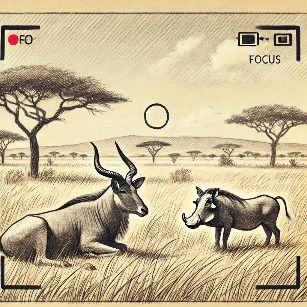
Help us find the animals in the pictures !
Research
Welcome to Chinko Nature Reserve!
 | Northern African lion populations were in decline in the Chinko Conservation Area due to poaching, the presence of armed groups and unmanaged pastoralism, until measures were implemented. To limit interactions between herders and lions, a large wilderness area and several transhumance corridors have been created in and around the park, separating protected areas from grazing zones and night enclosures to protect domestic animals from predators. Farmers were also made aware of the important role lions play in their ecosystems. Thanks to these measures, the Northern african lion population is on the rise at Chinko! |
If you want to read more:
https://lionrecoveryfund.org/project/lion-conservation-in-the-chinko-nature-reserve-and-the-continuous-wilderness-of-eastern-central-african-republic/
https://www.africanparks.org/the-parks/chinko/news
https://www.instagram.com/p/DIOSm9doZiS/?utm_source=ig_web_copy_link&igsh=MzRlODBiNWFlZA==|
Chinko's reserve presentation
The Chinko Nature Reserve covers an area of over 11,000 km2 in the south-eastern part of the Republic of Central Africa. Founded in 2012 by Thierry Aebischer, Raffael Hickisch and Erik Mararv, it has protected several hundred species, some of them highly endangered (three species of African pangolin, African wild dogs, etc.).
Made up of savannah and rainforest, with two rivers running through it, it enables several species evolving in different ecosystems to benefit from government and ranger protection. Indeed, before 2012, the fauna suffered greatly here, as the area was used as a large hunting reserve. Since 2014, the biodiversity conservation NGO African Parks has taken over management of the park.


Left: Aerial view of the Chinko reserve, showing one of the reserve's main rivers running through two forest ecosystems.
Right: Map of the Central African Republic showing the uninhabited wilderness that spans the wide ecotone between the wet Congolian rainforest in the south(>1 600 mm of annual precipitation) and the dry Sahelo-Sudanian savanna in the north (<800 mm). Indicated are all recognized national parks (NP) and faunal reserves (FR), including the Aire de Conservation de Chinko (ACC) with its core zone (status 2017).
The role of camera traps
 | For over 12 years now, camera traps have been set up throughout the Chinko Nature Reserve. As soon as the camera detects movement, it takes a picture. Researchers working in the park then retrieve these images, classify them, and identify the animals present on them. They then send them to Daniel Wegmann's lab in Switzerland so that the researchers can process the data and produce statistics. Camera traps are increasingly used in ecology to detect the presence of animals with minimum disturbance. The new cameras include both a night and a day camera, optimizing image quality (see picture on the left). |
One of the questions currently being asked is what impact poaching is having on certain species, such as the Leopard or the Eastern Giant Eland; in order to measure the density of these species and be able to answer them, the AI needs to be able to indicate with certainty the images containing these animals. To increase the AI's recognition rate and reduce its errors, we need to give it as much information as possible. This is how active learning works: the more we show the AI different points of view of the animals, the more it will be trained to recognize them in any situation.
Your help with this project is invaluable; by helping us to tag the animals in the photos, you're helping us to feed the AI and improve its performance. Once all the images received from the nature park have been determined, we'll be able to use them for statistics and answer our initial question.
If you want to read more about the park or Daniel Wegmann's lab, do not hesitate to follow the links:
https://www.unifr.ch/bio/en/research/bioinformatics/wegmann.html
https://www.africanparks.org/the-parks/chinko