



Finished! Looks like this project is out of data at the moment!
Want to try something else? Check out Experiment! Note: Experiment is external to Zooniverse. See this blog post for details.
Research

Image credit: B. Quint
The goal of this project is to look for new and rare transient phenomena in the night sky using data from the NSF-DOE Vera C. Rubin Observatory. It is an amazing telescope that will transform many areas of astrophysics. One aspect that makes it particularly exciting is that it will revisit the same part of the sky multiple times during its Legacy Survey of Space and Time (LSST). This repeated imaging allows astronomers to find changes in the night sky, which are released to the public in so-called 'alerts'. Identifying whether these changes are real is typically easy for really bright and obvious changes, but it quickly becomes more difficult once these become more subtle. This is especially the case if there is also a lot of background contamination (such as a bright host galaxy). This is where you come in! You can help us by looking at these images, and tell us whether what you see is real, or an artefact. Click on 'Classify' above to get started.
In this project, we will show alerts from the Vera C. Rubin Observatory that are coming from relatively nearby galaxies. We plan to upload new targets on a regular basis as the observatory releases new alerts. This means that what you see has been observed very recently and that you might be the first person to look at it! While we expect the Rubin Observatory to eventually generate millions of alerts each night, it is still warming up and slowly ramping up to that number. Therefore we also currently supplement our sample with data taken while the observatory was testing its systems (called "Data Preview 1"), which was taken between October and December 2024. On top of that, we also show simulated alerts to better understand what kind of alerts are difficult to classify.
As mentioned above, the goal of this project is to find interesting and rare transient phenomena. We are particularly interested in finding variability in stars that are about to explode as supernovae (also known as "Pre-Supernova Variability") and stars that share a common outer envelope and get close to merging (also known as "Common Envelope Events"). Both of these topics are described in more detail below. We will use classifications from this citizen science project to identify many of these rare events. The long-term goal is to release the largest publicly accessible catalogue of these phenomena to date and publish multiple scientific papers. Your classifications will directly help us find these rare and fascinating events! In the short-term, we are also interested in quickly identifying real targets as they are happening, as we have capabilities to follow-up a small number of the most interesting events with other telescopes. This will allow us to collect more data and gain a deeper understanding of what is happening in real time. We are also more broadly interested in all faint variables in the nearby Universe and we will likely stumble on other amazing science along the way. Finally, we want to share that the classifications obtained in this work may be used to train an AI model in the future. We hope that this AI model can take care of most of the targets, while we have humans only inspect the most interesting and difficult scenarios.
Pre-Supernova Variability
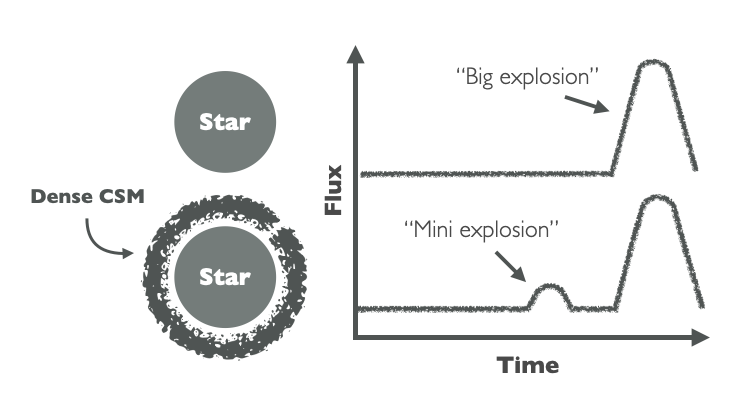
Massive stars end their life in an extremely powerful explosion that is called a supernova. We now know that many supernovae are surrounded by large masses of matter, also known as circumstellar material. However, it remains unclear how that material got there. One possible explanation involves eruptive outbursts from the star that exploded to produce the supernova. This would appear as a "mini-explosion" preceding the main "big explosion" that we see as the supernova, as shown in the image below. This phenomenon is known as pre-supernova variability. This behaviour has been observed in certain types of supernovae, but not others, and the current sample is still relatively small. This is mostly because pre-supernova variability is very hard to reliably find. With the help of the Rubin Observatory and this citizen science project, we aim to discover many more examples of pre-supernova variability. This will allow us to determine how common these events are, gain deeper insight into the final stages of stellar evolution, and assess whether additional mechanisms are needed to explain how all of that circumstellar material got there.
Common Envelope Events
Another cool phenomenon that we hope to identify are common envelope events. Common envelope evolution describes a short-lived phase of binary star systems where a primary, often more massive, star engulfs a nearby companion star. These events are thought to be the most likely mechanism for producing close binary systems, such as those detected via gravitational waves by the Laser Interferometer Gravitational-Wave Observatory (LIGO). Common envelope events often occur when stars become old and start to expand, often up to hundreds of times its original size, as shown in frames A and B of the image below. The companion will then share the envelope of the primary star, shown in shades of orange in frame B, as it continues to orbit, adding energy to the system that can eventually produce a supernova-like explosion as the primary star’s envelope is pushed off, leaving behind a close binary as a result (frame C).
The constraints for the physical properties of these events comes from observations of post-common envelope systems like those in frame C above. This is because CE events can happen rapidly, on the order of only a few months, making them difficult to catch “in-action.” While there have been some notable cases of observing an ongoing CE event, in some cases thanks to observations of the same target across multiple different instruments and in others thanks to efforts such as the Optical Gravitational Lensing Experiment, which looks to find long-term variability in the sky, these are limited in number. However, this is all expected to change with the Rubin dataset, where the sky will be observed each night for a decade, well within the timeframe for a CE event from frames B to C. With this new and rich information, researchers can better understand what is happening during the stage of companion engulfment, without having to rely only on the aftermath. This will fundamentally change the field and improve our efforts in simulations that work to replicate these events. In other words, Rubin marks a new era for CE astrophysics, and your work here will lay the groundwork!
