


Thanks to our incredible volunteers, we have now successfully transcribed over 65,000 four times. That's 1/4 million individual submissions to the project! Thank you so much--we couldn't have done this without you.
Research
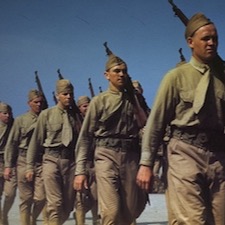
The American Soldier in World War II is a project to make available to scholars and to the public a remarkable collection of written reflections on war and military service by American soldiers who served during the Second World War. In its efforts to mobilize, train, equip, and lead the largest fighting force in the nation's history, the US War Department created an in-house Army Research Branch (ARB) staffed and advised by the country's leading social and behavioral scientists. To help create a more efficient and effective fighting force, the Branch surveyed approximately half a million individuals over the course of the war. Tens of thousands of these men and women not only filled out the Branch's surveys, but they were eager to offer additional advice, praise, and criticism, and to share their personal stories of serving in America's "citizen-soldier" Army. What did these soldiers think about the food they were served or about leave, or about the training they received? How did African Americans from the North feel about their time stationed in the South? What did they and others think about their placement in the Army and about their advancement, or lack thereof?
These are just a few of the myriad issues respondents candidly addressed under the promise of anonymity. The Branch's research team analyzed, summarized, and interpreted the responses of soldiers in the midst of the conflict, in real-time, for the War Department's benefit. After the war was won, the Research Branch's director, Samuel Stouffer, reanalyzed the ARB's data, publishing the results in an authoritative four-volume series of books, known collectively as The American Soldier (1949-50). The ARB's quantitative data sets were transferred from IBM cards to tape, then were eventually converted to computer files. Yet the Branch's one-of-a-kind collection of handwritten responses, the very personal words of tens of thousands of Americans who served the nation, has long remained available only to those who could to travel to the nation's capital to read the text on microfilm.
The American Soldier in World War II will render these rich, untapped sources accessible to the public for the first time. Some 65,600 images of handwritten survey responses have been digitized by the National Archives. The project team is using Zooniverse to transcribe the entire collection. By making these sources text searchable, students, scholars, and the public will quite literally write these tens of thousands of personal expressions of soldiers into the historical record. Phase II of the project will reunite these verbatim free comments with the ARB data sets through an open-access website that will allow the public and researchers to read, mine, and interact with these remarkable sources. The objective of this project is to provide the most complete and comprehensive portrait of the largest army in the nation's history. In addition to its public value, the project will benefit researchers and scholars in history and American studies, the behavioral and social sciences, African American studies, psychiatry, and, among other disciplines, military studies. Among these beneficiaries will be the project director, who is studying social adjustment from wartime to peacetime.
The American Soldier in World War II is a collaborative enterprise, based at Virginia Tech. This Zooniverse project has been made possible in part by the National Endowment for the Humanities: Exploring the human endeavor. This project is also receiving support from the National Archives and Records Administration. Our success, however, depends on you, the Zooniverse community.


