


Thanks to our incredible volunteers, we have now successfully transcribed over 65,000 four times. That's 1/4 million individual submissions to the project! Thank you so much--we couldn't have done this without you.
Thanks to thousands of Zooniverse citizen-archivists, on 7 December 2021, the 80th anniversary of the Pearl Harbor attack, THE AMERICAN SOLDIER IN WORLD WAR II website was launched @ americansoldierww2.org. Our deep gratitude to all who contributed.
Learn moreWe have several workflows from which to choose. We have retained the original titling of the US Army surveys in the workflow titles to reflect the intent of the Army researcher staff. We recognize that certain words, commonly used in the 1940s, would today be considered offensive. Our replication is not an endorsement. The handwritten commentaries are likewise unaltered and uncensored. Consider adding #tags after transcribing to help enhance your already-valuable contributions.
Zooniverse Talk
Chat with the research team and other volunteers!
The American Soldier Statistics
View more statsAll Time Stats
Active Stats
Active stats provide information about currently active workflows and subjects.
Message from the researcher
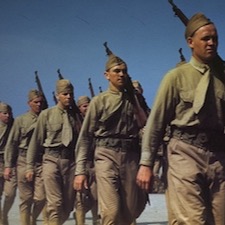
The American Soldier in World War II project is looks to make widely available, for the first time since WWII, a truly unique collection of historical records, 65,000 pages of uncensored commentaries written by U.S. soldiers stationed around the globe.
The American SoldierAbout The American Soldier
The US Army of the Second World War was a "citizen-soldier" force. Only a fraction of the some sixteen million men and women who served had any prior military experience. For some, the transition came easily, for others with difficulty. No two biographies are ever the same. Yet these citizen-soldiers shared similar wartime experiences, whether waking to the same bugle call, chowing down on the same grub, or wearing the same government-issued clothing, day in and out.
Early on, the War Department created an in-house social and behavioral sciences research unit to help citizens make this adjustment. Staffed with leading scholars, the US Army Research Branch was tasked with studying the American Soldier, to help create a more efficient and effective fighting force. During the war, the Branch anonymously canvassed some half a million service personnel. Free from the threat of censorship or censure, these citizen-soldiers not only filled out surveys; they also wrote tens of thousands of pages of commentary that touch upon myriad facets of their wartime experiences. They pleaded, confessed, pontificated, lamented, as well as extolled. They shared their stories of sacrifice, hardship, pride, accomplishment, and adjustment.
The only way the public could read these first-person narratives was to visit the nation's capital—that is, until now. You, the Zooniverse community, are helping to make history, one source at a time.
Update: VE Day 2020 marked the completion of our original goal of having all 44 scanned microfilm reels transcribed and annotated in triplicate within 2 years of our VE Day 2018 launch. (To our citizen archivist volunteers: you did it!) We are now releasing groups of reels with a "retirement" count set at 1. Having additional, in effect quadruplicate, data will improve our final output, we believe, while also providing research data to analyze the optimal retirement count for transcribed text. Mid-summer, we will transition to the next phase of verifying project data that is currently being algorithmically "cleaned."


