Finished! Looks like this project is out of data at the moment!
Thank you for your efforts! We've completed our project! Click here for more details. To browse other active projects that still need your classifications, check out zooniverse.org/projects.
The Team
CITIZEN ASAS-SN TEAM
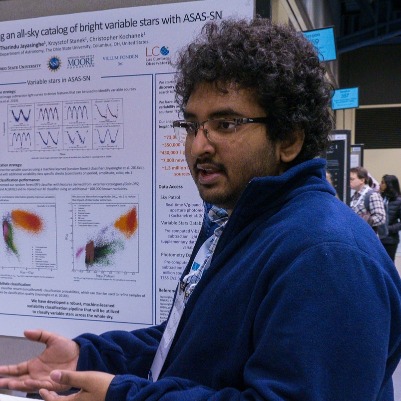
Tharindu is a PhD candidate at the Ohio State University working with the ASAS-SN project to study variable stars in numerous contexts. He also worked as the technical lead for the popular Zooniverse project: The Milky Way Project, whose main goal was to catalog mid-infrared phenomena like bubbles and bow shocks seen through the eyes of the Spitzer space telescope.
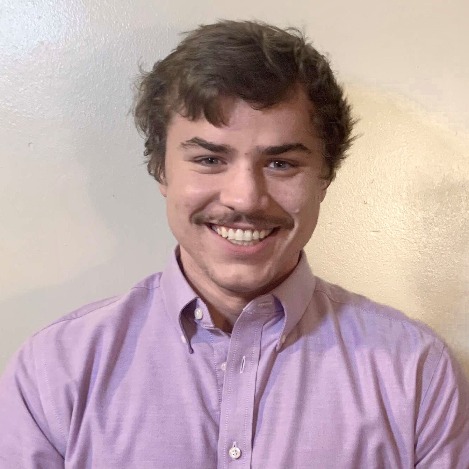
Collin is a PhD student at the University of Arizona as well as a collaborator and researcher for Citizen ASAS-SN. His primary research interests include time-domain astronomy with a focus on stellar variability, tidal disruption events, and supernovae. He was also the first author of Citizen ASAS-SN's research note (published to RNAAS) and Citizen ASAS-SN's Data Release I paper (published to PASP).
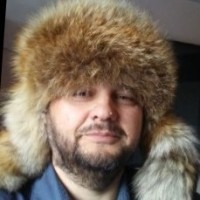
Prof. Stanek is an observational astrophysicist working on massive stars, supernovae, gamma-ray bursts, and the cosmological distance scale. Among his research accomplishments, Prof. Stanek and collaborators showed conclusively that gamma-ray bursts are directly linked to the deaths of massive stars and pioneered the use of red clump stars as a distance indicator in the Galaxy and beyond. An overarching theme of Prof. Stanek’s work is a focus on time-domain astronomy, variability, and transients. With Prof. Kochanek and other collaborators, he is leading the ASAS-SN project to discover supernovae in the local universe using a dedicated all-sky automated survey. Prof. Stanek was named a University Distinguished Scholar in 2018, and he shared the 2020 AAS Beatrice M. Tinsley Prize with Prof. Chris Kochanek for their work on ASAS-SN.
A member of the OSU Astronomy faculty since 2003, Prof. Kochanek has done influential work using gravitational lensing as a tool to constrain the physics of dark energy, the dark matter profiles and substructures of galaxy halos, and the physics of quasar accretion disks. He has worked on a variety of topics including binary neutron star mergers, the mass of the Milky Way, the cosmic distance ladder, and the luminosity functions of galaxies. He is particularly interested in time-domain astronomy, with recent works exploring the variability properties of massive stars and quasars, and the discovery of new types of supernovae. Prof. Kochanek’s recent theoretical work explores the physics of the explosions from most dust-obscured massive stars. In collaboration with Prof. Stanek, he has recently initiated an all-sky search for supernovae in the local universe. In 2020 he was awarded the Dannie Heineman Prize for Astrophysics by the American Astronomical Society and the American Institute of Physics, and shared the AAS Beatrice M. Tinsley Prize with Prof. Kris Stanek for their work on ASAS-SN.
Prof. Prieto is an observational astrophysicist working on stellar transients, massive stars, binary stars and the distance scale.
Zachary Way (OSU)
Zachary is an ASAS-SN analyst working at the Ohio State University on many things related to ASAS-SN.
Institutions supporting ASAS-SN
The Ohio State University is the lead institution for Citizen ASAS-SN, hosted in the Department of Astronomy and the College of Arts and Sciences.
The Center for Cosmology and Astroparticle physics (CCAPP) is an internationally renowned institute at The Ohio State University that connects the Department of Physics and the Department of Astronomy in the studies of dark energy, dark matter, the origins of cosmic structure, and the highest energy particles in the Universe
The Las Cumbres Observatory (LCO) hosts the ASAS-SN telescopes worldwide. We thank Las Cumbres Observatory and its staff for their continued support of ASAS-SN: we truly could not do this without your help.
ASAS-SN is supported by the Gordon and Betty Moore Foundation through grant GBMF5490 to the Ohio State University, and NSF grants AST-1515927 and AST-1908570.
Development of ASAS-SN has been supported by NSF grant AST-0908816, the Mt. Cuba Astronomical Foundation, the Center for Cosmology and AstroParticle Physics at the Ohio State University, the Chinese Academy of Sciences South America Center for Astronomy (CAS-SACA), the Villum Foundation, Peking University, the Kavli Institute for Astronomy and Astrophysics (KIAA)and George Skestos.