



Finished! Looks like this project is out of data at the moment!
Thank you for your efforts! We've completed our project! Click here for more details. To browse other active projects that still need your classifications, check out zooniverse.org/projects.
Classify the light curves of variable stars and help us find the most unusual ones!
Learn moreClassify periodic variable stars!
Zooniverse Talk
Chat with the research team and other volunteers!
Citizen ASAS-SN Statistics
View more statsAll Time Stats
Active Stats
Active stats provide information about currently active workflows and subjects.
Message from the researcher
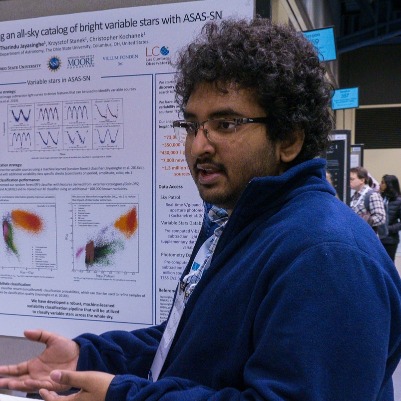
Variable stars consist of a few percent of all the stars and are crucial to our understanding of stellar astrophysics. The unusual variable stars that we hope to identify through Citizen ASAS-SN will likely change our understanding of these rare objects!
tharindujAbout Citizen ASAS-SN
DISCOVER VARIABLE STARS
Variable stars are useful astrophysical tools that have been used to study the evolution of stars, the structure of our Galaxy and they also form a rung in the astrophysical distance ladder to nearby star clusters and galaxies.
The goal of this project is to classify the light curves of variable stars identified in the ASAS-SN g-band data.
By classifying these light curves, you will help scientists better understand the population of variable stars in our Galaxy. Through your efforts, we also hope to identify unusual variables that inform us of the peculiar ways that some stars behave in.
ALL-SKY, ALL THE TIME!
Using 20 robotic telescopes distributed worldwide, The All-Sky Automated Survey for Supernovae (ASAS-SN) automatically surveys the entire visible sky every night down to about 18th magnitude in the g-band.
ASAS-SN measures the brightness of about ~100 million stars over time. Using the light curves of these stars, scientists can study their variability properties.
