


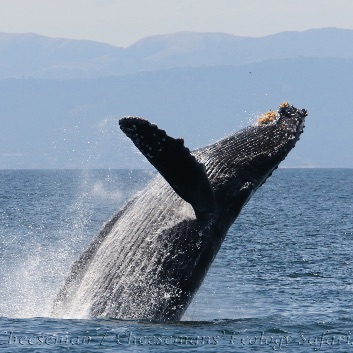
Finished! Looks like this project is out of data at the moment!
FAQ
What is the product of this work?
Our goal is to produce cutting-edge science that helps us better understand the world's great whales. To do so, we need to know individual whales, and we need you to help us 'see' the unique features of each whale. For more of this story, see the SCIENCE page above.
Here's the critical ID features for a Humpback Whale:

What do we want you to do?
We ask you help us find the critical ID features of each whale by drawing boxes around whale tails (flukes) and on those flukes, to mark critical starting points: tail tips and center of the tail's edge, where the tail edge forms a "V".
Here's the features we ask you to identify for us:

We will then apply computer algorithms to identify individual whales among the images you have marked by comparing against a database of known whales. Your contribution helps because, in short, it is much easier to tell a computer to find the pattern within the narrow bounds of a described box and between described points than it is to say, "Computer, we think there is at least one whale in this picture. Find it, figure out it's unique features, and find a known whale that matches it."
What if the whale tail isn't all visible?
We want a box drawn as tightly as possible around each visible tail (fluke) without cutting off any edges or tips. If part of the trailing edge of the fluke is outside the image frame or underwater, draw a magenta box up to the edge of where the tail is visible. For example:

If you see multiple overlapping flukes, draw overlapping boxes, for example:

How do I mark the tail tips if there are no obvious tips?
We want you to select the the highest point at each end of the tail. Even if the full fluke is visible, there may be no obvious tip. In this case please choose the highest point along the tail edge. For example, this Humpback lost the tips of its tail to an Orca attack, but he or she survived!

How do I mark points if the tips or center are not visible?
If the tip of the tail is underwater or outside the picture, select a RED point along the tail edge where the tail disappears. For example:

If the center "V" is underwater, select two MAGENTA points, one on either side, where the tail meets the water. For example:

These whale tails are cool! Can I share these images?
These images come from many contributors, and most are available under a license allowing sharing for scientific purposes only. Please do not share any greyscale (i.e. not in color) images, because these come from an archive with multiple contributors, where it is very difficult to credit each contributor. You may share the uncropped color images for educational, non-commercial purposes, as these are available under a creative commons non-commercial license, so long as you credit "Happywhale.com and its contributors".