


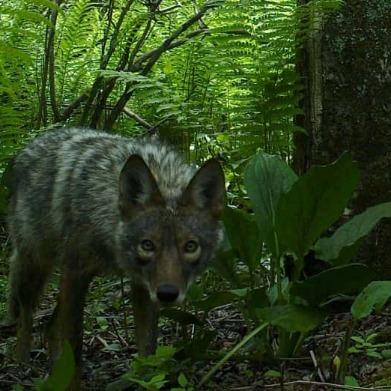
Finished! Looks like this project is out of data at the moment!
Research
About Canid Camera

Young forests are the vibrant and diverse result of natural succession. Full of the energy of youth, they are characterized by dense vegetation including young trees and abundant shrubs. Over 100 species rely on young forests in the northeastern region of the United States. Unfortunately, as a result of human influences these forests are becoming increasingly rare and fragmented, resulting in declines of many animal species. In response to these declines, an unprecedented collaborative effort to create and improve young forest is underway. However, identifying the best methods to create high quality young forest for a diverse array of species has presented challenges to biologists and land managers.
Scientists interested in these challenges and in improving methods for creating and enhancing young forest to benefit wildlife began a camera trapping study in 2014 to monitor wildlife diversity and distributions within the forests of the Hudson Valley, NY. Our team continues to use camera traps to answer these questions to this day. To learn more about recovering young forests visit https://youngforest.org/.
An Opportunity for Young Scientists
In 2017, a team of researchers and exceptional students from the SUNY College of Environmental Science and Forestry recognized the need for identifying and cataloging the data from this effort and helped to create Canid Camera. These students now gain research experience and experience in communicating science to public audiences by helping to maintain Canid Camera, creating and releasing newsletters and materials, monitoring discussion forums, and helping identify wildlife in photos.
The Science
Wildlife Diversity

Where are different species most frequently found within forests? Which forest types have the highest wildlife diversity in New York? Which forest management practices are most beneficial to particular species? These are the kinds of questions we are seeking to answer with the data collected from Canid Camera. We hope results from this study will inform forest management and to improve forest health habitat quality for wildlife.
New England cottontail

The New England cottontail is our only native cottontail in North America east of the Hudson River. Exclusive to dense cover, such as that provided by young forests, the New England cottontail has declined precipitously with declines in young forest and is at risk of disappearing from our planet. Efforts to recover the New England cottontail are underway and are headed by efforts to create young forest. However, we still do not know how factors such as competition with deer for high quality food or common predators like the coyote, a recent arrival to the Northeast, may affect the recovery of New England cottontail. We are using data from Canid Camera to examine how these wildlife species interact, so that we can better manage forests to help the cottontail.
Support
A very large thank you to the American Wildlife Conservation Foundation who provided support for Season 2 of Canid Camera. The American Wildlife Conservation Foundation (AWCF) supports research and public education towards enhancing scientific wildlife management, and conservation of wild habitats in North America.