


Finished! Looks like this project is out of data at the moment!
Thank you for your efforts! This project's classification effort is complete! To browse other active projects that still need your classifications, check out zooniverse.org/projects. Also see news from Deep Sea Explorers here
Research
The Science Behind "Deep Sea Explorers"
The Deep Sea Explorers project takes place in the context of KM3NeT, the KiloMeter Cube Neutrino Telescope.
The purpose of this introduction is to give you all the scientific background you need to fully enjoy the classifications you are going to achieve in this project. Why KiloMeter Cube? And Neutri-what? Reading through the following sections, you will be able to understand what a neutrino is, how they are produced, how we can detect them, why we want to observe them and (the most important!) why we need you!
The first section of this research tab is dedicated to the main aspects of the Deep Sea Explorers project. In the second section, you will find a lot more details! And in the third section, you will learn why and how we need you.
Table of contents
- Deep Sea Explorers: main facts!
- Deep Sea Explorers in more details
- And your contribution in all this? A great help for us!
Deep Sea Explorers: main facts!
- The Deep Sea Explorer project is related to the KM3NeT experiment, a neutrino telescope deployed in the Mediterranean Sea.
- Neutrinos are elementary particles that are extremely difficult to catch. We need huge detectors (at the cubic kilometer scale) to have a better chance of observing them.
- Neutrinos are produced in a lot of different mechanisms, all involving the weak nuclear force.
- Neutrinos have a lot of different origins: nuclear reactors on Earth, the Sun, supernovae and a lot more.
- Neutrinos are invisible to us. To see them, we record Cherenkov radiations.
- The Cherenkov radiation is a kind of shock-wave phenomenon for light, similar to the acoustic shock-wave emitted when an airplane is going faster than the speed of sound.
- The Cherenkov radiation is seen in media denser than vacuum, that is why KM3NeT is deployed in the seawater.
- The Seawater in the vicinity of our detector is full of life: bioluminescence and marine mammals.
- Bioluminescence and marine mammals are noises in our detector: light and acoustic noises respectively.
- Bioluminescence can be mixed with the Cherenkov radiation we want to detect. Marine mammals emit acoustic signals that can interfere with our acoustic triangulation system.
- Bioluminescence and marine mammals are also marine life that can be studied. They have never been systematically studied in the deep sea.
- Your classifications of light and acoustic "noises" from marine life will help us to better tune our detector (for neutrino observations), AND to better understand life in the vicinity of our detector in the deep sea.
- From all the Deep Sea Explorers project team: thanks for taking part in this project!
Deep Sea Explorers in more details
Neutrinos? A very short introduction
The neutrino is one of the most mysterious of the known elementary particles. And we don’t say that because we are neutrino physicists! Among known particles and despite being the second most abundant particle in the Universe, it is the most difficult particle to catch.
Wolfgang Pauli postulated the neutrino in 1930 in order to explain a disconcerting experimental observation, i.e. the apparent non-conservation of energy in beta decays, which are radioactive decays where an atomic nucleus emits a positron or electron. He also postulated that the neutrino would be very difficult to detect! He said:
I have done a terrible thing, I have postulated a particle that cannot be detected.
He was almost right. In 1956, 26 years later, the first direct detection was made: Clyde Cowan et al.. And now, in 2020, almost 70 years later and thanks to a lot of scientific experiments, we know a lot more about neutrinos.
As far as we know, it is an elementary particle: like the electron you may know, it can’t be broken into smaller particles. Moreover, its properties are understood in the context of the Standard Model of particle physics, the theory we use to describe three of the four fundamental forces, as well as to classify the elementary particles.
In the following picture, you have the list of known elementary particles. If you look carefully at the bottom row, you can see that there are three types of neutrinos: electron neutrinos, muon neutrinos, and tau neutrinos. Electron, muon, and tau are in fact a quantum property, which we call flavor.

What is really interesting is that, depending on the flavor, neutrinos behave differently. For example, they are not produced the same way and they interact differently with other particles. In the above picture, you can also see that other elementary particles come with different flavors. But what is really special with neutrinos is that they can change flavor when they are traveling through space, void or matter! The discovery of this very peculiar phenomenon, the so-called neutrino oscillation, was awarded the 2015 Nobel Prize. The experimental confirmation of this oscillation process is pretty new so there are still things we don’t really understand about it. More on this in the following sections!
Let’s finish this section with a fun fact, to illustrate how abundant neutrinos are, and how weakly they interact with matter:
Every second, around 100,000,000,000,000 neutrinos are crossing your body.
Impressive, right? This is indeed a really huge number. In fact, neutrinos interact so weakly with matter that they are all going through your body without doing anything. Even considering this huge number of neutrinos, the probability that one actually hits you during your whole lifetime is very close to zero. But don’t worry, even if one of the most energetic neutrinos interacts with one atom of your body, you wouldn’t feel anything!
If you want to know more:
Neutrino
Beta Decay
Standard Model
Neutrino Oscillation
Where do they come from? A non-exhaustive list of production origins
Neutrinos are produced in different ways, all of which involve the so-called weak (nuclear) force, one of the fundamental interactions in nature that is responsible for the radioactive decay of atoms and other nuclear reactions. One example is the beta decay we have already cited. In fact, as long as there is some matter (so almost everywhere in the Universe!), the production of neutrinos can occur in different scenarii. The aim of this section is to show you the main known ones.
A large number of them were produced around 1 second after the Big Bang, that occurred 13.8 billion years ago. Their energy is so low that it is nearly impossible to detect them with any currently-known detection methods!
Why? Mainly because on average they have an energy 10,000,000,000 smaller than the neutrinos we already have some difficulties to detect. And the lower the energy, the lower the probability to detect them.
It's a shame, because it would be extremely interesting to observe them. Indeed, nowadays, the oldest picture we have of the Universe is what we call the Cosmic Microwave Background, taken around 379,000 years after the Big Bang. Before that, it is impossible to see any light, because the Universe was not transparent, a bit like some kind of frosted glass. So imagine we could observe these neutrinos. As they are traveling almost freely since their production, we would have a picture of the Universe at 1 second just after the Big Bang!
Now, let’s be more down-to-Earth. Neutrinos can of course be produced on Earth, in a huge variety of processes. First, we have natural geological sources. Stating the obvious, Earth is made from matter, and this matter can radioactively decay, thus producing neutrinos. Then, neutrinos are also produced in the atmosphere, in the air just above your head.
In fact, a lot of particles, coming from all over the Universe (we call them Cosmic Rays), are hitting atoms in our atmosphere every second. Secondary particles are created by these interactions, including neutrinos. This is what is illustrated in the following picture, where you can see that the cosmic ray coming from space creates a cascade of secondary particles (neutrinos are the dashed lines).
CMS Knowledge Transfer: Cosmic rays

Still down-to-Earth, we also have artificial sources such as particle accelerators like the LHC on the French-Swiss border, but also nuclear reactors all over the world and nuclear weapons.
Not far from our dear Earth, the Sun is the biggest neutrino factory in the solar system. Why? Basically, because the Sun is like an extremely huge fusion nuclear power plant! Solar neutrinos are emitted in all directions, including toward the Earth. That is why we know they exist, because we are able to detect them.
Farther from our solar system, we know that extremely energetic phenomena, such as core-collapse supernovae and some blazars can produce them. Indeed, direct detection of these has already been done. Neutrinos from the SN 1987A supernova were detected by the Kamiokande II, IMB and Baksan experiments. Moreover, some high-energy neutrinos of the TXS 0506+056 blazar were detected by the IceCube experiment.
In the center, the remnants of the SN 1987A.

And finally, in the rest of the Universe, we suppose that other phenomena such as gamma ray bursts, active galactic nuclei, or dark matter could produce them, but we have yet to confirm this through observation.
If you want to know more:
Weak interaction
Big Bang
Cosmic neutrino background
Cosmic microwave background
Cosmic Ray
Supernova Core collapse
Blazar
Gamma-ray burst
Active galactic nucleus
Dark matter
How can we detect a neutrino? A very interesting physical phenomenon
If we want to see something with our own eyes, this something has to have a surface that emits or reflects light. For example: a star, the Moon, an asteroid, a table, one of your friends, a cat, a virus, etc. The problem with neutrinos is that, like any other elementary particles, they are too small. Even if we had the best microscope ever, we wouldn’t be able to directly see them like an everyday life object.
So, now you may be wondering: "How on earth are you able to detect neutrinos?". And it would be a really good question.
If we can’t see an object, we may be able to see how it interacts with matter around it. If this object moves, it can leave a trace in the medium in which it propagates: this trace, or trajectory, is much easier to observe than the object itself. You can look at the example displayed in the following picture:


The picture shows the world’s first observation of a neutrino in an hydrogen bubble chamber. You can see curved and spiraled lines: these are the trajectories of charged particles (proton, muon, Pi-meson, electrons) interacting with the bubble chamber. In fact, the particles are literally heating the liquid of the detector, leaving bubbles of gas in their wake. The bubbles are what is actually detected. If you look carefully at the same picture, another good remark may come to your mind: "We can’t see the neutrinos trajectory!". Indeed, we can’t see its trajectory in this detector, nor in any other ones. The neutrino is invisible to us. Why? Because the neutrino has no charge.
Ok, so we can’t see either them or their trajectories directly. So, how can we be sure that we are really seeing a neutrino in this picture, and in other neutrino detectors? Because of the confidence we have in the theory that describes interactions (remember the Standard Model?). By carefully observing the products of an interaction with matter, in certain circumstances we can tell you with a really high confidence that yes, these are and can only be neutrinos.
The Standard Model is a really robust theory because many aspects of it have been experimentally confirmed. So, what we just have to do is observe interactions and their products with a very well-tuned detector. Your contribution, as explained in the last section, takes place in the tuning of our detector.
As we have said before, neutrinos interact weakly with matter. So in order to observe more neutrinos, we have to build bigger and bigger detectors, basically at the cubic kilometer scale. This is huge. Really, really huge. The problem with such huge detectors is that it would cost too much, both in materials and money, to be able to record every trajectory of every interesting particle. In order to save materials and money (and time!), the idea is therefore to rely on another probe of the propagation of particles in a medium: the Cherenkov radiation.
The Cherenkov radiation is the consequence of a charged particle going faster than light in a medium denser than vacuum. It is a kind of shock-wave phenomenon for light, similar to the acoustic shock-wave emitted when an airplane is going faster than the speed of sound. It is mainly a blue light, which we can record thanks to very sensitive light detectors. In optimal conditions, this magnificent light can even be seen by eyes, as in the following picture taken in the Advanced Test Reactor:
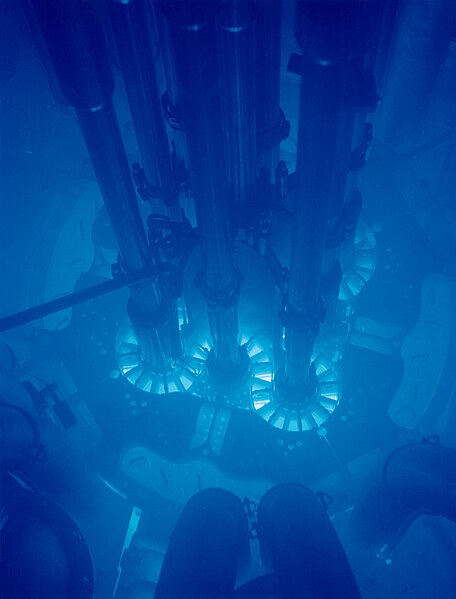

By reconstructing the geometrical and time parameters of the emission of this light, we can deduce the trajectory of the particles that are responsible for this Cherenkov radiation, and finally check if it is coming from a neutrino or not.
In conclusion, one of the methods to detect neutrinos is to record the Cherenkov radiation in a medium denser than vacuum. That is why for KM3NeT we have chosen to put our detector in the seawater of the Mediterranean Sea. This decision is backed up by the scientific and technical successes of a previous neutrino experiment, also deployed in the Mediterranean Sea: ANTARES.
If you want to know more:
Bubble Chamber
Cherenkov Radiation
KM3NeT: A Neutrino Telescope
KM3NeT is a research infrastructure that we are currently deploying in the Mediterranean Sea. It will be composed of two telescopes of different sizes, each of which has a different science goal (more on this in the following section). The first one, called ORCA (Oscillation Research with Cosmic in the Abyss), is deployed off-shore of Toulon in France, 40 km from the coast. The second is called ARCA (Astrophysics Research with Cosmics in the Abyss) and is deployed off-shore of Sicily, in Italy, 90 km from the coast. ORCA will be smaller than ARCA. You can look at the following picture for the size comparison:

One key aspect of KM3NeT is that both ORCA and ARCA are based on the same technology: the Digital Optical Module, or DOM.

As you can see on the picture above, these DOM are composed of smaller golden parts. These are PhotoMultiplier Tubes (PMT), which we use to detect light. Each DOM is composed of 31 PMT. The telescopes consist of a regular 3D array of these DOM, equally spaced along flexible lines anchored on the seabed.
Why on the seabed? Because we use all of the water above as a shield to protect us from other light emissions, such as ones coming from the Sun. As the Cherenkov radiation we want to detect is really weak, it would be really difficult to detect it in the light of the Sun or the Moon. An artist’s impression is available in the following picture:
(Imagine that everything is deployed in the pure darkness of the seabed.)

There are 18 DOM per line. Eventually, ORCA will have 115 lines and ARCA 230. To go a little bit more into the numbers, ORCA will correspond to 8 Mton of instrumented seawater, and ARCA 1 Gton. So really huge detectors indeed.
Still in the same picture, you have also an example of a neutrino event. A neutrino, coming from below, interacts with matter near the telescope. Then a muon is produced and, as it is going faster than light in the seawater, it emits a cone of Cherenkov radiation.
How do we know that a muon is coming from a neutrino interaction, and is not directly produced, for example, in an atmospheric cascade? This is precisely what is illustrated in the picture: we look downward. Why? Because at the energies we are looking at, only neutrinos can cross the Earth! Down-going muons (those coming from above) are indeed mostly by-products of the interaction of a cosmic ray with the atmosphere. It is almost impossible to distinguish them from neutrinos. In the following video, you have several examples of atmospheric muons detected by the 6 lines of ORCA that are currently deployed:
(Time has been slowed down in the video.)
One last question you may have and which we haven’t yet answered, should be: why two detectors of different sizes? In fact, because of the two main different science goals of ARCA and ORCA, we are not looking at the same energy range with each of them: ARCA will focus on higher energies than ORCA. And the higher the energy, the bigger the Cherenkov radiation. So to properly detect higher energy events, we need a bigger detector. What a perfect way to transition to the next section!
If you want to know more:
Photomultiplier tube
What can we learn from neutrinos? A very interesting science case!
One of the main probes in astrophysics and cosmology is light. The sky has been observed by eyes since the dawn of mankind, and for centuries with more complex instruments. On the other hand, we have been observing the sky with neutrinos for only a few decades now. One thing we want to do with KM3NeT is to map the neutrino sky more precisely and, for example, to discover new sources of neutrinos.
To observe one particular source, we can use the same messenger at different energies. For example, observing the Sun in different wavelengths (light), as like what is done by the SOHO probe:

Each wavelength tells us something different about the Sun, because the corresponding light is only produced in certain conditions. Of course, we can go beyond this "single messenger" observation, and use different ones to look at one particular source. With the great imagination that characterises us as astrophysicists, we called it: multi-messenger astronomy.
For a few decades now, we have been able to observe the sky in light and cosmic rays simultaneously. More recently (1987 to be precise), we added neutrinos to the list, with the example of the 1987A supernova. And even more recently (2017!), gravitational waves joined the party, thanks to a neutron-star collision. Basically, the more messengers we add, the more we understand the underlying physics in the source we observe. This allows us to build better theoretical models that describe the astrophysical objects populating the cosmos.
Are neutrinos produced in black hole mergers? In gamma-ray bursts? Active galactic nuclei? What is the neutrino energy range and number emitted by a core-collapse supernova? Thanks to your contributions, we will try to answer these questions, along with many more, allowing us to better understand how our Universe works.
The vast majority of these astrophysical observations are and will be done in what we call the high energy range, that is to say above the TeV (1012 eV, eV = Electronvolt). ARCA was specifically designed for this. On the other hand, ORCA will take care of lower energies, around the GeV (109 eV). This region of the energy spectrum is of great interest, in order to help us learn more about the neutrinos themselves, in particular by looking at the parameters of the neutrino oscillation phenomenon we have mentioned above.
For example, one open problem concerns their mass. You remember that there are three flavors of neutrinos (electron, muon and tau), right ? In fact, our most recent theoretical model tells us (hold on, we are going even more quantum here!) that "these three flavors are mixed together in different proportions into three mass states". This is what is illustrated in the following picture:

We have three mass states (1,2,3) made of the three flavors (red, green, blue). But to be honest, we don’t know (yet!) how exactly these three mass states are ordered. Is mass state 3 above (heavier) or below (lighter) mass state 1 and 2? This problem is called the neutrino mass hierarchy, or neutrino mass ordering, and thanks to ORCA (and you!) we are going to solve it.
If you want to know more:
Electrovolt
Neutrino Mass Hiearchy
And your contribution in all this? A great help for us!
You may wonder: "And me in all this? How can my contribution help you in detecting neutrinos?". The answer is pretty simple: our detector is not (and can’t be!) perfect. Because of the material we rely on to build it, but also because of the medium it is deployed in. For KM3NeT, this medium is the seawater, where we can detect life in different forms. As neutrino scientists, marine life has two sides from our point of view. Let’s begin with the bad one.
Life can produce light. We call this light bioluminescence, and it is noise for us because it can be mixed with the Cherenkov radiation we want to detect. Of course, noise is bad so we want to get rid of it. The best we can do is to try to understand the patterns of these emissions so that we can de-correlate it from signals of interest. We could give this task to a computer, right? But in fact, human eyes and ears are still better than computers at noticing subtleties in the data. So basically, by classifying bioluminescence signals, you will be helping our computers to do a better job!
The good side of life in the vicinity of our detectors is that… it is life! What is really interesting for us is that we can also do sea science with a neutrino telescope. By doing your classifications, you are participating in a completely new study: the systematic analysis of life-related light signals in the deep sea. How many occurrences of bioluminescence do we have in a day? During a month? The whole year? What is its intensity? Does it depend on the depth? Temperature? These and more are all interesting things we want to discover and, thanks to you, we will!
Finally, there is something we haven’t talked about: acoustic data. Unfortunately, due to currents, the seawater is moving, and so is our detector. To properly reconstruct the Cherenkov radiation, we need to know, with the best precision possible, the position of all of the DOM of our detectors. To check these positions, we have designed an acoustic triangulation system with emitters and receivers. What is really interesting is that, thanks to the acoustic receivers, we can detect the acoustic signals of marine mammals! Like bioluminescence, acoustic signals from mammals can be a noise in our detector. Thanks to your classifications, we are going to better understand the specificities of this background and, in the end, our detector will be better tuned! Moreover, these acoustic classifications will help us study and characterise the diversity of marine mammals in the vicinity of our detector, mainly by improving (in range and in efficiency) species identification models.
If you want to know more about bioluminescence and bioaccoutics and their challenges as fields of research, you can find more information in the two following sections.
Bioluminescence : bursts of light in the darkness of the oceans
This section is largely adapted from The Dark Ocean is Full of Lights page of the Frontier for Young Minds website, written by S. Martini and W. R. Francis.
Below a few hundred meters, everything is pitch black underwater. So to communicate, to hunt, to eat or even to defend themselves, a lot a marine species developed the ability to produce light. The emission of light by living organisms is called bioluminescence. Unlike phosphorescence and fluorescence, this phenomenon does not need an external source of light. Thanks to a chemical reaction between a molecule called luciferin, the luciferase enzyme and some oxygen, living organisms can produce light by themselves. On the picture below, you can find some illustrations of different ecological roles of bioluminescence:

On land, we can find a few bioluminescent species: fireflies, for example. But in the ocean, it is almost the norm: you can find it everywhere. In fact, recent analysis estimates that 76% of the species living in open waters (so-called pelagic species) are bioluminescent.
What is interesting is that, if you look at the species living on or near the seafloor (so-called benthic species), only around 30 to 40% are bioluminescent. This important difference may come from the fact that on the seafloor, you have many obstacles, such as rocks or even rugged topographies, that you don’t have in open water. Bioluminescence is hence not as efficient as it is in open water, which would be why in proportion less benthic species developed the ability to emit light than pelagic species.
Bioluminescent species, with a size ranging from less than one centimetre up to around one metre, are found in many forms: fish, squid, jellyfish, coral, worms, sea stars, crustaceans, or pyrosomes. Some bacteria also emit light, and you can find them everywhere, even in some rare cases of symbiotic relationship with another species.
Most of the bioluminescence emitted by marine species looks blue or green. Researchers think that this is most probably because blue and green wavelengths are the ones traveling the furthest underwater. Green emitters are mainly found in shallow waters, blue emitters in open water. But purple, yellow and red light emitters are also found in some rare cases. These light emissions are usually very short, ranging from sometimes below 1 second up to around 10 seconds, and, depending on the species it can take many forms, such as circular patterns, clouds or short flashes. Bacteria emit continuously.
Even if this bioluminescence phenomenon has been known for centuries, researchers are still far from understanding everything about it. What are the ecological roles of this light emission and how does it impact marine communities? Do we know all of the patterns marine species can produce? How many luminous species are still unknown? How are certain species able to produce light? Thanks to your contribution in the Deep Sea Explorers project, we will be able to perform some very new and extensive studies to try to answer some of these questions.
If you want to know more:
The Dark Ocean is Full of Lights, and references within
Bioacoustics: studying the biodiversity with sound
100% of the cetaceans use sound waves in almost all aspects of their lives: to communicate between members of the same species, to locate themselves in their environment, to hunt and to locate prey, and even to repel predators.
What is very interesting is that each species has its own signatures in terms of frequencies and wave forms. What is even more interesting is that for the same species, if we have precise enough devices, we can get information about the sex, the size, and the age of each particular individuals.
Below are pictures of individuals from two main cetacean species found in the Mediterranean sea, with first the sperm whales and then the Pilot Whale


Below, you can find an example of a click (millisecond range sound wave) from a sperm whale:

Bioacoustics is a cross-disciplinary field of science, in which sounds emitted by living organisms are studied. In our case, it is a non-invasive and passive method to study marine diversity: we just put microphones (so-called hydrophones!) in sea water. This means that we don’t disturb the behavior of the animals we want to study. We just record what is in the vicinity of our detectors.
One of the advantages is that we don’t have to be near the specimen to study it. Sound waves can travel over hundreds of metres, even a few kilometres. Over these distances, it is impossible to take pictures and videos because, in the open waters, below 100m where the cetaceans usually live, it is pitch black. The drawback is that we are never 100% sure which species we are recording. Thanks to precise models and to our understanding of the phenomenon, we usually have a very high level of confidence, but in some cases, for example a faint signal coming from very far away, we are not sure. This is why improving our identification models is important, because it will allow us to have more precise identification in more cases.
Thanks to bioacoustics, we can study the populations of different species, count individuals, track their movements throughout the year, and have a better understanding of their life, including hunting, reproduction and migration. We can even discover new species (even though this may be unlikely because cetaceans are big and usually don’t go around unnoticed!). We can also improve the real time localisation of cetaceans in order to avoid deadly collisions between them and boats. Some of the cetacean species are endangered, and this would be a way to help contribute to the prevention of extinctions.
Finally, as cetaceans rely on sound for many aspects of their life, noises, particularly anthropomorphic noises (the ones made by humans), can severely impact them. These include, for example, noises coming from: boats, military sonars, wind farms, seismic studies and drilling of the seabed for oil, and many more. These noises can be the source of a lot of stress in cetaceans, triggering sometimes unusual behavior for them that can lead to death, through stranding. Sometimes, for really stressful events, they can even miss decompression stages, while going to the surface in order to avoid danger. This leads to deadly embolisms, which are really unusual for cetaceans. Of all of the species on earth, they are certainly the ones that have mastered the art of diving.
These noises can also impact them less directly, but still very badly. Indeed, noises reduce the size of, and contribute to the fragmentation of, their communication network. The genetic mixing can be reduced and the species weakened, endangering it even more. Bioacoustics can help a lot in these matters, by identifying the sources of stress, their impact on marine life and by trying to find alternatives. Thanks to bioacoustics, we can make the oceans a better place again for cetaceans.
Thanks for reading! And most of all, thanks for your involvement in the Deep Sea Explorers Project!