


Finished! Looks like this project is out of data at the moment!
Ahoy The Living Sailors Volunteers! Our Case Study of The Living Sailor Project is now online, read the paper here 🪼⛵🐦🥤 Thank-you all for studying the strange and beautiful jellies on the sea surface with us!! See the results
FAQ
The Living Sailor Frequently Asked Questions
We encourage you to bring any and all questions to not answered here -- or new ones that emerge from reading this FAQ -- to the Talk section of our project.
Guidance Relating to Classification
See the Field Guide (the tab on the right of your screen) for information relating to classifying subjects
General Living Sailor Biology Questions
What is a living sailor?
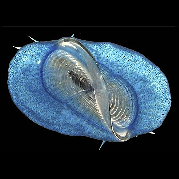
Living sailors, also known by their genus and species names, Velella velella, are a member of the Phylum: Cnidaria. More specifically, they are a hydrozoan in the Porpitidae family. Living sailors are a key member of the neustonic community, a large group of animals that live right at the sea surface, drifting with the ocean current, wind, and waves. The sea surface is an extreme environment and it is the first ocean zone to receive human impacts, e.g., plastic pollution, ocean acidification, a warming climate.
How do living sailors survive the extremes at the sea surface?
Living sailors have a variety of tools in their toolkit to avoid being eaten and surviving in the brightly lit, harsh sea surface environment. They are blue-pigmented providing both protection from damaging ultra-violet radiation from the sun, and for camouflage to avoid visual detection from predators, such as sea birds and turtles.
How do living sailors avoid drifting onto shore?
That is the question that is motivating this research! We are fascinated by the global ocean dynamics that may be guiding these living sailors into different ocean basins, and what features help determine where and when living sailors aggregate and mass-strand.
What do living sailors eat?
Living sailors are carnivores, they dangle many dangerous (if you are a little zooplankton, at least) tentacles underwater to capture prey. While they are carnivores, they are also predators of opportunity, consuming all sorts of drifting food morsels as they are incapable of navigating on their own. They sit, drift, and wait for the prey to get ensnared in their tentacles. Additionally, living sailors quite cleverly have endosymbionts, also known as zooxanthellae, that hide in the comparatively safe, brightly lit living sailor tissues, and share in the bounty of their photosynthesis.
What eats living sailors?
The sea surface poses many challenges to living sailors. Predators lurk both above and below the waterline and can include a variety of seabirds, turtles, and fishes.
How do living sailors reproduce?
Living sailors reproduce by a method known as alteration of generations, whereby they have two distinct phases of their life cycle. The sailors as we know them are actually a colony comprised of many polyps (or individuals) each with their own specialty, and with each individual sharing resources with the rest of the colony. The other main phase of their lifecycle includes a small, free-living medusa form that buds off asexually from the sailor eventually reaching sexual maturity forming eggs or sperm.
What causes left vs. right handedness?
The complete lifecycle of living sailors is understudied, we are not certain whether right handed living sailors only reproduce righty's or if it is a mix of righty's or lefty's and vice versa. More efforts to culture living sailors and track their reproduction is needed.
Do living sailors sting humans?
In most cases, the stinging tentacles in living sailors are benign to humans. Though some irritation may occur, depending on the person.