


Research

The importance of clouds
Looking at a satellite image of our planet, the first thing that strikes the eye are clouds. Almost 70% of the Earth is covered by clouds at any time. But clouds are not simply clouds. They come in a wide variety of shapes and forms. Tropical cumulonimbus can reach heights of more than 12 km, while stratocumulus sheets are a few hundred meters thin but can blanket huge swaths of the Pacific or Atlantic.
As atmospheric scientists we are interested in cloud formations not (only) because of their beauty but because small changes in the way clouds organize matter a lot for the climate. In particular, shallow clouds reflect a significant portion of the incoming solar radiation back into space and thereby help to keep the planet cool.
As rising greenhouse gas emissions lead to an increase in the global mean temperatures, we need to know: How will these shallow clouds react? Will there be more of them, slowing down the temperature increase through a negative feedback loop? Or, will the cloud cover decrease, leading to an even faster rise in temperatures?
Current climate models disagree widely on the response of shallow clouds to global warming. Climate model grids are too coarse to actually resolve these shallow clouds, which therefore are only approximately represented. To better represent these important clouds in models we first need to gain a better understanding about why they behave the way they do. This is where this project comes in.
Seeing patterns
In 2017 a group of cloud experts came together to talk about shallow clouds. In the process they looked at a lot of satellite pictures on NASA Worldview. In particular, they were interested in clouds over the Atlantic, just to the East of Barbados, where the Barbados Cloud Observatory is located.
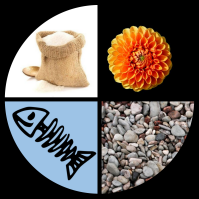
Flicking through many of these satellite images, they started to notice patterns. In particular, four patterns caught their eyes.
Sugar
The term sugar describes fields of small cumulus clouds that are very shallow and confined to the lower boundary layer with cloud depths of only a few hundred meters. They might look organised by a larger-scale flow, but evidence of self-organisation is little.
Gravel
Gravel is, as the illustrative name might suggest, of a coarser structure than the sugar pattern. Cloud patches reach higher and eventually hit the trade-wind inversion. Nevertheless, they show little evidence of stratiform cloud patterns.
These features are organised on smaller scales, often with clouds along lines or arcs as might be associated with gust fronts and cold pools.
Flowers
Cloud patterns with distinctive stratiform layers. The blotches of high reflectivity show little evidence of organisation, but a good separation among each other by regions devoid of clouds.
Fish
The largest pattern considered in this study is the "Fish" pattern. It is organised on the large-scale (100s of km) and becomes apparent by its skeletal like networks of clouds separated from each other or other cloud forms by well defined regions devoid of clouds. Cloud top heights of above 2.5 km are not uncommon.