



Investigação
As nuvens são uma característica familiar nas atmosferas dos planetas. Como podem tanto aquecer como arrefecer a atmosfera, são importantes para a compreensão do clima e do tempo atmosférico dos planetas. Em Marte, nuvens geladas podem formar-se em altitudes elevadas na atmosfera (acima dos 50 km, cerca de 30 milhas), na chamada "mesosfera", sendo designadas por "nuvens mesosféricas". Estas nuvens são particularmente interessantes por várias razões. Embora Marte seja um planeta seco, existe vapor de água na atmosfera que pode originar nuvens de água gelo. No entanto, como a atmosfera de Marte é composta quase inteiramente (95%) por dióxido de carbono e é muito fria, podem também formar-se nuvens de gelo de dióxido de carbono (pense no gelo seco!).
Aqui pode ver-se um exemplo de uma nuven mesosférica vista pelo rover da NASA Curiosity da superfície. [Credit: NASA/JPL-Caltech/MSSS]

Some important questions about these clouds:
- What causes the atmosphere to get cold enough for carbon-dioxide to freeze out?
- How do clouds change from day to night, or during different seasons, or in some years more than others?
- What are the clouds made of?
Our goal with this project is to first find and map these clouds to create a database that will help answer such questions.
Our dataset, how we find clouds, and why we need your help.
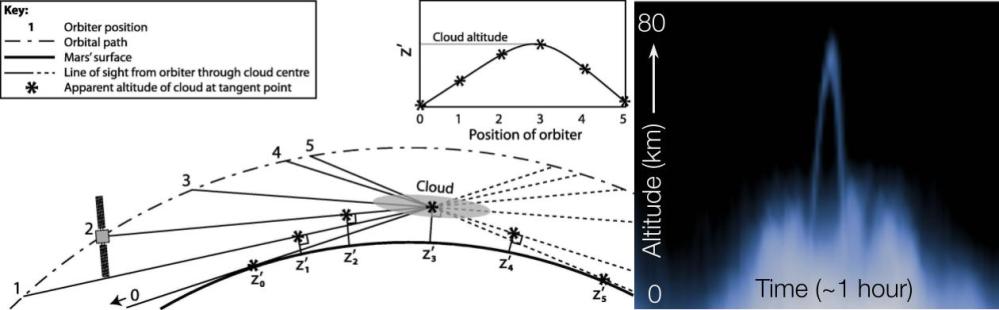
To do this, we'll be searching through data acquired by the Mars Climate Sounder (MCS) on the Mars Reconnaissance Orbiter (MRO). MCS is an instrument that peers at the horizon of the planet in the infrared and visible to measure temperature, water-ice, and dust content of the atmosphere on Mars (McCleese et al., 2007). From nearly the first day that MCS sent data back to Earth, strange features were observed at high altitudes. These features have an arch-like or loop shape to them and have since been recognized to be clouds (see figure below).
The arch shapes arise because the apparent altitude of the cloud changes as the spacecraft moves along its orbit as shown in the figure below on the left (Diagram of geometry from Sefton-Nash et al., 2012). As the spacecraft moves from point 0, to points 1, 2, and 3, MCS views a different part of the atmosphere (continuing to look at the limb) such that the apparent altitude of a cloud (z') rises from the surface. The peak of the arch in altitude (point 3) represents the true altitude of the cloud. Once the spacecraft moves on to points 4 and 5, the cloud appears to descend in altitude, which completes the arch-like shape. Arches have been seen since the beginning of the mission, and now there's...over 15 years(!) of observations from MCS. To find these clouds, we will look at radiance, emitted heat, measured by MCS in all of its spectral channels (which look in different wavelengths in the infrared and visible) and pick out the peaks of the arches. From those identifications, we'll back out the location and time to create citizen scientist curated maps of mesospheric clouds across Mars.
Long term goal
First, we hope you and other citizen scientists will aid us in finding clouds during Mars Year 29 (it takes Mars 687 days to go around the sun), which was from December 2007 - October 2009. With a full Martian year of identified clouds, we can determine how mesospheric clouds change during different seasons on Mars, and compare in which spectral channels clouds are observed in order to get a handle on what types of clouds form at different times. These results will act as a "ground-truth" dataset for a machine learning algorithm to determine how accurate that model is at identifying clouds that citizen scientists have found. With a useful model, we can more quickly search other years for additional clouds and study how these clouds change year-to-year. However, we will likely need more help from citizen scientists like yourself to understand these changes. We expect to also add observations from Mars Year 30, where the Red Planet was much less dusty than the previous year, and Mars Year 31, where MCS began a new observation mode that looked at the planet in a different way, enabling studying different times of day (normally MCS observes at around 3 AM and 3 PM on Mars).
Resources to learn more about Mars and clouds!
Want to learn the basics about Mars?
- Start here if you like to read or here if you prefer videos.
- Then "visit" Mars in virtual reality with Access Mars, thanks to NASA Jet Propulsion Lab and Google.
- Explore Mars with NASA's Mars Exploration Program.
- Do a deep dive on clouds in the middle atmosphere of Mars.
- Find out the latest on the Mars Reconnaissance Orbiter.
Or about Earth's mesospheric clouds?
- Learn about (and watch some impressive videos!) on mesospheric clouds on Earth.