


Finished! Looks like this project is out of data at the moment!
Provisional results now available! Please see Talk board for more information.
Research
About the Prickly Pear Project
What is an invasive species?
When a species is introduced to an area outside of its natural range by humans, either deliberately or accidentally, it is called a non-native species. Some non-native species explode in abundance and spread rapidly across the landscape - they have become invasive. Invasive species can have severe impacts on the environment and the people who live there.
Opuntia
Prickly pear cacti (Opuntia) are a group of cactus species which occur naturally in Central America, the Caribbean, and parts of the USA. Several members of the group have been introduced and become invasive in dry regions all over the world.

Several species of Opuntia are invasive in Laikipia County, Kenya. Opuntia stricta was introduced by the British colonial administration in the 1950s as a living fence around their offices in the town of Doldol, and more recently has rapidly spread from there to invade the surrounding landscape. Opuntia engelmannii was introduced to Loisaba Conservancy as an ornamental plant in the 1970s, when its negative impacts were not yet known. It has since spread to cover thousands of acres of the conservancy.
Opuntia invasions have severe consequences for the environment and local communities. Many of these impacts are direct - invaded areas are unsuitable for livestock and crops, causing loss of livelihoods, food insecurity, and the displacement of communities. Opuntia also infests large areas of land in conservancies, altering the habitat and threatening the diversity and abundance of native species.

However, invasive plants such as Opuntia can also cause indirect impacts by changing the behaviour of wild animals. These impacts are in need of further investigation so that we can better predict and manage them.

Our Question
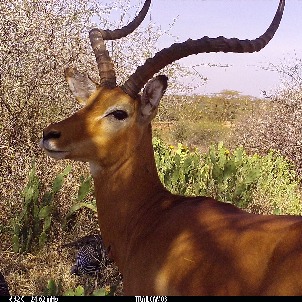
We are trying to understand how Opuntia invasion alters the habitat use of wild mammals. This is important because the movements of wild mammals around the landscape has consequences for the patterning of ecological processes, and may influence the occurrence of human-wildlife conflict. Also, the movements of animals which feed on Opuntia fruit, including elephants and baboons, may influence the future spread of the cactus. To help us understand Opuntia's effects on habitat use, we are using motion-activated cameras, known as camera traps.
We need your help!
Camera traps are a fantastic tool for studying wildlife, but they have one major drawback - they take so many photos that even a relatively short project like ours can result in over a million images.
We used the Megadetector machine learning model to automatically screen out most of the empty images (e.g. when the camera gets triggered by waving grass), but this still left us with over 100,000 images containing animals - far too many for us to classify without your help!
