



Finished! Looks like this project is out of data at the moment!
Welcome to Rubin Comet Catchers! Update 3 September 2026: Thanks for your super-FAST comet classifications of Rubin data! Wow! And great news: we unearthed MORE special datasets from Rubin’s Early Data Preview 2 data! By popular demand, we are releasing a limited edition workflow for identifying near-Earth objects (NEOs) in Rubin data! These trailed sources — lovingly called sausages — are important to understand for planetary defense, and they can have comet tails too! And don’t worry, comet fans — we also have new images of Centaurs and other populations coming up or already online! All of these are actual Rubin images that the science team figured out a clever way to get at more science! Just how much and what is in there is up to you to discover… we’re super-excited!
Thanks, everyone, for all your hard work! You can always check out this YouTube video featuring Colin on a show he hosts about the upcoming Rubin Observatory and the Legacy Survey of Space and Time! It features Citizen Science, and Clare Higgs of Rubin Education and Public Outreach presents, too! Thanks again, everyone! We cannot do this without you!
Research
About Rubin Observatory
The NSF-DOE Vera C. Rubin Observatory is a groundbreaking new observatory, located on Cerro Pachón in Chile, which will revolutionize the way we explore the cosmos. Using the largest camera ever built, Rubin will repeatedly scan the sky for 10 years and create the greatest cosmic movie ever made. To learn more about the observatory, its science and the first images revealed, visit rubinobservatory.org.
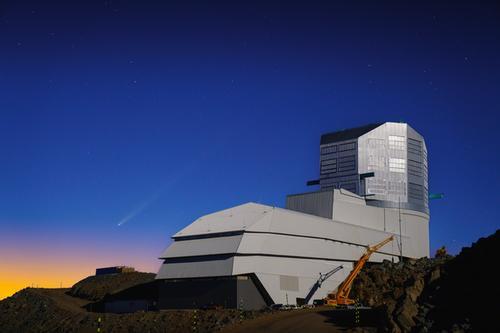
Rubin Observatory with Comet Tsuchinshan-ATLAS.
Image Credit: RubinObs/NOIRLab/SLAC/DOE/NSF/AURA/H. Stockebrand
NSF–DOE Vera C. Rubin Observatory is jointly funded by the U.S. National Science Foundation and the U.S. Department of Energy’s Office of Science. Rubin Observatory is a joint program of NSF's NOIRLab and DOE’s SLAC National Accelerator Laboratory. Rubin Observatory recognizes the unique and important role of public participation and collaborates with the Zooniverse to support projects like this. Zooniverse citizen science projects with Rubin data are supported by UK Research and Innovation through STFC.
Rubin Observatory will conduct the Legacy Survey of Space and Time (LSST), starting in late 2025. The data used in this project is a preliminary, testing data set, known as DP1, observed with a commissioning camera. This data set provides a valuable resource for scientists to start exploring the Universe with Rubin while preparing for the much larger LSST datasets.
Rubin Comet Catchers
Rubin Comet Catchers is a Citizen Science project focused on discovering new comets in early data from the Vera C. Rubin Observatory, a next-generation facility under construction in Chile. These observations—taken during the observatory’s commissioning phase—offer a rare opportunity to identify never-before-seen comets and activity from icy bodies in the outer solar system.
Comets are icy relics from the solar system’s formation. When heated by the Sun, they often form long, glowing tails and dusty comae. Studying these objects helps scientists answer fundamental questions:
- How did Earth get its water?
- What was the early solar system like?
- Where are the volatile-rich regions that could support life?
Some of the most intriguing cases come from active asteroids—objects that appear asteroidal in orbit but exhibit comet-like activity. These hybrids challenge our traditional classification of small solar system bodies and hint at hidden ice, collisions, or other dynamic processes.
A Proven Model: the Active Asteroids Project
Rubin Comet Catchers builds directly on the success of the Active Asteroids Zooniverse project, also a NASA Partner program. That project engages with thousands of volunteers to review archival images from the Dark Energy Camera (DECam), which has so far led to multiple peer-reviewed discoveries of activity in asteroid populations.
Active Asteroids demonstrates that volunteers can reliably detect subtle tails and activity, even in challenging image conditions. With this strong foundation, Rubin Comet Catchers is applying a proven model to Rubin’s vastly larger and deeper dataset — perfect for finding new comets and active bodies!
Procedure
We extract short flipbook-style image sequences of moving objects observed with Rubin’s engineering test camera, which began collecting images in 2024. These images come from a public, early-phase survey of the Southern Hemisphere.
Volunteers are shown a sequence of 2–20 images for each object, allowing any comet-like tails or comae to become visible, and distinguishable from background sources like galaxies or image artifacts. Objects flagged by multiple volunteers are then reviewed by scientists and, if promising, followed up with deeper analysis (including archival investigations and telescope follow-up) and possible publication.
Citizen Science
Rubin Observatory will detect over 5 million moving solar system objects, most at least 100 times! That's far too many for any single team to examine alone.
That’s where you come in.
By helping classify flipbooks in this project, you’ll:
- Discover brand-new comets
- Expand the known population of active asteroids
- Support science with immediate impact, including real scientific publications
Feasibility and Proof of Concept
Rubin Comet Catchers is led by a team with extensive experience in solar system science, public engagement, and data from large observatories. Our first (and sister) Zooniverse project, Active Asteroids, resulted in many discoveries published in scientific journals, such as
- SAFARI: Searching Asteroids for Activity Revealing Indicators
- Six Years of Sustained Activity in (6478) Gault
- Cometary Activity Discovered on a Distant Centaur
Now, with your help and Rubin’s powerful new dataset, we’re just getting started.