


Finished! Looks like this project is out of data at the moment!
Try out drawing on these streams with the Experiment platform - click here and select the Stellar Streams workflow. Experiment is external to Zooniverse. See this blog post for details.
Research
Goals
We want to understand how dark matter is distributed around galaxies. Dark matter is invisible—we cannot see it directly with a telescope. But we can detect its presence through gravity.
Instead of searching for dark matter itself, we look for signs of how its gravity influences normal matter, like stars. You may have heard the analogy that galaxies are like giant merry-go-rounds. Stars orbit around the center, much like horses go around on a ride. When we count the visible stars and gas there isn’t enough matter to create the gravity needed to keep the galaxy spinning as fast as it does. The extra gravity must come from dark matter. It is what makes the galaxy merry-go-rounds work!
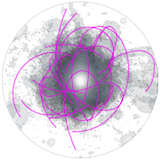
But perhaps the best way to see how dark matter’s gravity influences normal matter isn’t by looking at the galaxy itself, but something called a stellar stream — a long, thin trail of stars orbiting the galaxy. By studying the shapes of these streams, we can learn about how dark matter is arranged in and around galaxies.
With your help, we are finding stellar streams in nearby galaxies. Together, we can build a new map of dark matter across the cosmos!

What Do My Efforts Accomplish?
On a large scale, your efforts make possible a new and powerful technique for mapping the dark matter in galaxies.
A lot of what we’ve learned about dark matter at galaxy scales comes from techniques like gravitational lensing, which studies how light is bent by mass. But using streams has some unique advantages:
- They don’t require stacking images or complex modeling,
- They let us probe smaller galaxies and the inner regions of galaxies, where we can learn how normal and dark matter interact,
- And they let us do this one galaxy at a time.
But there’s a challenge: streams are rare and faint—especially when we’re looking at galaxies billions of light years away. That’s where you come in.
As a volunteer, you’ll help us find these elusive streams in images from the Euclid Space Telescope, a European Space Agency mission launched in 2023. Your task is simple but powerful: you’ll look at images of galaxies and decide whether you think a stream is present. Each image will be shown to many volunteers, and when enough people agree, we can flag it as a promising stream candidate.
Here’s an example of what you’ll help us uncover:

On the left, you see the original galaxy image. In the middle, we show what we’ve learned from the stream: its shape tells us about the gravitational pull of the galaxy, and even where the galaxy’s center of mass is located. On the right, we show different ways dark matter might be distributed inside the galaxy—some shapes are possible, others are ruled out!
And the science doesn’t stop there. After identification, we’ll ask volunteers to draw the stream’s path in a follow-up task. These annotations will let us model each stream’s curvature and use it to map the dark matter more precisely.
Just as exciting, we can combine results from many galaxies. This allows us to build a bigger picture—linking galaxy-scale measurements to cosmic-scale models of dark matter across the Universe:

We’ll use your classifications as the first step in a larger analysis pipeline. After you help us identify and annotate streams, we fit physical models to them to infer the shape, size, and center of each galaxy’s dark matter halo. These measurements are crucial for testing theories about how galaxies form—and even what dark matter is.
We’re also working with machine learning models trained to look for stream-like features. But human eyes are still more reliable, especially when dealing with rare, complex, or ambiguous cases. Your input helps us build better training sets, improve detection algorithms, and validate the results. In short: your decisions guide the science at every step.
By participating, you’ll be helping us create the first-ever large-scale map of dark matter using stellar streams. It’s a brand new way to explore the invisible side of the Universe—and we can’t do it without you.