


Finished! Looks like this project is out of data at the moment!
Thank you for your efforts! This project's classifications are currently complete! To browse other active projects that need your classifications, check out zooniverse.org/projects
Research
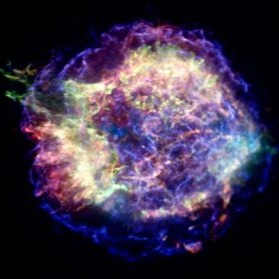
Super rare, superluminous supernovae (SLSNe) are stellar explosions that are at least ten times more powerful than the typical supernovae, making them the brightest explosions in the known universe.

[Artist impression of the explosion of SN 2006gy, a superluminous supernova. Credit: NASA / CXC / M.Weiss.]
SLSNe are classified in two different spectral types; those with narrow hydrogen emission lines in their spectra (SLSN-II) and those without (SLSN-I). However, this information is not always easy to obtain. Generally, collecting enough data from these supernovae to generate spectra that are free of contaminations requires a lot of observation time. With so many exciting events going on in the universe, observational astronomers have to use their telescope time wisely. Therefore we tend to collect the spectra of objects if they are interesting and we have a sense of what they could be. One way to decide if they are interesting is by examining their light curve. A light curve is a graph that shows how an object's brightness varies with time. The light curves of superluminous supernovae typically show a significant rise in brightness over a long period (usually more than 25 days) followed by a slow decline in brightness that can last more than 200 days.

[This graph demonstrates how much brighter superluminous supernova SN 2006gy is compared to typical standard supernova classes. The famous supernova SN 1987A is also shown. Not only are superluminous supernovae much brighter but they also remain brighter for much longer. Credit NASA/CXC/UC Berkeley/N. Smith et al.]
Why are we interested in SLSNe?
For starters, we aren't exactly sure how they form. Over the years, multiple models have been proposed to describe what scenarios may produce an SLSN. These include core-collapse in very massive stars, millisecond magnetars, interaction with dense circumstellar material, or pair-instability supernovae. As of yet no single model can explain every SLSNe found, but the models have suggested that stars 40 times more massive than our Sun are likely to form SLSNe.
Supernovae are among the most momentous events in the cosmos. They disburse into space all of the chemical elements that were produced inside their progenitor stars, including the elements essential for making planets and life. Heavy elements like gold and platinum, to uranium and plutonium, are known to be forged within the violent explosions associated with SLSNe. The fact that we find these heavy elements here on Earth signifies that SLSNe have contributed to the material that formed our Solar-system. We need to figure out the extent of their heavy element production and how often SLSNe occur to understand the significance they have had on the chemical evolution of the universe.
With more advanced telescopes coming online, we can begin to look deeper and deeper into the universe in search of these extremely elusive explosions. Unfortunately the majority of the supernovae candidates we will discover will not be SLSNe. Therefore we need volunteers to scan through the light curves of these candidates and pick out the good from the bogus. The more SLSNe we can identify, the better our chances of solving the mystery of their origins and the evolution of the universe.