


Please leave us your feedback using this short Google form: https://docs.google.com/forms/d/e/1FAIpQLSfwtd6V5WDO5W7hJnZ5-QnRncyrytsBEI_PFMhWzK9r7fmVxQ/viewform
Research
What We Do
Our Mission
California’s marine protected areas (MPAs) are ocean and coastal areas set aside to help conserve and protect the structure, function, and integrity of marine ecosystems and wildlife. The Marine Protected Area (MPA) Collaborative Network ensures these special protected places are effective by providing a robust structure for civic engagement in MPA management. We are augmenting existing monitoring efforts with crowdsourced community-contributed observations of the subtidal zone (areas where the seabed is below the lowest tide, aka underwater!) inside and outside of MPAs. This project harnesses the power of community scientists and machine learning technology to extract classified images of organisms from underwater videos for contribution to biodiversity databases such as GBIF (Global Biodiversity Information Facility). Ultimately, these observations will integrate with ongoing efforts by the California Academy of Sciences and MPA managing agencies to use community science data to better understand and monitor biodiversity across California’s coast and MPAs.
Current Focus
The first phase of this project is focused on sea stars! Brightly colored and popular amongst locals and visitors alike, sea stars are an important species for ocean and coastal ecosystem health. However, these ecosystems have been thrown out of balance. In 2013 and 2014, a mysterious sea star wasting syndrome decimated sea star populations along the entire West Coast, including the sunflower star, a primary predator of urchins. From 2014-2016, unusually warm ocean conditions led to limited nutrients for kelp growth. These combined factors led to a rapid decline in kelp forests and a simultaneous boom in purple urchin populations. Kelp forests, which provide crucial habitat for a broad range of marine life and pull carbon from the atmosphere, were eaten through by an overabundance of hungry urchins, creating "urchin barrens" (an area of kelp forest habitat that has been lost and is now completely dominated by urchins). Researchers, community scientists, and managers are working hard to better understand and address this complex issue.
Did you know...
- California has a world-class network of over 124 MPAs with unique levels of protection
- There are over 20 species of sea stars in California integral for a balance between healthy kelp ecosystems and urchin barrens
How You Can Help
We need your help through community science to identify, document, and understand how sea stars are making a come back from many stressors including sea star wasting syndrome and a warming ocean!
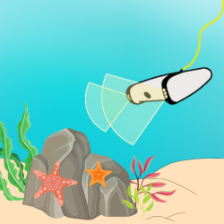
Your classifications will be used to train computer vision algorithms to detect and identify sea stars. These algorithms can then be used to automate the analysis of various underwater footage formats. Our goal is to make it possible for everyday people to go out, take videos of their underwater dives or ROV excursions, and then have those videos contribute to biodiversity monitoring efforts like OBIS!
More information on the complex ecosystem interactions of kelp forests, urchins, sea stars, and ocean conditions can be found here: https://www.nature.org/en-us/magazine/magazine-articles/kelp-forest/