


Finished! Looks like this project is out of data at the moment!
Project Finished: Huge thank you to all the volunteers who have worked on this project! We couldn't have searched all these data without your help. We're hard at work analyzing the results, so look out for Newsletter updates in the near future.
Research
What are extreme galaxies?
When people think of galaxies, the image of a normal galaxy likely comes to mind—that is, one shaped like a spiral or ellipse. It turns out that most normal galaxies fall under these two categories, spiral or elliptical (shown below), which is a useful characteristic to use when classifying galaxies. Other features such as color and structures (e.g. spiral arms) provide more bases of comparison needed to classify the many galaxies in our universe.
NGC 7398 (left, spiral galaxy) and M87 (right, elliptical galaxy)


(Image Credit: DESI Legacy Imaging Surveys)
However, some galaxies don't resemble spiral or elliptical galaxies at all. They might be extremely difficult to spot, or have features so irregular that none of the normal structures we associate with galaxies are discernible. In this project, we will refer to these objects as extreme galaxies, and the ones that we are interested in are known as "blue blobs" and diffuse galaxies.
Blue Blobs
Blue blobs are unique stellar systems because they have highly irregular, clumpy shapes and consist almost entirely of young, blue stars. There are only 5 known examples and they are all in the Virgo galaxy cluster, which is an extremely hostile environment to the cold gas needed to form new stars. Yet, blue blobs have somehow survived under these conditions and appear to be isolated from any other galaxy or companion, so the fact these isolated systems exist with young blue stars is a bit of a conundrum!

(Image Credit: Next Generation Virgo Cluster Survey/Canada-France-Hawaii Telescope)
Diffuse Galaxies
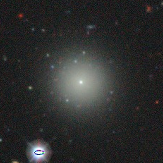
Diffuse galaxies are objects with about the same number of stars as dwarf galaxies (roughly a million to a billion) but an effective radius comparable to the Milky Way (which has hundreds of billions of stars), meaning that half of the galaxy's light is contained within this radius. This is why they're called "diffuse" galaxies, since there is a low density of stars (mainly older stars) spread across the entire volume of the galaxy. As a result, these type of galaxies possess a much lower surface brightness than normal galaxies which makes them appear as a blurred patch of light.

(Image Credit: Next Generation Virgo Cluster Survey/Canada-France-Hawaii Telescope)
Why are we interested in these types of extreme galaxies?
Just 10 years ago, very few extreme galaxies were known. As improvements in imaging surveys were made, there was an explosion in the number of these objects known and now we can't explain why so many of them exist. Blue blobs for example were discovered more recently and might not even be galaxies, but rather star clusters that formed outside of their parent galaxy. The origins of both blue blobs and diffuse galaxies can't be explained by the processes that form normal galaxies, so we hope that studying them further will help fill in gaps in our understanding of galaxy formation.
Why do we need your help?
The first step to understanding extreme galaxies is finding more of them. For more regularly shaped galaxies, astronomers can employ special computer algorithms to efficiently identify these objects in a large dataset. While there are algorithms developed to identify diffuse galaxies, it's difficult to know how reliable they are without checking their findings against human identification, since diffuse galaxies appear more like smudges than distinguishable objects. Blue blobs, on the other hand, are harder for computers to identify because no two objects look alike and they can be exceptionally faint. Therefore, the most reliable method is to identify both of these objects with the human eye. Surveys of nearby galaxy clusters, though, correspond to thousands of images, far too many images for any one person to look through. In our project, the complete Fornax Deep Survey (shown below) of the Fornax galaxy cluster will correspond to about 16,000 subjects, while the Next Generation Virgo Survey of the Virgo galaxy cluster (also shown below) corresponds to 46,400 subjects! However, with a large team of citizen scientists, we can tackle this challenge together, and by doing so, you will be playing a vital part in helping us solve the mystery of extreme galaxies!
The following map shows where in the sky the Fornax Deep Survey covers, compared to known galaxies in the Fornax cluster denoted by the red dots (Ferguson 1989).

(Image Credit: Peletier et al. 2020)
The following map shows the spatial distribution of known galaxies in the Virgo Cluster. The area covered by the Next Generation Virgo survey is the region confined by the red solid lines.

(Image Credit: Ferrarese et al. 2012)
How will we use your classifications?
Your classifications help us narrow down where in a galaxy cluster we should be looking in order to study extreme galaxies more closely on an individual basis. We will review all of the classifications made by citizen scientists and select the best candidates to follow up with other telescopes to look for any signs of gas and to study their stellar populations. With this larger sample and the new information from follow-up observations, we aim to better understand how these objects formed and how they will evolve in the future.