




Research
Clouds on Mars and why we study them
Clouds are a familiar feature in the atmospheres of planets. Because they can both warm and cool the atmosphere, they are important for understanding the weather and climate of planets. On Mars, icy clouds can form throughout the atmosphere and may tell us about the winds, which are otherwise invisible to spacecraft and researchers. Although Mars is a dry planet, there is water vapor in the atmosphere that can form water-ice clouds. However, because the atmosphere of Mars is made up almost entirely (95%) of carbon-dioxide and it is cold, carbon-dioxide ice (think dry ice!) clouds can also form.
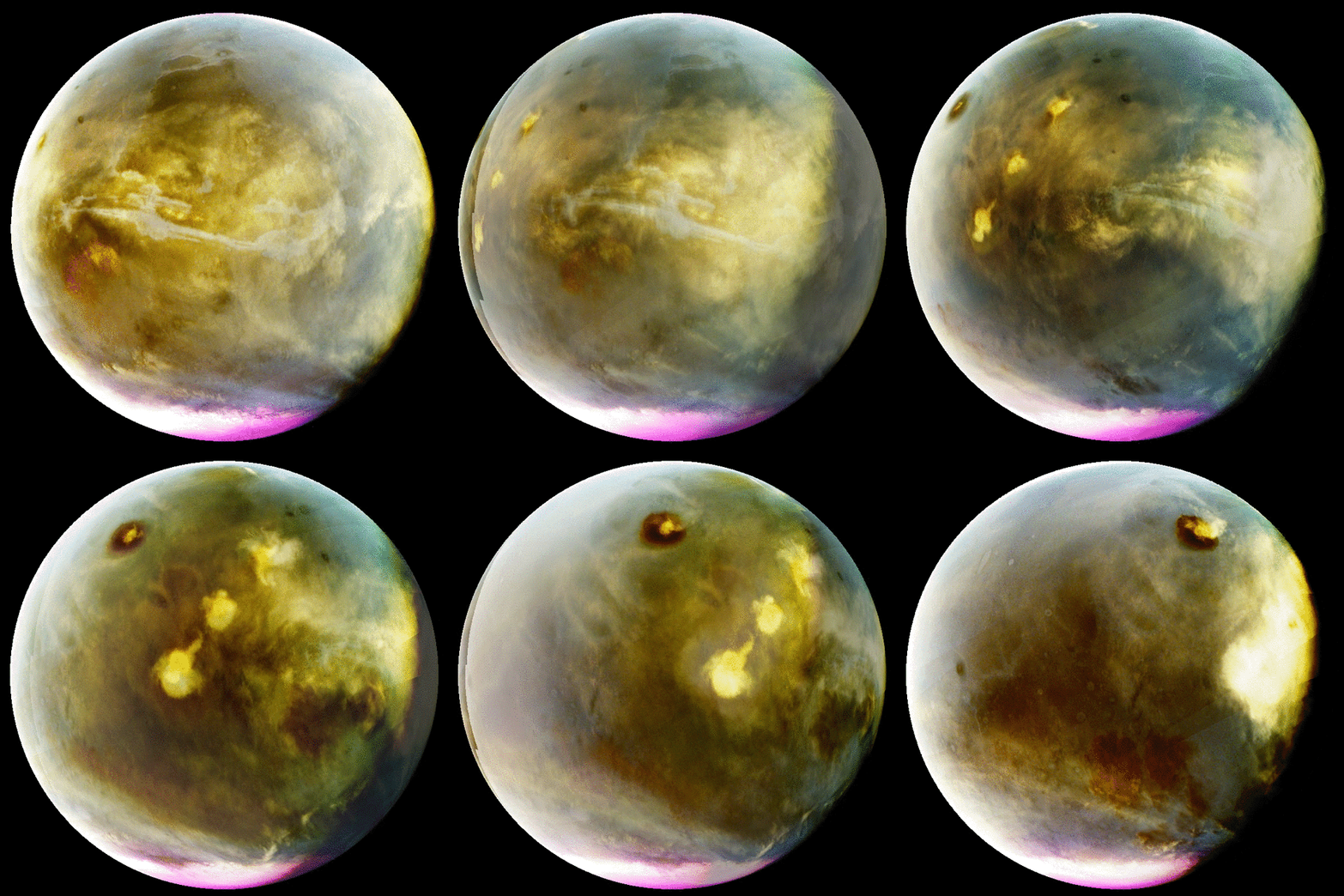
Some important questions that, with your help, we are investigating about these clouds:
- What are the daily, seasonal, or annual patterns in Martian cloud shapes and distributions?
- How well do cloud forms reflect prevailing wind patterns?
- Do the structural similarities between Earth and Mars' cloud types point to similar formation mechanisms?
Our goal with this project is to first find and map these clouds to create a database that will help answer such questions.
Our dataset, how we find clouds, and why we need your help.
To do this, we'll be searching through years of data acquired by the Imaging Ultraviolet Spectrograph (IUVS). IUVS observes the entire disk of Mars in the ultraviolet to measure water-ice and dust content in the Martian atmosphere. While most images of Mars include some form of dust or haze, large clouds are observed quite regularly, in a variety of shapes. There are a variety of recurring unique cloud types that exist on Mars and are also seen on Earth, which leads us to question how similar these groups of clouds might be.
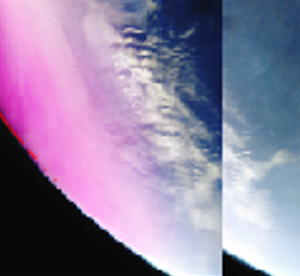
These cloud shapes tell us not only that there is water ice present, but also may shed light on the underlying atmospheric conditions. For example, on Earth prevailing winds that encounter a mountain can form a series of waves behind them, with clouds forming in the rarified air in these waves (gravity wave clouds, or street clouds).
Similarly, as wind pushes warm moist air up a mountain, it can rapidly cool and condense, forming cap clouds over the top.
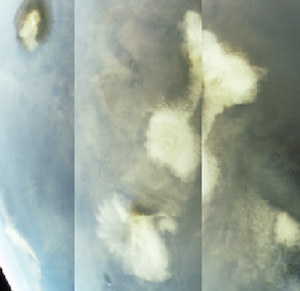
In these cases, the shape and extent of the clouds can be used to tell us about the steadiness of the wind, temperature conditions, or the availability of water vapor in the atmosphere. By finding similar cloud features on Mars, we can begin to determine what mechanisms cause them to form there.
Short term goal
Over the next year, beginning with our highest spatial resolution data, we hope to identify and map the six major cloud types in order to create a useful database for scientists to reference in modeling and data analysis efforts. Along the way, we may discover other unique clouds and these too will become useful in subsequent studies. As the investigation progresses, we will include some of the lower spatial resolution data from IUVS, and see whether clouds can be spotted in those data as well.
Long term goals
We hope you will join us in finding clouds over the life of the MAVEN mission (2014-present). With your help we can determine how these cloud types appear and change during different seasons on Mars, and use this information to enhance our understanding of the dynamics of the atmosphere. These results will create a new library for use by all Mars scientists, including you, that reports on the frequency, spatial extent, and variation of these forms throughout the years. With this substantial library, we can begin to investigate how year to year variability presents itself, and what mechanisms inhibit or encourage cloud formation in the lower atmosphere. However, we will likely need more help from citizen scientists like yourself to understand these changes.
Resources to learn more about Mars and clouds!
Want to learn the basics about Mars?
Start here if you like to read or here if you prefer videos.
Then "visit" Mars in virtual reality with Access Mars, thanks to NASA Jet Propulsion Lab and Google.
Explore Mars with NASA's Mars Exploration Program.
Do a deep dive on clouds in the atmosphere of Mars.
Find out the latest on the Mars Atmosphere and Volatile EvolutioN mission.
Or about Earth's various clouds?
Learn about a number of different water ice/vapor clouds on Earth.