


Please sign in before starting!!.
Research
Why are we studying adipose tissue?
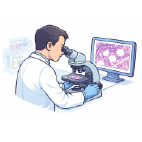
Cancer diagnosis often begins with the study of tissue biopsies. These samples are usually stained with Hematoxylin and Eosin (H&E) and examined under a microscope. Today, digital pathology and artificial intelligence (AI) allow us to analyze these images at much larger scale and in much greater detail.
AI can detect visual patterns in tissue that may be linked to how a disease develops, how aggressive it is, or how a patient may respond to treatment. These patterns can become biomarkers: measurable features in tissue that provide useful biological or clinical information.
Why focus on adipose tissue?
This project focuses on adipose tissue, also known as fat tissue. Adipose tissue is easy to see in many biopsy samples, but it is often overlooked.
Adipose tissue is not just a passive energy store. It plays an important role in inflammation, hormone signaling, metabolism, and tissue remodeling. These processes are closely linked to diseases such as cancer.
Researchers have found that the shape, size, density, and organization of adipocytes (fat cells) may contain valuable information about disease. In other words, adipose tissue may contain new biomarkers that could help us better understand cancer and other diseases.
What is the challenge?
Although adipose tissue is clearly visible in many histology images, it is difficult to analyze automatically.
During tissue preparation, the thin walls around adipocytes can appear broken, faint, or incomplete. Because of this, AI models may make mistakes when segmenting the tissue. For example, they may merge neighboring vacuoles that should remain separated, or fail to follow a real tissue boundary.
These errors reduce the quality of the annotations and make it harder to measure adipose tissue morphology reliably. That is a major problem if we want to use these features as biomarkers.
Why is human annotation important?
Many of these errors are visually understandable to people, even when they are difficult for AI.
A person can often recognize when a tissue wall should continue, when a boundary is misplaced, or when an image is too unclear to annotate confidently. This makes the task especially suitable for collaborative human review.
By involving volunteers, we can improve annotation quality at a much larger scale than would be possible using expert review alone.
What are the goals of this project?
This project has two main goals:
-
Improve tissue annotations in adipose histology images
Volunteers help review AI-generated masks and identify cases where tissue walls are missing or incorrectly placed. -
Support biomarker discovery
Better annotations allow researchers to measure adipose tissue morphology more accurately. These improved measurements may help identify new biomarkers related to cancer and other diseases.
How will volunteer contributions help?
For each image, volunteers review a two-panel view that includes:
- the original histology tile
- the predicted tissue mask
Volunteers help decide whether the mask is:
- clearly correct
- missing a wall
- too hard or ambiguous to judge confidently
If the image is classify as 'missing a wall', you could use drawing tools to correct the mask.
These contributions will help us build better datasets, improve AI models, and study adipose tissue as a source of disease biomarkers.

Figure 1. Example of a histology tile and the AI-predicted tissue mask. Volunteers review these images to decide whether the mask is clearly correct, missing a wall, or too ambiguous to judge confidently.
Why does this matter?
Better annotation is not only a technical improvement. It is a necessary step toward better biological understanding.
If we can measure adipose tissue more accurately, we may be able to discover tissue patterns linked to cancer progression, prognosis, or other disease-related changes. In that way, volunteer contributions can directly support biomedical research.
A collaborative approach
This project combines:
- digital pathology
- artificial intelligence
- citizen science
By working together, researchers and volunteers can create higher-quality data and open new paths for biomarker discovery.