


Finished! Looks like this project is out of data at the moment!
Please help us out by filling in a short feedback form: https://forms.gle/87odfTkTYLAR7ogy9
Research
How do we know that there is dark matter?
There is a long history in astronomy of predicting the existence of objects from the anomalies that they create among our observations—a history of the effects of unknown objects betraying their hiding places. A famous example comes from the mid-19th century when French astronomer Urbain Le Verrier predicted the existence of Neptune using only the fact that the observed orbit of Uranus deviated slightly from the orbit that Newton's laws of gravity predicted given the known planets.
This kind of meditation on the "invisible" was and is a favorite topic among natural philosophers, and it is here that dark matter has its roots. Though there is documented speculation about the existence of "dark" objects in the universe as early as the 18th century—and likely undocumented speculation earlier still—the modern conception of "dark matter" was not concretized until the discoveries of Fritz Zwicky in the 1930s, and not widely accepted until the compelling, meticulous work of Vera Rubin and contemporaries nearly 40 years later.


Key pieces of evidence for dark matter are the rotational speed of the visible contents of galaxies and galaxy clusters. Galaxies and clusters are held together by the gravitational force that arises from the matter inside of them; the more matter that one contains, the greater its mass, and the greater the gravitational force that is exerted on its constituents. Gravity is what binds all of the individual pieces of the galaxies and clusters together, preventing them from flying apart.

What Zwicky and Rubin saw, and what has since been confirmed many times over, is that there exist galaxies and clusters whose internal motions cannot be explained by the amount of luminous matter that they contain. (Their luminous matter can be inferred based on the light that they emit). Were these galaxies and clusters to be composed only of this luminous matter, there would not be enough gravity to bind their pieces together and they would fly apart. But, the pieces are bound together and they are not flying apart—how could this be? One possibility is that our theory of gravity—Newton's Law of Universal Gravitation, or equivalently Einstein's General Theory of Relativity which includes Newton's law—which works so very well to understand our solar system and its contents, must be amended at the distance scales involved in galaxies and larger structures. Another possibility, and the one on which we will focus, is that galaxies and clusters contain additional matter that does not shine and that is supplying the additional gravitational force needed to hold them together. Astronomers aptly call this "dark" matter: dark matter.
Here's an experiment that you could perform that illustrates the principle of stable rotation requiring a sufficient "holding" force:
Place a coin at the edge of a spinning platform and spin it slowly. You will see that the coin does not move from its position on the platform; it is being held in place by their mutual frictional force, much like the stars and planets in galaxies are held in place by their mutual gravitational force with the matter around them. Now spin the platform faster until the friction between the coin and the platform is no longer strong enough to hold it in place and it flies off:

We could measure the frictional force between the coin and the plate, and then predict the rotational speed at which the coin could no longer be held in its position by this force alone. These calculations would match what we saw in the real world very closely (there is no "dark friction"). But, when we try to make these same calculations with respect to the stars and planets in rotating galaxies, we find that the galaxies are rotating at a speed that is large enough to make all of the "coins resting on them” fly away—there is not enough visible matter to create enough gravitational force to hold stars and planets in place, but they stay there anyway!
If you are looking for a demonstration that has some stronger connection to our current best understanding of gravity you can similarly illustrate this principle by placing a ball inside a frying pan or bowl with sloped edges, holding the ball and container out front of you, and spinning around while gradually increasing your rotational speed. At first, the ball will hug the edges of its container, being held in place by the inwards force exerted on it by the sloped walls. As you spin faster, the ball will gradually rise up and over those walls.
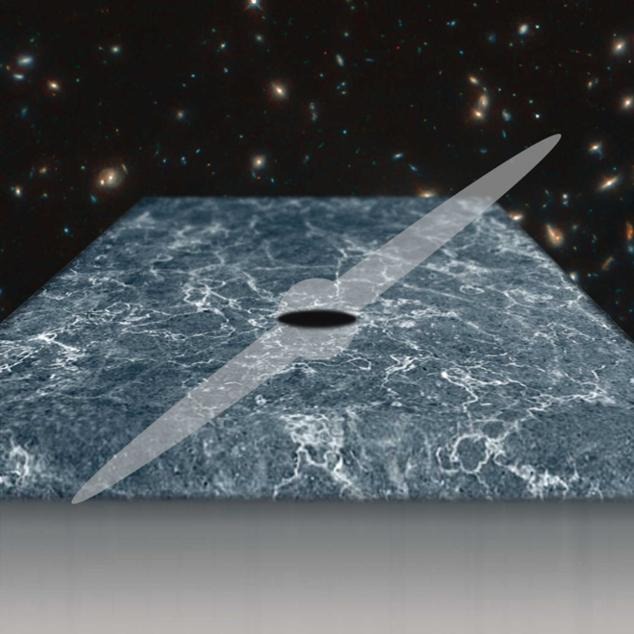
As remarked, this demonstration is more true to what physicists believe to be—in accordance with Einstein’s General Relativity (GR)—the mechanism by which gravity operates. It was one of Einstein’s most consequential discoveries that massive objects, such as stars, warp and “indent” the otherwise flat space around them. The reason that planets orbit stars is that they are being held inside of such indentations—much like how the ball was being held inside of its container by the sloped walls. When we use Einstein’s General Relativity to calculate the inwards force exerted on the stars and planets in rotating galaxies by the indentation created by the matter that we see, we arrive at the same conclusion as before: there is not a great enough gravitational indentation (or, “steep enough walls”) to hold them in place—there must be dark matter inside of the galaxies that is indenting the space by the extra amount needed for their stable rotation.

What is a macro?
If we know anything about dark matter, we know that it is difficult to detect.
It is believed that dark matter constitutes around 85% of the total matter of the universe, meaning that there is 5 times more of it than all of the matter we have seen directly. How could dark matter be so abundant and yet not make its presence glaringly obvious to us? There are two options:
- It does not, by nature, interact strongly with so-called "Standard Model" particles (all of the particles that we know about to date; these include protons, neutrons, electrons, photons, etc.);
- It does interact strongly with Standard Model particles, but because each dark matter unit is massive, they are few in number and their interactions are therefore so rare that they have yet to be observed, despite our best efforts.
Option 1 would imply that whatever dark matter is made of, it is not anything that we have seen before. Theoretical physicists have put forth some particles that could fit this bill, the most popular of which are "WIMPs" (Weakly Interacting Massive Particles) and "axions." To date, these particles have never been observed and there is not yet any experimental evidence to support the theories underlying them.
Objects that would satisfy Option 2 encounter a similar problem; we don't know for certain that they exist, or — even if they do exist — that they could explain dark matter. However, option 2 does have one major point of appeal. It suggests that dark matter could exist within the Standard Model — that dark matter could be made of particles that we already know exist. But, if this were true, wouldn't that make it not "dark"? Why would the issue of "dark matter" have arisen in the first place? The answers to these questions lie in a deeper exploration of Option 2, and they are the ideas that motivated the suggestion of "macros."
For the interactions between regular, visible matter and strongly-interacting dark matter to be rare, the dark matter particles would need to be rare themselves. With dark matter constituting such a large percentage of the total matter in the universe, for it to be as rare as Option 2 suggests, it would have to come in "clumps" that massive compared to the fundamental particles we know — at least 55g. For these clumps to have evaded detection, they would have to be small, but much much denser than ordinary matter, like rock. We have precedence in physics for such small, dense clumps: the nuclei of atoms. These nuclei are composed of protons and neutrons, which are themselves composed of up quarks and down quarks. Their characteristic density, aptly named "nuclear density," is on the order of 10^14 (a hundred trillion) grams per cubic centimeter. Compare this to osmium, the densest material known, which is 22 grams per cubic centimeter.
These nuclei sound like a promising dark matter candidate. Though we do have one problem — large nuclei are unstable. We can only add so many protons and neutrons to a nucleus before it can no longer hold itself in a stable configuration and it decays. Regular nuclear matter cannot satisfy Option 2; though it is dense enough, it cannot form large enough clumps. What we need is a way to make the nuclei stable past their "breaking points." It is possible, but not proven, that we can do this by adding "strange matter" (matter that includes strange quarks or particles that include strange quarks, in addition to the up and down quarks, or the protons and neutrons that are made of up and down quarks) to make them "strange nuclear matter." Strange nuclear matter fits Option 2 perfectly; it would be very dense, and perhaps it is stable even in very large clumps.

Strange nuclear matter is one of the things we are referring to when we speak about "macros." In general, macros refer to a class of composite particle clumps that are much higher density than ordinary matter, have cross-sections best quoted in cm^2, and masses between approximately 55 grams and the mass of the earth (6 x 10^27 grams).
How can macros be detected?
One way that macros could be detected is through their interaction with various astronomical objects, including the Earth. If macros do exist, they would likely have been assembled when the universe was less than a second old. As the universe expanded, they would have been carried along for the ride and become distributed throughout it. This means that there would be some macro dark matter within the neighborhood of the Solar System, and that as the Earth moves along its orbit, it would inevitably run into some of it. When it did, the macros would enter the Earth's atmosphere and collide with its crust at speeds of roughly 250 km/s — 20 times that of a rocket. Due to their high speeds, their trajectories would be extremely straight and they would penetrate at least a few kilometers — maybe passing through the Earth! In scattering off of the Earth's crust, they would leave behind them a thin path of melted rock that is dark and cylindrical, making the evidence of their passage distinguishable from other naturally-occurring phenomena.
In the past, ancient mica rock has been excavated and inspected on a similar principle to search for evidence of dark matter or other theoretical kinds of matter. Large sheets of mica, however, are not that common, and the technique for looking for the traces of dark matter's passage is involved. Wouldn't it be convenient if there was a kind of rock that was already being excavated in mass, professionally prepared, displayed to the public for commercial purposes, and where it would be easy to see the effects of dark matter? Thankfully for us, there is: granite.

Over the duration of the project, our research team will be visiting granite warehouses and showrooms and taking pictures of the granite slabs that you all will help to inspect and classify. If a granite slab once interacted with a macro, we would be able to see on its surface an elliptical mark with a dark color where it had been melted previously—we call these "tenebrites" (Latin for 'darkness') and it is your job to find them. Were one to be detected and confirmed, we would immediately know the identity of the dark matter.
Why We Need Your Help
Given the rarity of macros, it is very difficult to detect them directly. Most of the progress we make on understanding what they could be and the sizes and masses they could take on, is done by using astrophysical observations to "constrain" the Macro Dark Matter parameter space. The parameter space is a plot with possible macro mass on the x-axis and possible macro cross-sectional area on the y-axis. We constrain the parameter space by showing that, given our observations, it is not possible for macros with a certain range of masses and cross-sections to constitute the dark matter of the universe.
With this project, we hope to constrain the region of the parameter space shown below in purple:

This could only be done by carefully examining 1000 m^2 of granite slabs — something that we wouldn't be able to do all by ourselves. It is only with your help that we can accomplish this task and make further progress on our pursuit to better understand the nature of dark matter. Our quiet hope is that in examining all of this granite we will find direct evidence of a macro and solve the mystery altogether — and you could be the one to do this! — but either way, valuable scientific knowledge will be gained.