


Finished! Looks like this project is out of data at the moment!
Please help us out by filling in a short feedback form: https://forms.gle/87odfTkTYLAR7ogy9
Education
Dark Matter Overview
The universe has a lot of “stuff” in it, "where by stuff we mean, anything that has energy associated with it." Stars, planets, moons, and asteroids only make up a small part of “normal” matter, which includes everything in the universe made of the same matter that make up us and our environment. Most of it resides in dispersed clouds of gas, especially between galaxies. But when scientists measured the rotation of objects in nearby galaxies, they found that stars in spiral galaxies were orbiting at much faster velocities than expected, and in fact it shouldn’t have been possible for the galaxies to stay together. There just shouldn't be enough gravity due to the visible matter to account for these stars maintaining their orbits. In order for their calculations to make sense, scientists had to assume that there was a lot of stuff out there that we couldn’t see. We don’t know what this unseen stuff is, but if it didn’t exist, the large, complex structures in the universe wouldn’t have been formed in the way we see them today. We call this mysterious dark material “dark matter.”
Scientists concluded that normal matter —- the stuff that makes up you, the Earth, our sun, other stars, and everything else we can see -— was only a small percentage of the total mass in the universe. In fact, there is most likely more than five times the amount of dark matter compared to the visible matter in the universe.
So what is dark matter? We don’t really know yet, but scientists have come up with a few ideas.
Main Topics
History and discovery
The first major evidence of dark matter came from a study conducted by Swiss-American astronomer Fritz Zwicky. He noted a large discrepancy between the mass of a galaxy cluster and the observed velocities of the galaxies in it. He found that the galaxies were moving much faster than they ought to be able to. Without the “missing mass”, the galaxies would escape the gravitational pull of the cluster, due to their immense velocities. Zwicky concluded that there must be a great deal of mass that was unobserved.
During the 1960s, Vera Rubin, often in collaboration with W. Kent Ford Jr., studied the rotation curves of stars in spiral galaxies -- the velocity with which stars are orbiting the galaxy as a function of how far they are from the center.
They observed that in the outer reaches of galaxies, the galaxy rotation curves remained constant, whereas Newton’s laws of gravity predicted that the orbital velocity should fall the farther out you went -- the stars near the edges of galaxies were moving just as fast as stars nearer the center. Rubin and Ford eventually concluded that these galaxies had to contain nearly ten times as much “dark matter” as compared to visible matter. Over the course of the following years, Rubin’s colleagues—many of whom were initially skeptical — confirmed her findings.
Galaxy rotation curves
A galaxy rotation curve is a plot displaying the relationship between the orbital velocity of components of a galaxy (eg. stars) and the distance from the center of the galaxy. Based on Newton’s laws of motion and his law of gravity, scientists expected that stars far from the galactic center should be moving more slowly than stars outside of but close to the main central region, predicting a rotation curve that starts off high and then decreases outward along the x axis, as the distance from the galactic center increases. What has been observed, initially by Rubin and Ford, however, is a rotation curve that appears “flat” at large distances. This means the rotational velocity remains constant as stars and other “tracers” (eg. luminous gas) are measured at increasing distances from the center. This suggests the existence of a “halo” of unseen mass around each galaxy.

Credit: Cosmos: The SAO Encyclopedia © Swinburne University of Technology by permission

Galaxy clusters & Gravitational Lensing
Galaxy clusters are groupings of galaxies that are gravitationally bound to one another. Such clusters can be incredibly massive, containing ~1000 galaxies, each many billions of times more massive than our sun. They are important for the study of dark matter. The masses and densities of galaxy clusters are so high that they measurably bend the light passing near them -- a phenomenon referred to as “gravitational lensing.” Because clusters are unlike the carefully made lenses of eyeglasses or telescopes, this lensing distorts the apparent shapes of the galaxies as seen by distant observers like us. By comparing these distorted images to the shapes that galaxies normally have, scientists can reconstruct the cluster. They have found that in each cluster they observe the galaxies and gas visible inside the cluster cannot account for the amount of warping. The natural explanation is that dark matter is responsible for the “extra” lensing.
Scientists also use X-Rays to infer the masses of galaxy clusters. They can use X-Rays to estimate the temperature and density of the hot gas between the galaxies of the cluster, and these values can be used to determine the amount of gravity required to bind the gas. Yet again, these results suggest that dark matter must be present in massive quantities to bind the gas to the cluster.

Credit: NASA, ESA, and J. Lotz and the HFF Team (STScI)
Cosmic Microwave Background
The cosmic microwave background radiation (CMB) is the leftover “relic” light from a time when the universe was about 380,000 years old. This is an incredibly long timespan for us, yet for a universe that today is almost 14 billion years old, the universe was just an infant. The CMB consists of radiation that today is mostly in the microwave part of the electromagnetic spectrum. This was not always the case. When the radiation was first emitted, the universe was about 3000K (3000 Celsius degrees, or 5400 Fahrenheit degrees, above absolute zero),half as hot as the surface of the Sun, and the CMB, like sunlight, was mainly in the visible and ultraviolet part of the spectrum.
Due to the expansion of the universe, its contents get cooler and less dense over time. Today the average temperature of the universe is less than 3K. Before this “recombination” moment, when the universe was less than 380,000 years old and hotter than 3000K, it was filled with an opaque plasma -- full of electrons and ions. Like the interior of the Sun, light could not travel very far through it. When the temperature fell below 3000K, the universe had cooled sufficiently to allow the plasma to become a gas, somewhat like Earth’s atmosphere, which was transparent to light. All the light that had been bouncing around in the cosmic plasma, was suddenly freed to travel through space nearly unimpeded. However, these electromagnetic waves have been “stretched out” over time by the expansion of our universe. We call this process in which the wavelength of light gets stretched by the expanding universe “red-shifting,” because it shifts blue light toward the red end of the visible spectrum. That visible light, over the course of 13.8 billion years of expansion became microwaves.
The CMB is important for the study of dark matter because it indicates that dark matter’s influence extends back to the primordial universe. This conclusion derives from the analysis of the CMB’s power spectrum, which is a measure of the fluctuations in the CMB’s temperature from place to place. Viewing the CMB, we observer extremely small differences (just a few ten-millionths of a degree) in different directions. These are believed to originate in acoustic oscillations (i.e. sound waves) traveling through the hot plasma in the early universe. Since scientists know the physics of plasma very well, they can compute the properties of the hot gas needed to create this power spectrum. By comparing what they measure to what they compute, scientists can learn about the amount of dark matter and its properties.

The Cosmic Microwave Background
Structure Formation
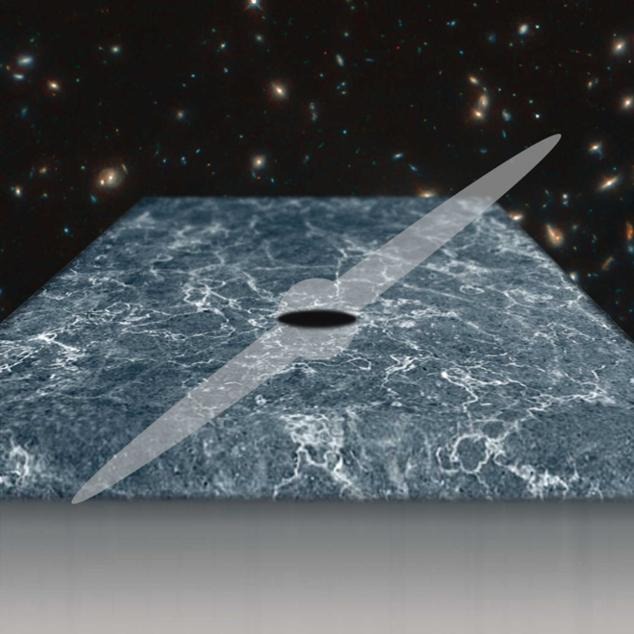
In the CMB, scientists observe that there were small fluctuations present in the early universe. Denser regions expanded more slowly compared to under-dense regions. This caused gravitational instability in these regions, causing them to collapse. Gravitational collapse caused the formation of dark matter halos, forming the complex web of mass and gravity which served as the “blueprint” of structure in our universe. Eventually, gaseous ordinary matter clumped inside these dark matter halos, eventually forming the stars and galaxies that we can see in the night sky.
Theoretical Possibilities for Dark Matter
Although there is good evidence that dark matter exists, those observations are derived exclusively from the needed gravitational interactions of dark matter. Since all known forms of matter and energy gravitate, this gives us very little information as to what the dark matter is made of. With that freedom to speculate, scientists have proposed many possibilities:
MaCHOs
Massive astrophysical Compact Halo Objects (MaCHOs) were one of the first proposed dark matter candidates. MaCHOs are any type of non-luminous, ultra compact object that are difficult to detect through normal means. These objects would include black holes, neutron stars, brown dwarfs and stray planets, all composed of normal baryonic matter. In effect MACHOs are massive macros.
Black holes are massive, dense objects that emit no light. They can be formed when a massive star collapses in on itself in a supernova. Other much larger ones are found near the centers of most large galaxies -- exactly how they formed is not clear. There are not enough of either of those types of black hole to account for the dark matter. Neutron stars are formed during supernovae, like black holes. However they do not have enough mass to completely collapse in on themselves. Instead they are “squished” together to a point at which most of the protons and electrons of the stars atoms fuse into neutrons. This turns it into a massive and extremely dense atomic nucleus held together by gravity. Neutron stars are dense and dim, but like black holes, scientists consider them unlikely dark matter candidates. White dwarfs are less dense still -- the sun will one day become one. They too do not meet all the requirements of dark matter -- they are too heavy and made too late. Brown dwarfs are simply stars that did not grow heavy enough to perform nuclear fusion in their cores, thus rendering them cold and dim. Yet again, scientists cannot use them to account for the mass of dark matter alone.
It was once believed that the sum of such objects that arise from the death of stars might be able to account for the “missing mass” of dark matter. However, many studies have since made this conjecture unlikely. The possibility of dark matter being made up of the objects in our universe that scientists consider completely “ordinary” is unlikely.
Primordial Black Holes (PBHs)
Proposed by the late Stephen Hawking, this theory suggests that dark matter is composed of black holes that formed fractions of a second after the big bang. These black holes would have different origins than the black holes that result when stars 20 times the mass of the sun or more run out of fuel and collapse under their own gravity. They would also be different from, and maybe entirely unrelated in origin to, the supermassive (millions or billions of times the mass of the sun) black holes that are found near the centers of most galaxies.
Some scientists hypothesize that the denser regions observed in the CMB could have collapsed into these black holes. The predicted masses of them vary, as they could have been as light as an asteroid, or as massive as many thousands times the mass of our sun. This theory is attractive to many scientists because it does not require the existence of any as-yet-undiscovered particles.
The challenge for this theory is that scientists have yet to observe an amount of black holes substantial enough to account for dark matter. By a variety of methods they have precluded black holes of a wide range of masses from serving as all the dark matter -- they have noted the effects they would have had on the CMB, the changes they might have induced on the various isotopes of hydrogen, helium and lithium made in the early universe, the high-energy light they would have emitted as light PBHs evaporated (yes, black holes are thought to evaporate, though very slowly if they are massive), the gravitational lensing they would have caused, the damage they would have done to neutron stars and white dwarf stars, and more. These studies argue against this theory, yet scientists aren’t done searching. If astronomers were to observe a black hole with a mass less than that of our sun, it would transform the debate. This is because such black holes are incapable of being formed by stars, suggesting that it would have been formed shortly after the big bang. None of these sub-solar-mass black holes have yet been found, but the search goes on.
WIMPs
Weakly interacting massive particles (WIMPs) are a wide class of hypothetical subatomic particles. “Weakly interacting” means that these particles rarely interact with regular matter and each other, which means that they are very hard to detect. Specifically, they are electromagnetically neutral, so they do not emit, absorb or scatter light, and also don’t scatter easily off of electrons.
They are also “colorless,” meaning that they don’t feel the force that hold together protons and neutrons. Because they are massive -- heavier than protons or neutrons -- they move much more slowly than the speed of light -- the universe is too cold for them to have enough kinetic energy to do otherwise. This allows them to not escape from galaxies, which is key if they are to account for dark matter’s “clumpiness” which facilitated the formation of galaxies and clusters of galaxies.
WIMPs are assumed to be “non baryonic” -- not made of the same quarks as protons and neutrons. This is because the amount of baryons understood from our study of the early universe to be present shortly after the big bang is too small to account for dark matter, as mentioned above.
These WIMP particles are not predicted by the Standard Model, our unbelievably successful theory for how all of the known elementary particles interact with one another.
So the exact nature of these WIMPs is not specified by the name. However, theories of supersymmetry, an extension of the Standard Model that was invented by particle physicists for reasons completely unrelated to dark matter, predict certain elementary particles that are “partners” of currently known particles, and that would be good candidate dark matter WIMPs.
Despite heroic efforts over the last four decades, so far, no hypothetical WIMP particles have been detected, but scientists are still searching. Research teams are currently working to finalize experiments involving even larger giant underground WIMP detectors than have previously been built.. Scientists had also hoped to create WIMPs in powerful particle accelerator collisions, but that too has so far failed. A third way to detect WIMPS is by staring out into space with telescopes for revealing radiation signals predicted to be produced by two WIMPs annihilating one another. Despite several claims over the years of possible detections by this method, so far no evidence has emerged that has been viewed by scientists as widely convincing.
While the results have yet to show any signs of WIMPs, many scientists remain confident that they could be found within the next few years using these methods if they are there.
Axions
Axions are hypothetical particles that are the chief rival candidate particle to WIMPs as a dark matter candidate. Axions are “featherweight”, to put it lightly. Individually, they would be billions of times lighter than an electron. Axions emerged out of the solution to something called the Strong CP problem, proposed by Roberto Peccei and Helen Quinn. The problem is to understand why strong interactions (the force that binds quarks together into protons and neutrons) can’t tell the difference between matter and antimatter. This “ignorance” manifests in subtle ways. For example, scientists noticed that the neutron arranges its constituent quarks in such a way that not only is the neutron neutral overall, but there is no lopsided distribution of the charge to create an electric field around the neutron.. If there was, then flipping the charges of all the neutron’s quarks, and reflecting the neutron in a mirror would give you an antineutron whose spin was oriented the opposite way with respect to its electric field. That is just not observed to be the case. Peccei and Quinn proposed that there is a field that permeates all of space which suppresses such possible asymmetries of the neutron.
The existence of such a field, implies the existence of a new particle. This particle was dubbed the “axion”, and its mass would be incredibly small. The axion makes a really good dark matter candidate because it would have very little interaction with ordinary matter. Also, because of how axions would have been formed in the early universe, they would be very slow moving today.
Axions wouldn’t be completely undetectable, as now and then they would transform into two photons. Scientists realized that saturating an area with a strong magnetic field would stimulate axion decay. Many studies have been performed attempting to detect axions, but none have yet provided positive results.
Axions still remain hypothetical. But as many other dark matter candidates become more elusive, experimental groups are looking toward axions as one of the currently most plausible particle candidates for dark matter.
SIMPs
Strongly interacting massive particles (SIMPs) are fairly recent candidates for dark matter. The emergence of SIMPs as a dark matter candidate have begun recently due to the lack of evidence found of WIMPs after decades of study. Like WIMPs, SIMPs, are hypothesized to have been produced in large quantities during the early stages of the universe. But unlike WIMPs, SIMPs would interact strongly with themselves (i.e. not just via gravity) but weakly with normal matter. The SIMP could also be smaller than a WIMP, which would mean that there are larger numbers of them. Large numbers would allow them to be more detectable, as their weak interaction with normal matter might still leave a fingerprint at large scales.
These fingerprints could be observed, for example, in colliding galaxies, where dark matter seems to lag behind the visible matter. This has been observed in the Abell 3827 cluster. This might be explained by interactions between dark matter, since if the particles could scatter off each other, that would “hold them back” compared to the rest of the system.
SIMPs might also be able to explain the distribution of dark matter in small galaxies better than WIMPs. Numerical simulations involving WIMPs predict that dark matter clumps together in a sharp “cusp” in the center. However, observations have shown that the concentration is milder. However SIMPs can scatter off one another, and can disperse the cusp through collisions, smoothing out the mass distribution towards the center of a galaxy.
Unlike WIMPs and axions SIMPs did not emerge naturally out of particle physics for some reason completely independent of dark matter -- they were proposed specifically as a dark matter candidate. Nevertheless, experiments are being planned and beginning to be conducted searching for SIMPs.
Neutrinos
Neutrinos were once disregarded as a possible dark matter candidate -- the three known neutrinos are too light to serve as cold dark matter. In recent years, they have resurfaced with the hypothesized new type: the sterile neutrino. Neutrinos are ghost-like particles that pass right through objects made up of normal matter. As you read this, billions of neutrinos are passing through your body every second. But while normal neutrinos occasionally interact with normal matter via the weak nuclear force, sterile neutrinos, if they exist, would only interact with normal matter via gravity.
The idea for sterile neutrinos began in the 1990s, when experiments recorded a strange excess in one type of neutrino, the electron neutrino. The particles should have appeared in equal numbers of each type of neutrino, but experiments at the time also revealed that neutrinos transform from one type to another spontaneously. Scientists postulated a fourth type of neutrino, the sterile neutrino, in order to account for this imbalance.
Assuming this hypothesis is correct, sterile neutrinos would only account for a fraction of the dark matter. But, it could be possible that there are multiple types of sterile neutrinos, just as there are multiple types of “standard” neutrinos. Furthermore, neutrinos may not be the only type of particle to have a sterile counterpart -- the combination of all these sterile particles could account for the dark matter in the Universe. If proven, this would open a door to particle physics beyond the standard model.
Multiple teams of scientists all over the globe are now attempting to find these sterile particles.
Macros
Many of the candidates listed above explored the realm of the exotic, requiring extensions of the standard model of physics. Scientists have been searching for these exotic particles and have yet to find them. Instead, some physicists have recently turned back towards the standard model to find dark matter.
Dark matter “macros” are a wide class of dark matter candidates that are hard to see not because they don’t interact with light, but because they are massive -- and so it doesn’t take very many of them to make up the dark matter. We know they must be at least 55g, and could be as much as the mass of a decent asteroid. These are macroscopic rather than microscopic objects, and so we call them “macros.” They need to be denser than ordinary rock, but don’t need to be as dense as black holes.
The leading candidates for macros are variations on a theme of giant nuclei, very much like the ones you find inside of atoms, but much much bigger. Typically nuclei with more than about 200 protons and neutrons combined are all unstable -- they fall apart. This makes them poor candidates for dark matter. However protons and neutrons aren’t necessarily the only possible ingredients of nuclei -- they could contain “strange” baryons. Baryons are particles like protons and neutrons that are made up of three quarks. Protons and neutrons include only two types of quarks up and down. (A proton is two up quarks plus a down quark; a neutron has two down quarks and an up quark.) A strange baryon includes at least one strange quark -- a heavier variant of quark from the normal up and down quarks. Large nuclei that include strange baryons may or may not be stable -- we can’t calculate the answer to that question and so far we haven’t been able to determine the answer in the lab.
The macros would have needed to be assembled during the early universe, when temperatures reached above 3.5 trillion degrees Kelvin. They would have also formed with a 90% efficiency, leaving the remaining 10% of matter to form the protons and neutrons that make up most “normal” substances.
Like many of the dark matter candidates listed here, macros have not yet been found. If a macro collided with Earth’s surface, it would burn a path many kilometers long through the Earth, leaving a cylindrical path at the collision. They might even pass right through the Earth. One might wonder: what if a macro hit a human? Well, if a macro did hit a person, the wound would be almost akin to a gunshot wound, but worse. It would tear through the body, burning a path that could heat up to over 10 million Kelvin. It is safe to say that getting hit by a macro is a one-way ticket underground. Fortunately, there has been no documentation of even one strange death that would suggest that it was caused by a dark matter macro. And so, the search goes on.
Modified Gravity (MOND)
Modified Newtonian Dynamics (MOND), is a hypothesis that doubts our current understandings of gravity. It proposes a subtle modification of the Newtonian laws of gravity, the addition of a fundamental acceleration scale that would account for the galaxy rotation curve problem. This removes the need for dark matter by simply modifying the theories we already have. Unfortunately, experimental results have shown that it doesn’t quite do the job.
After analyzing the rotations of many galaxies, scientists have discovered that the value of this acceleration scale was unique to each galaxy, and seemed to be resulting from the internal dynamics of the individual galaxies.
One of the biggest problems with MOND is that it often fails to represent the early universe and its initial conditions. When making this argument, scientists often use the Cosmic Microwave Background as evidence for early cluster formation due to dark matter. Moreover, computer simulations using MOND have consistently failed to demonstrate galaxy formation and evolution, something that dark matter simulations are capable of.
Recently, however, new theories have arisen that may be able to explain the behavior of the universe without dark matter. Theorists at the Central European Institute for Cosmology and Fundamental Physics, Tom Złosnik and Constantinos Skordis, have dubbed their theory: RelMOND. Their theory proposes a field that behaves almost as “invisible matter” on the grandest scales, blurring the line between the two theories. The field also explains galaxy rotation curves without the need for any extra matter. The model also stays true to the CMB.
However, this model has yet to be fully tested. The researchers are not sure how the field acts for large scale galaxy clusters. And despite the theory’s current achievement, dark matter remains a simpler theory. Mathematically, this new theory requires four new moving parts.
Scientific supporters of MOND are holding out for this new theory, yet just like the candidates for dark matter, concrete evidence remains elusive.
Works Cited
Stephanie M. Bucklin - Feb 3, 2. (2017, February 03). A history of dark matter. Retrieved November 04, 2020, from https://arstechnica.com/science/2017/02/a-history-of-dark-matter/
Becker, K. (2017, August 28). Galaxy clusters offer clues to dark matter and dark energy. Retrieved September 12, 2020, from https://phys.org/news/2017-08-galaxy-clusters-clues-dark-energy.html
Berkeley Cosmology Group. (2005). Galactic Rotation Curves. Retrieved September 08, 2020, from http://cosmology.berkeley.edu/Education/Essays/galrotcurve.html
Carr, B., Kohri, K., & Sendouda, Y. (2020). CONSTRAINTS ON PRIMORDIAL BLACK HOLES. Retrieved September 29, 2020, from https://arxiv.org/pdf/2002.12778.pdf
CERN. (2015). CERN Accelerating science. Retrieved October 04, 2020, from https://home.cern/science/physics/supersymmetry
Editors of the Encyclopedia of Britannica. (2018). Weakly interacting massive particle. Retrieved October 04, 2020, from https://www.britannica.com/science/weakly-interacting-massive-particle
Falk, D. (2020, June 23). Is Dark Matter Made of Axions? Retrieved October 10, 2020, from https://www.scientificamerican.com/article/is-dark-matter-made-of-axions/
Filippini, J. (2005, August). The Cosmic Microwave Background. Retrieved September 19, 2020, from http://cosmology.berkeley.edu/Education/CosmologyEssays/The_Cosmic_Microwave_Background.html
Gibney, E. (2020, October 02). Last chance for WIMPs: Physicists launch all-out hunt for dark-matter candidate. Retrieved October 04, 2020, from https://www.nature.com/articles/d41586-020-02741-3
Gnida, M. (2015). Miraculous WIMPs. Retrieved October 04, 2020, from https://www.symmetrymagazine.org/article/july-2015/miraculous-wimps
Hadhazy, A. (2019, December 13). What is Dark Matter Made Of? These Are the Top Candidates. Retrieved October 18, 2020, from https://www.discovermagazine.com/the-sciences/what-is-dark-matter-made-of-these-are-the-top-candidates
Klesman, A. (2019, July 10). What are primordial black holes? Retrieved September 28, 2020, from https://astronomy.com/news/2019/07/primordial-black-holes
OSU CCAPP. (n.d.). Introduction to Cosmology. Retrieved September 24, 2020, from http://www.astronomy.ohio-state.edu/~dhw/A5682/notes12.pdf
Robert Sanders, M., & Sanders, R. (2017, December 06). MACHOs are dead. WIMPs are a no-show. Say hello to SIMPs. Retrieved October 15, 2020, from https://news.berkeley.edu/2017/12/04/machos-are-dead-wimps-are-a-no-show-say-hello-to-simps/
Sokol, J., & Quanta Magazine moderates comments to facilitate an informed, S. (2020). Physicists Argue That Black Holes From the Big Bang Could Be the Dark Matter. Retrieved September 28, 2020, from https://www.quantamagazine.org/black-holes-from-the-big-bang-could-be-the-dark-matter-20200923/
Spector, D. (2013, April 06). How Dark Matter Went From Crazy Idea To Bombshell Discovery. Retrieved September 6, 2020, from https://www.businessinsider.com/the-history-of-dark-matter-2013-4
Staff, S. (2019, September 17). From primordial black holes new clues to dark matter. Retrieved September 28, 2020, from https://phys.org/news/2019-09-primordial-black-holes-clues-dark.html
Starr, M. (2019, July 18). A New Paper Says That One Dark Matter Candidate Hasn't Killed Anyone. Retrieved October 25, 2020, from https://www.sciencealert.com/a-new-study-has-found-that-one-dark-matter-candidate-hasn-t-killed-anyone
Sutter, P. (2019, June 11). Here's How Colossal Galaxy Clusters Reveal Dark Matter Secrets. Retrieved September 12, 2020, from https://www.space.com/galaxy-clusters-rule-dark-universe.html
Van den Bergh, S. (1999). The Early History of Dark Matter. Retrieved September 6, 2020, from https://iopscience.iop.org/article/10.1086/316369
White, L. (2017). WIMPs in the dark matter wind. Retrieved October 04, 2020, from https://www.symmetrymagazine.org/article/wimps-in-the-dark-matter-wind
Williams, M. (2019, April 06). Now We Know That Dark Matter Isn't Primordial Black Holes. Retrieved September 28, 2020, from https://www.universetoday.com/141923/now-we-know-that-dark-matter-isnt-primordial-black-holes/
Wood, C., & Quanta Magazine moderates comments to facilitate an informed, S. (2019, November 23). Top Dark Matter Candidate Loses Ground to Tiniest Competitor. Retrieved October 10, 2020, from https://www.quantamagazine.org/why-dark-matter-might-be-axions-20191127/
Wood, C., & Quanta Magazine moderates comments to facilitate an informed, S. (2020). How Ancient Light Reveals the Universe's Contents. Retrieved September 18, 2020, from https://www.quantamagazine.org/how-the-cosmic-microwave-background-reveals-the-universes-contents-20200128/
Betz, E. (2020, February 17). Does the universe need dark matter to form galaxies? A controversial model says 'no'. Retrieved November 17, 2020, from https://www.discovermagazine.com/the-sciences/does-the-universe-need-dark-matter-to-form-galaxies-a-controversial-model
Dark matter may be massive: Theorists suggest the standard model may account for the stuff. (2014, November 04). Retrieved November 13, 2021, from https://www.sciencedaily.com/releases/2014/11/141104111629.htm
Guest. (2020, February 10). Dark matter vs mond: A tug of war. Retrieved November 16, 2020, from https://astrobites.org/2019/04/03/dark-matter-vs-mond-a-tug-of-war/
Hadhazy, A. (2019, December 13). What is dark matter made OF? These are the top candidates. Retrieved November 11, 2020, from https://www.discovermagazine.com/the-sciences/what-is-dark-matter-made-of-these-are-the-top-candidates
Wood, C., & Quanta Magazine moderates comments to facilitate an informed, S. (2020, July 28). An alternative to dark matter passes critical test. Retrieved November 19, 2020, from https://www.quantamagazine.org/modified-gravity-theory-passes-a-critical-test-20200728/
Case Western Reserve University. (2014, November 4). Dark matter may be massive: Theorists suggest the standard model may account for the stuff. ScienceDaily. Retrieved November 3, 2020 from www.sciencedaily.com/releases/2014/11/141104111629.htm