


Please give us your feedback using this short Google form https://forms.gle/xko7tfJiALyVZX5FA
Research
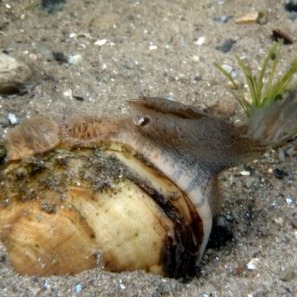
The shells of animals, including mussels, are known to vary based upon their environments. For example, the shells of marine mussels grow at different thicknesses depending on whether they are exposed to predator cues (Leonard et al 1999). However, some shell characters are genetic and not strongly affected by environmental conditions, e.g. shells of land snails Helix pomatia (Pollard 1975). Although genes do play a role in shell structure, extensive ecophenotypic variation in freshwater mussels in the superfamily Unionoidea makes these animals ideal candidates to use as indicators of past environmental conditions based on shell morphology. The possibility that shell morphology is strongly affected by their environment, even over such small scales as within a single lake, has been long recognized (Eager 1948). Some mussel species have been observed to grow more slowly in forests than grasslands, giving rise to differences in shell characteristics (Morris and Corkum 1999). Additionally, both mussel communities and shell shape of widely distributed mussels in those communities change from upstream to downstream, becoming more sculptured, as well as relatively wider and deeper as fine sediments increased in downstream areas (Hornbach et al. 2010). Recent research has confirmed that such differences truly depend on the environment in which mussels live (ecophenotypic) and that it is not genetically based; for example, one study found that morphological differences in shell structure among populations are more related to geographic distance than genetic differences (Inoue et al. 2014).
This ecophenotypic effect represents a pressing need for the conservation efforts of freshwater mussels. Frequently, when a bridge structure or location is changed, when a dam is built or removed, freshwater mussels are affected. A common way to address these impacts is to relocate mussels to a different area within the same river system. Unfortunately, few such projects monitor long-term outcomes of relocation attempts (Cope and Waller 1995). The success of relocation and use of “in situ refuges” depends strongly upon the way that the project is conducted for most species of mussels, but it has been effective in many cases (Cope et al 2003). However, shell shape may be unique to and specifically shaped by a particular river. Successful reintroduction of some threatened and endangered species, such as Margaritifera margaritifera, may depend not only on the genetic constitution of a particular population but also their ecophenotype (Preston et al. 2010). Interactions with predators may also influence which mussel morphologies are observed in a given area, because predators, such as muskrats, select large individuals of small species and smaller individuals of species that are generally large (Tyrell and Hornbach 1998).
Thus, the entire ecology of a given species needs to be examined to plan reintroductions and artificial in situ refugia.
One way to increase the visibility of museum collections and ecological research is to involve the public through citizen science. The popular citizen science web platform Zooniverse has the potential to collect unique and detailed morphometric data. This platform offers simple tools to collect measurements such as length-to-depth ratios, which are a common measurement in freshwater mussels but also allows users to conduct more in-depth data collection by tracing the outline of a specimen and collecting landmark data. These unique data collection techniques may be useful in collecting extensive landmark and shape data, not captured by the simple metrics often collected in field studies. Because I have worked with the digitization team to plan the upcoming collection of digital photographs of the mussel collection at the Milwaukee Public Museum, I know that the planned photographs of these mussels will provide size-referenced views of the mussels in the collection that will allow us to analyze changes in their morphology from each of the appropriate angles. I have also recruited a student from Carroll University, who is writing a separate grant that supports student research to take part in this work, selecting for herself a unique part of the project.
I expect to find that mussel shells will have changed the most in areas where the mussel community has changed the most, based on my work from 2016, and in areas with the most human development in the watershed. Areas in which forests have either remained or have been allowed to regrow will likely produce mussels with smoother shells and mussels that are longer relative to their other dimensions. Mussels in areas with more intense development either for agriculture or urban uses should be more sculptured and robust because these areas are likely to experience increased fine particle inputs due to erosion.
Goals for summer 2019
Test for differences in shell morphology between mussels collected in 2016 and 1970s
Compare length: depth: width ratios among streams and surveys (1970’s and 2016)
Explore geometric morphology and compare the growth rate between the 1970s and 2016

