


Please give us your feedback using this short Google form https://forms.gle/xko7tfJiALyVZX5FA
This project has been built using the Zooniverse Project Builder but is not yet an official Zooniverse project. Queries and issues relating to this project directed at the Zooniverse Team may not receive any response.
Morphology and shell structure in freshwater mussels
Learn moreBasic shell shape - This workflow asks you to provide a few simple measurements that will give us an idea of the size of mussels in our collection and the ratio between length and other dimensions.
Advanced shell shapes - This workflow is more exploratory and takes more time for each photograph. It helps us to estimate the age of mussels and find out more about their shape and adductor muscles from when they were alive.
Zooniverse Talk
Chat with the research team and other volunteers!
Flexing Mussels: Environmental Change In Wisconsin Over 100 Years Statistics
View more statsAll Time Stats
Active Stats
Active stats provide information about currently active workflows and subjects.
Message from the researcher
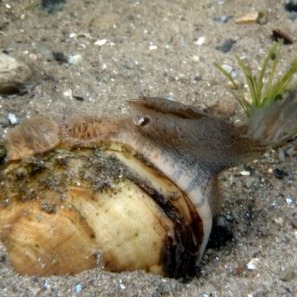
We're musseling into some really interesting questions.
levinetdAbout Flexing Mussels: Environmental Change In Wisconsin Over 100 Years
When animals die, their bodies leave clues to what they experienced in life. Freshwater mussels live and die at the bottom of rivers and lakes. Their shells are famously variable depending on their environment, sometimes with more variation within a species than between individuals of different species. We are measuring shell characteristics of mussels that have been found throughout Wisconsin during surveys to better understand these animals and their environments. Shells collected from areas with lots of silt and mud have different shapes than those collected from areas with coarser rocks. As the way that we use the land around these water bodies changes, we affect everything that lives in them because the water runs over the land and into streams and rivers. Freshwater mussels are globally endangered and are extremely vulnerable in North America. The Milwaukee Public Museum holds a large collection of mussels from our region that is continuously growing. This collection will allow us to look back at mussels collected in the late nineteenth century and in the 1970's, then compare them to shells collected last summer. This unique set of collections will give us a picture of the changes over more than a century. By exploring geometric morphology among surveys, we will better understand the changing conditions in the rivers and the variability within and among species of mussels.