


Finished! Looks like this project is out of data at the moment!
Research
Fossil Atmospheres is a Smithsonian Institution citizen science project from the National Museum of Natural History and the Smithsonian Environmental Research Center.

What we want to find out
We want to create a record of how the atmosphere has changed through time by calculating the ratio of two different types of leaf cell (stomatal and epidermal) for many leaves, from the present and the geological past. We know that the composition of the Earth's atmosphere has changed over time, and that it is changing now. It is important for us to understand what effect climate change might have on life on our planet in the long term.
One way we can understand the effect of climate change is to look at the geological past - millions of years ago - and the fossil record, to see what happened to organisms during periods of time in Earth history when there were similar changes in the atmosphere and climate. If we want to build an accurate picture of these past changes, we need to know what the atmosphere was like back then.
Our planet's atmosphere is composed of many different gasses, one of which is carbon-dioxide (CO2). Through extensive research we now know that CO2 concentration in the atmosphere has a very important influence on Earth's climate. There are several ways researchers try to reconstruct past climates; we call these climate proxies. One proxy for CO2 concentration comes from plants, and is known as stomatal index. This is a measure of the number of gas-exchange holes on the surface of a leaf, relative to the number of normal cells.
The Science behind it
Find links to even more information on the science in the Education section.
Plants
Every plant survives by photosynthesis - using energy from light and carbon-dioxide to make energy in the form of sugars, which it uses to grow and repair itself. To achieve this, the plant must allow CO2 into the leaves, and allow oxygen and water (the waste products of photosynthesis) to escape. It does this through stomata. These are tiny holes in the leaf surface that can be opened and sealed shut using special 'guard' cells.

When the stomata are open, gas exchange occurs. CO2 diffuses into the leaf and oxygen and water diffuse out. Both CO2 and water are vital for the plant to function, therefore it has to regulate the amount of CO2 entering the leaves and the amount of water vapor escaping. Day-to-day each plant does this by opening and closing its stomata. From previous experiments we've found that there is an optimal number of stomata on each leaf area (the stomatal index) that allows a plant to get the most effective control on gas exchange. The optimal number of stomata depends on several different environmental factors. The concentration of CO2 in the atmosphere is the dominant environmental factor. We know that other environmental factors such as temperature and humidity play a role, but their effect is less well understood.
If we can find out exactly how stomatal index relates to these different environmental factors we could count the stomatal index of a leaf and use it to work out the conditions when it grew. Once we can do this we will be able to use the stomatal index from many leaf specimens collected from different places and geologic time periods to reconstruct a record of how the environment changed through time.
The Paleocene-Eocene Thermal Maximum
There is one period of time that we are particularly interested in, this is the Paleocene-Eocene Thermal Maximum, or PETM for short. It happened 56 million years ago and lasted for around 150,000 years. During the PETM a very large amount of carbon-dioxide was released into the atmosphere and the average temperature of the planet rapidly increased by about 5 degrees Celsius.
We hope to create a more precise and accurate record of this change in atmospheric CO2 concentration and temperature, that we can compare to changes in the animals and plants at the time to gain a greater understanding of how life on the planet responds to changing climate.
Why Ginkgos?
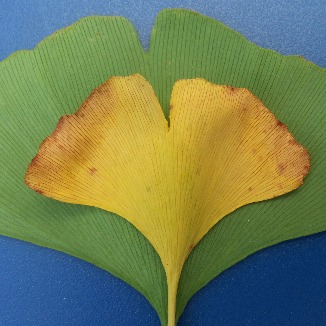
Ginkgos are a unique type of plant. They're gymnosperms like conifers, meaning they have seeds but don't produce flowers. The first species of Ginkgo evolved in the Permian, before the dinosaurs. One species is still alive today, so we know that Ginkgos have survived through three mass extinctions, including the one that eventually caused the dinosaurs' demise. There have been many different species of Ginkgo, but they all belong to one genus and the leaves are recognizably similar in all the different species. This makes them an ideal plant to study because they can provide a record from 300 million years ago through to the present.

How we're going to do it
This is where you come in! We have already collected and imaged lots of modern and fossil Ginkgo leaves, but we need to find their stomatal index. Once you've helped us do this we will combine the data with the results from experiments with living Ginkgo trees (see below) to produce a record of past environments. Having citizen scientists count stomatal index means that we can collect far more data than we would be able to do otherwise, as well as having many people count each image to make sure the counts are as reliable as possible.
Experiments on living trees
At the same time as you're doing all this counting, Rich Barclay is growing Ginkgo trees in specific concentrations of CO2 (up to 1000 ppm - 2.5 times present atmospheric levels) to see how they respond. There have been previous experiments of this kind, but always in lab conditions. This new experiment allows the trees to grow in their natural environment, allowing us to measure how stomatal index varies with environmental conditions in a realistic setting that is more likely to represent how stomatal numbers on leaves would have varied in real life.

Experimental Ginkgo trees at the Smithsonian
Pretty soon we will also be asking you to help us count stomata on images that we make from leaves collected from these living trees too. This will help us get a more detailed and accurate idea of the relationship between stomatal index and all the environmental factors like CO2, temperature, and humidity. By doing this we will be able to be more confident about any conclusions we draw about past climate from the fossil leaves.
Why should you care?
The sensitivity of climate to CO2 has enormous economic and societal implications because of the effect climate change will have on sea level, food production, storm strength, water availability, and many other factors. By improving our ability to quantify the effects of CO2 on climate, you will be contributing to the basic science underlying projections of future environmental change.