


Finished! Looks like this project is out of data at the moment!
Thanks everyone, PROJECT IS COMPLETE! (There will be some oddities while I collect the overall statistics.)
Research

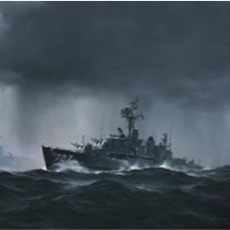
The Spider and the Fly - USS Hornet (detail), by Dwight Shepler; 1945, Naval History and Heritage Command.
How To
This project will transcribe selected data from the deck logs of 19 World War II ships. These data are:
- Navigation (Date, Zone Description, Latitude/Longitude or Place)
- AM and PM Barometer
- AM and PM Temperatures
Step-by-step instructions for these tasks are provided in the FIELD GUIDE (see tab on the right side of your screen).
The Mission
The purpose of this project is to recover hidden marine weather data recorded in U.S. Navy ships' logbooks during World War II. Like all Old Weather projects, these data will be used to drive sophisticated computer models that help us understand weather and climate in extraordinary detail. But there is another goal that is just as vital - to uncover the source of a mysterious distortion in the Navy temperature data collected during the war.
Service members have been carefully recording marine weather observations since the 1850s. Weather observations were logged on every ship, every hour, almost without fail. This was done even in the midst of battle, in the heart of a typhoon, or in the fatal grip of the Arctic icepack. Now, with the challenge of climate change upon us, it is astonishing that most of this legacy is still unused and unknown. Work you contribute here to recover these hidden data will make a lasting impact on climate science, but also shine a new light on the dedicated work of thousands of service members who collected these observations over nearly two centuries.
19 Ships
Nineteen ships were selected for this mission. They are representative of the main classes of warship in use during the period: battleship, aircraft carrier, cruiser, destroyer, and gunboat. These ships also share some particular characteristics. All but two survived the entire war, 1941-1945. Twelve were based at Pearl Harbor in 1941, eighteen were in the Aleutian Islands in 1942-1943, and ten were caught in Typhoon Cobra in December 1944. These convergences allow us to investigate a range of potential sources of bias, from factors associated with different ship types, the weather instruments in use at different times, or changes in methods required by wartime operations (such as blackout for example). It will also be possible to investigate how tropical and sub-polar environments may have influenced the data in different ways. Another benefit of keying in these data now is they can also be used to train machine-learning systems to automatically transcribe the remaining millions of typed weather observations that were collected by the Navy.
History
For those interested in the deeper history of the ships, the crew, and the events that took place, there are photographs and links to ship histories from Naval History and Heritage Command (NHHC) in the Ships section, and in the Index you will find links to the digital logbook volumes on the U.S. National Archives Catalog. Here you can read the first-hand accounts of daily events in the REMARKS pages in date sequence, and at your own pace.
Note: This project uses primary source documents. While the language used in a ship's logbook tends to be dispassionate, you may encounter challenging content or marginalia relating to armed conflict, racism, and other difficult topics.
The digital images used in this project were obtained through a collaboration between the U.S. National Archives, the National Archives Foundation, the Pacific Marine Environmental Laboratory of the National Oceanographic and Atmospheric Administration (NOAA), and the University of Washington Cooperative Institute for Climate, Ocean & Ecosystem Studies. Major support was provided through a Digitizing Hidden Collections grant from the Council on Library and Information Resources (CLIR). The grant program is made possible by funding from The Andrew W. Mellon Foundation.
All data generated by Old Weather is dedicated to the public domain. External content found on this project website is also sourced from the public domain unless otherwise noted.