


Finished! Looks like this project is out of data at the moment!
Research
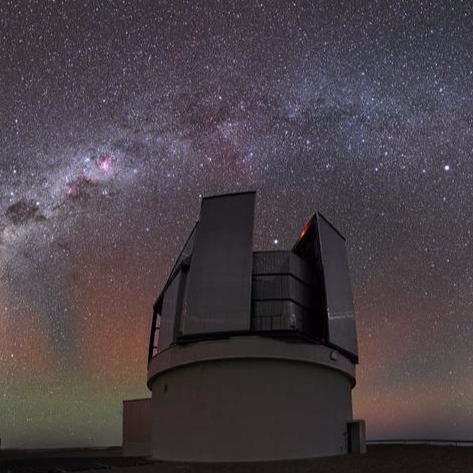
The VISTA Variables in the Vía Láctea (VVV) survey is an ESO Public Survey that is mapping the central region of the Milky Way, that we call the “bulge”, in near infrared light. It is also acquiring ~100 repeated exposure in the Ks band, so we can construct a movie of the sky.
One of the key goals of the VVV Survey is to identify new variables stars, i.e., stars whose brightness changes periodically with time. Many of them are stars that expand and contract, as if they were breathing, such as RR Lyrae, Cepheids or Miras. Each of these stars breath (we say that they “pulsate”) only during a very specific phase of their evolution, corresponding to a very specific internal stratification that we understand and are able to model very well. Once we identify one of these variables, we can predict what is their real luminosity, their mass and their age.
The real luminosity, i.e., the energy they produce per second, allows us to derive their distance, by comparison with their apparent luminosity. Distances are of paramount importance in astronomy, because they allow us to go from our two-dimensional view of the night sky to a three-dimensional representation of our Galaxy in space. On the other hand, their age will give us information about when did star formation occur in that region of the Milky Way. Hence it will tell us how did the inner Galaxy form.
In order to identify one of these variables, we look at the period and the shape of their luminosity (or brightness) change versus time, also known as “light curve”. However some variables have similar light curves, that are not easy to tell apart with automatized software. In addition, some variables have light curves similar to those of binary stars. The latter do not change their individual luminosity, but the total light we see might change because they periodically eclipse each other.
We have millions of light curves for variables that we have not yet identified. Here we have uploaded thousands of them to be classified. Because no automatized software does a better job than your brain (they are faster, but not smarter) perhaps you can lend us a few of your neurons for a short period of time, and help us with the task of identifying what kind of variable star we are looking at. You will be contributing to the mapping of the 3D inner structure of the Galaxy we live in, and to the understanding of when the stars we see on a dark night formed.
