




Finished! Looks like this project is out of data at the moment!
Thank you! With your help, we've compiled the first comprehensive catalog of clumpy galaxies in the local Universe. Check out our results page for papers published using this catalog! And if you want more clumpy galaxies in your life - come on over to Clump Scout II.
Research
In the nearby Universe, most galaxies can be categorized as spirals, ellipticals, or irregular systems. However, in the more distant (and younger) Universe, galaxy shapes were more diverse and galaxies with "clumpy" structures dominate. Galaxies of the past went through a period of intense star formation which is thought to be largely responsible for these unusual shapes. This period of star formation has since died off and most galaxies today have settled down into the types we see in the local Universe. That is to say, "clumpy" galaxies weren't thought to exist in large numbers today.
Distant clumpy galaxies (from Hubble)
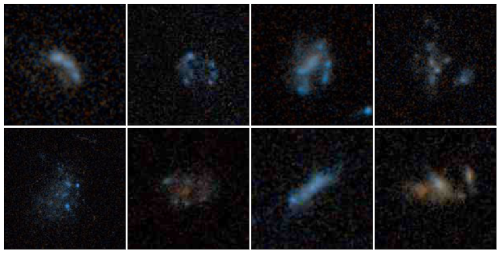
The above image shows a sample of these distant clumpy galaxies classified during the Galaxy Zoo: Hubble (GZH) project. That project also included a small sample of images from the Galaxy Zoo 2 project which focused on nearby galaxies. It turns out that dozens of "clumpy" galaxies were discovered in our own cosmic backyard! (shown below)
Nearby clumpy galaxies (from Sloan Digital Sky Survey)
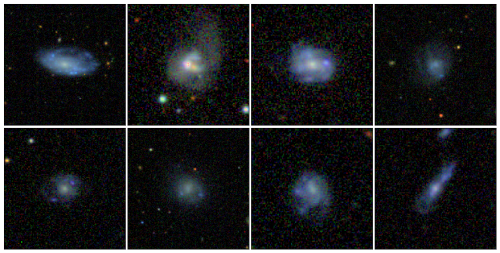
The similarities are remarkable, and this is exciting because it's much easier to study nearby galaxies than distant ones. If we can find more clumpy galaxies close to us, it could help us understand the distant clumpy galaxies and, subsequently, the period of ferocious star formation of the past.
One outstanding mystery is that we don't fully understand how clumps form. It could be due to mergers between galaxies, or due to instabilities within the galaxy itself that cause large clouds of gas to collapse and rapidly form stars. We also don't fully understand what happens to the clumps over time. Some models predict that these large clumps eventually migrate to the center of the galaxy to form the galactic bulge. Other models suggest that these clumps are short lived and dissipate before they can migrate to the center. Determining which scenario is correct could have dramatic implications about the formation and evolution of disk galaxies.
We asked the "clumpy" question in the Galaxy Zoo: Hubble and Galaxy Zoo: CANDELS projects because we knew that this type of galaxy would be plentiful in the distant Universe. But since the discovery of dozens of these galaxies in the local Universe we've decided that we need to reconsider the Galaxy Zoo 2 project which never asked the "clumpy" question. In this project, we're asking you to take a second look at a portion of the original Galaxy Zoo 2 images that volunteers strongly classified as having features and asking if you see any clumps in these nearby galaxies.
As always, we couldn't do it without you!