


Finished! Looks like this project is out of data at the moment!
This project has been built using the Zooniverse Project Builder but is not yet an official Zooniverse project. Queries and issues relating to this project directed at the Zooniverse Team may not receive any response.
Help us build a catalogue of extended radio sources in the field of the Small Magellanic Cloud
Learn moreIn each image, there will be multiple colour-coded shapes. The Radio contour lines are solid green, sources that are categorized as bright radio sources have a blue solid ellipse, and sources with weaker signal strength, but which are still worth looking at, have a green dashed ellipse.
The workflow consists of answering some questions about the central source in each image. These central sources all have solid blue ellipses around them. A secondary task will ask volunteers to mark all ellipses they think are associated with the central Radio source. Finally, the question of the presence of an associated optical source will be asked.
Zooniverse Talk
Chat with the research team and other volunteers!
Radio whispers from our neighbouring galaxy Statistics
View more statsAll Time Stats
Active Stats
Active stats provide information about currently active workflows and subjects.
Message from the researcher
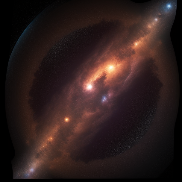
The study of celestial phenomena at radio wavelengths, radio astronomy, came into being after the accidental discovery of cosmic radiation by radio. -Karl Jansky
Radio whispers from our neighbouring galaxyAbout Radio whispers from our neighbouring galaxy
A nearby irregular dwarf galaxy, the Small Magellanic Cloud (SMC), has been the subject of loads of research in various areas of Astronomy, ranging from X-ray to optical, and radio. These studies have uncovered various sources within the SMC galaxy, including populations of radio pulsars, supernova remnants, planetary nebulae, and X-ray binaries. However, despite these discoveries, the majority of sources detected in the SMC's direction are background galaxies. A recent radio survey has revealed over 8000 sources located within and behind the SMC (Joseph et al. 2019).
The extended sources in the direction of the SMC are the ones of highest interest during this citizen science project. Volunteers will be asked to identify sources that look like bubbles, clouds or galaxies while being shown optical images from the superCOSMOS Sky Surveys with visual aid elements shown on these images. The results gathered from classifications made by volunteers will help with the compilation of a catalogue of extended radio sources in the SMC.