



Research
Welcome to the Heritage Quest Luxembourg!
Join us in our search for undiscovered archaeological remains
Our mission
The aim of this project is to find archaeological remains hidden under dense vegetation cover, especially prehistoric burial mounds and ancient roads. In recent years high-resolution elevation maps created with a technique called LiDAR have become widely available. The big advantage compared to many other measurement techniques is that LiDAR is not hampered by the presence of vegetation. This allows the investigation of areas in which archaeological remains are currently obscured by forest cover or other types of vegetation.
Based on the success of the Heritage Quest, initiated by the University of Leiden, this project will help to uncover new sites on the territory of the Grand-Duchy of Luxembourg, a diverse region including the densely forested highlands of the Eisleck and the valleys of the Guttland.
Since 2019, the Heritage Quest has investigated two regions of the Netherlands with spectacular results. The Veluwe and the Utrechtse Heuvelrug regions have yielded large number of burial mounds. Luxembourg is likely to produce equally spectacular results. The dense forest cover, for instance along outcrops of Luxembourg sandstone(Grès de Luxembourg), undoubtedly hides many more archaeological sites.
By jointly inspecting the c. 2,586 km2 of the territory of present-day Luxembourg we are certain that many unknown archaeological remains will be discovered. These new discoveries will inform our understanding of past societies and will be added to the national database of known archaeological features collected by the Institut National de Recherches Archéologiques (INRA) and as such protected for posterity.
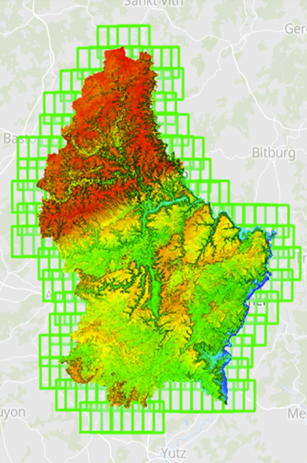
LiDAR elevation map of the Grand-Duchy of Luxembourg divided in tiles of 500 x 500 m (source: Geoportail, Luxembourg)
What are LiDAR data?
LiDAR (Light Detection And Ranging) is a survey technique that measures the distance to a target by illuminating the target with pulsed laser light and a sensor that registers the reflected pulses. The result is a 3 dimensional point cloud.
The entire surface of the territory of Luxembourg has been measured by airborne LiDAR providing a detailed elevation model. This constantly updated model is made available for public use by the Administration du cadastre et de la topographie and can be visualized on the National Geoportal of the Grand-Duchy of Luxembourg, the official national platform for governmental geodata and services.
For the first time, these LiDAR data allow for the investigation of areas which are obscured by forest cover.
You therefore could be the first person in 4000 years to find a burial mound.

Traces from the past: what do we expect
A large number of past human activities resulted in local changes in elevation. These are the type of archaeological remains that we can identify in LiDAR data. Based on our present knowledge we expect a range of features to frequently appear in the maps presented here.
The most common and probably best recognisable feature is the burial mound, also known as barrow. These are ancient burial places marked by an earthen mound. In the Netherlands this type of burial was used from c. 2800 BC until the Roman period (c. 200 AD).
The second category that will be systematically searched for in this project are mardelles. These are shallow, basin-shaped humid depressions in the ground. These landforms can have a natural origin, for example as dolines formed by the dissolution of rock, but they can also result from human activities, such as pits created for the extraction of soil material, which in some cases have been documented since the Iron Age. Mardelles also act as sediment traps, where plant remains, wood, and other artefacts can accumulate over long periods of time. These deposits represent valuable sources for reconstructing past environmental conditions, vegetation, and possible settlement activities.
The third type of features that we are looking for are charcoal kilns. These are relatively recent features associated with industrial activities in forested areas.

There are also several other types of archaeological finds that will appear less frequently. These include for example traces of fortification systems, celtic fields or medieval boundaries.
Machine learning and automated detection
In addition to discovering unknown examples of archaeological remains, this project aims to assist innovative academic projects that investigate the potential of machine learning and automated detection in archaeology. The task of the Heritage Quest project is to enlarge the number of archaeological remains that can act as examples from which the computer can learn how to independently identify archaeological features like burial mounds. At the same time the archaeological features newly discovered by volunteers will be used to verify the output of the computer.

How can Zooniverse volunteers help?
The territory of the Grand-Duchy of Luxembourg covers an area of about 2,586 km2. This is an enormous region to inspect and impossible for professional archaeologists to examine alone. Moreover, it has been widely attested in archaeological prospection that people's ability to identify specific features varies. People tend to have a bias for certain types of remains. It is therefore important that several different people inspect every dataset. By registering as a volunteer you can start the search. Through the talk section we will keep you informed about all activities and first results of the project.
So if you are interested in the past join our quest for archaeological heritage! Although be warned the search can be addictive!

